
Women Illustration
Overview of the personalised Resilience Assessment Report

See how we measure Resilience and the detailed insights into individual strengths and growth areas.

Download Report

A History of Resilience: One Founder’s Perspective

  • Resilience, as a business and health concept, went from a peripheral, almost fringe idea in the early 1990s to a mainstream field now attracting billions in investment.
  • The field’s biggest ongoing challenge isn’t a lack of evidence, it’s fragmentation: dozens of overlapping terms, disciplines, and providers competing to define what “resilience” actually means and how to measure it well.
  • Organisations invest in resilience for three distinct reasons, genuine care, economic return, or fear of risk, and the strongest solutions address all three at once rather than picking one.

This is a personal history, told from the perspective of Resilience Institute’s founder, reflecting on decades spent building a field that didn’t really exist as a business category when it started. It’s a reflection written from a particular point in time, its predictions about the future of resilience are exactly that, predictions, worth reading as one experienced practitioner’s view rather than settled fact.

With a professor-of-paediatrics father, a psychiatric-social-worker mother, two competitive brothers, a background in special forces, triathlon, ocean swimming, surfski racing, medicine, and an MBA, building a resilience business seemed like it should have been straightforward. It hasn’t been. It’s been long, complex, and genuinely difficult, even while helping tens of thousands of people and many organisations along the way. Scaling what should, on paper, be a very good business has been maddeningly slow.

In the early days, family and medical colleagues were openly sceptical. Executives found the whole idea strange. Why build resilience deliberately, the thinking went, when it’s genetic? Why would an organisation involve itself in the personal territory of an employee’s health, suffering, emotions, and thoughts? Why prevent disease at all when treating it is so much more lucrative?

Today, “resilience,” alongside a long list of overlapping synonyms, sits at the centre of parenting, education, business, NGOs, government, infrastructure, ecosystems, and sport. Billions are being invested in new ventures. It’s become something of a celebrity feeding frenzy, genuine experts working alongside gurus, placebos, and outright scams. This reflection covers the big challenges, the foundations that actually matter, the science and evidence, real mistakes made along the way, and where the field might be heading.

Discovering Resilience

“Resilience” first entered my consciousness in 1994, through Daryl Conner’s Managing at the Speed of Change, which introduced the concept’s role in leading organisational change. The underlying idea wasn’t new. My parents had spent their careers using medicine to shape better lives. Sport taught me the discipline required for genuine expertise. Special forces training revealed the real depth of human will. Sports medicine gave the whole thing a modern scientific frame. My own angle on it was simple: could business and organisations be used to build the capacities of excellence across more communities, not just individuals who could already afford it?

At the time, health insurers had already studied the impact of simple physical wellbeing programmes. A good programme combined leadership engagement, health risk assessment, and relevant lifestyle education, and the early studies were consistent: health risk factors dropped, sickness events and costs fell, absenteeism and turnover declined, and morale and productivity improved. Health status improved, sickness-care costs fell, and organisations saw a genuine positive return, studies of the era suggested a net present value of $2 to $3 for every $1 invested, in a US market carrying roughly double the health costs of most developed economies. In publicly funded health systems, the financial incentive for organisations to manage health risk directly was far weaker.

In 1989, we were building simple health risk assessments and basic workshops on exercise, nutrition, and health risk management. By 1992, I’d built the first version of a health check designed to be completed electronically. Early adopters existed, but they were almost entirely senior executives and professionals.

A client asking for “stress management” to be added to an executive health programme led me to Merv Dickinson, who held a PhD in leadership psychology. Together we designed interventions to build self-awareness and self-mastery, and that partnership became the foundation of our work in executive leadership development. Merv mentored me directly into the territory of emotion, mind, and spirit, and how to actually facilitate leadership teams through it. Our first resilience programmes launched from there, and genuinely progressive businesses started paying attention.

After an MBA and five years running an executive health clinic, Resilience Institute finally launched. The intent was clear: engage leaders directly, run genuinely rigorous health assessments, and deliver evidence-based, motivational workshops that actually changed behaviour. It worked. Physical, emotional, and mental measures moved in the right direction, and the engagements themselves carried real, visible energy.

Through most of the 2000s, competition was minimal, the market was tiny, and the whole concept sat at the periphery of business thinking. Building a viable business in that environment was genuinely tough, but it was a productive stretch. We ran health checks on thousands of people, delivered hundreds of workshops, and brought the concept into Australia, learning along the way how to collect and present health and resilience data properly, while respecting privacy and security.

As emotional intelligence, neurobiology, and the resilience concept itself matured, training with Daniel Goleman and later Andrew Shatte sharpened how we assessed and coached the emotional and cognitive dimensions of resilience directly. Small teams formed across Australia, Europe, Singapore, and the UK, and our reputation grew steadily through organisations like PwC, GE, AXA, and several major banks, each pushing our thinking further.

By 2014, digitising further was clearly necessary. Training was moving online, and the app economy was expanding fast. We ran psychometrics and analytics across our assessments, experimented with new platforms, converted our workshop content into short micro-training videos, and began exploring how tracking and artificial intelligence could be built directly into the platform. The Resilience app was born out of that period.

At the same time, the wider world woke up to resilience. It went mainstream. Organisations actively sought it out. Entrepreneurs, scientists, and celebrities rushed in to build businesses doing good while making money, with enormous variability in quality, from overnight charlatans to genuinely credible, deep specialists. Hundreds of start-ups now invest billions building solutions, and the self-improvement app market has expanded into the tens of thousands of individual products. Established consulting firms have rebranded themselves as experts overnight. It’s a genuinely chaotic market, whether you’re a provider, an organisational buyer, or an individual trying to make sense of it all.

Defining Resilience

Resilience today sits roughly where logistics sat during World War II: the challenge is integrating a vast number of interacting, moving parts, each guarded by specialists defending their own domain and hoping to dominate the solution. Will it be sports scientists, psychologists, neurobiologists, doctors, coaches, technology companies, or the major consultancies who define the field? The honest answer is probably some combination of all of them, which is exactly the problem.

The first real challenge is language. “Wellness” means different things to different people, and depression alone can legitimately be addressed through multiple, genuinely different approaches. Are you buying wellness, mental health, wellbeing, emotional intelligence, mental skills, stress mastery, peak performance, or medical services? Making sense of both the need and the right solution requires two axes: level of function, from diagnosed disease through to genuine excellence, and the specific territory being addressed. Testing your own understanding against both axes tends to expose real confusion fast, and providers, purchasers, and researchers would all benefit from more of that clarity up front.

The second challenge is integrating these concepts into a realistic, evidence-based, practical framework, one that respects each contributing field without letting any single one claim the whole territory. A psychologist might initially believe CBT is the only real answer to depression, and with genuine wisdom and flexibility, come to acknowledge that sleep, fitness, connection, breath training, or medication may work better for a given client. A good diagnostic and development model defines level of function and the realistic options available, since even genuine experts experience mental illness themselves, and people who are genuinely unwell can still benefit meaningfully from non-medical interventions alongside clinical care. Some people naturally understand the world through a physical lens; others through emotion, mind, or a more spiritual frame. There are many legitimate paths to resilience, and a good coach, trainer, or consultant recognises which lens a given client is actually using and adjusts accordingly, rather than insisting on one universal framework.

Measuring Resilience

Any assessment can increase self-awareness to some degree, but a genuinely good one has to be evidence-based, integrated across domains, and practical. Most existing tools rest on a single framework, say CBT, address a single level of function, typically depression, and cover only one dimension of resilience, usually mental or emotional. Many psychological assessments were originally built and validated on university student populations, and don’t always translate cleanly to other communities.

A genuinely good assessment needs to be clear, simple, appropriately short, reliable, and valid, which takes years of psychometric work across different populations, real experimentation with reporting formats, and careful evaluation of whether interventions actually move the needle. The web and mobile apps have transformed the practical ability to run assessments at scale, but people only complete them consistently if the experience itself is genuinely compelling.

Wearable technology now adds objective measures directly, steps, heart rate, sleep, heart rate variability, even blood pressure, which combined with subjective self-report is pushing assessment tools toward real power: potentially a coherent panel spanning physical measures (heart rate, blood pressure, heart rate variability), emotional measures (heart rate variability, the ratio of positive to negative emotion), and mental measures (focus duration, task-switching, idea generation, situational agility).

Evidence for Resilience

Investment decisions tend to come from three distinct places. Some organisations invest because it’s genuinely the right thing to do, they value their people, want to reduce suffering, and want to be recognised as a good employer; their people tend to engage wholeheartedly as a result. Others invest purely on economics, asking specifically what financial return the investment produces; if the numbers don’t clearly show it, they simply aren’t in the market, regardless of what their people might actually need. Others invest out of fear, which is exactly why safety and mental health services can be so lucrative: these organisations are genuinely afraid of risk and being held publicly accountable, so they gravitate toward mitigating risk concentrated in a small number of people while the broader workforce quietly disengages.

A genuinely good resilience solution addresses all three motivations at once: helping organisations understand and mitigate real risk, improving the function and productivity of their people, and supporting a genuine claim to being a good employer. Demonstrating that value convincingly is difficult, expensive, and time-consuming, requiring an evidence-based, integrated framework, an effective assessment, a comprehensive reporting dashboard, both face-to-face and digital engagement, meaningful goal-setting, and follow-up reassessment over time.

There is genuinely good evidence that resilience initiatives deliver real results. Many providers still focus narrowly on single-factor gains, health improvement, positivity, optimism, in isolation. Resilience Institute’s own data shows something broader: resilience as a whole improves following training, and every one of the underlying categories and factors measured shows improvement in post-training assessment, not just the single metric a narrower programme might target. A genuinely good assessment can also pinpoint exactly where an individual or organisation’s risks and strengths sit, so training investment can be targeted precisely rather than applied uniformly, which remains one of the biggest open opportunities for organisations that take this seriously.

The Future of Resilience

Many of the classic survival-era risks and fitness tests have been engineered out of daily life for most people. Natural selective pressure is, for now, largely held at bay. Much of the physical, emotional, and mental suffering that remains traces back to self-neglect: the pressures of modern life produce a slow-burn distress that human physiology genuinely isn’t well prepared for. The costs, lifestyle disease, loneliness, distress, anxiety, depression, are enormous and continuing to grow. With nature’s usual pressures largely removed, communities, families, and individuals increasingly have to take ownership of resilience directly. Neglecting body, emotion, and mind carries a real personal and community cost; deliberately building these resources produces real, outsized benefit, especially when nature does eventually deliver a shock, fire, flood, earthquake, or otherwise.

The evidence for taking this seriously is clear, and the cost of continued inaction is increasingly obvious. Enlightened communities and organisations are already acting on it. Assessments will likely continue combining with data analytics and artificial intelligence, offering increasingly precise insight into where risks and opportunities actually sit and how to engage them. Implementation, training, and coaching will likely shift progressively from external consultants toward in-house resources, the same way an elite sports team builds its own extensive support and coaching infrastructure rather than outsourcing it entirely.

Some people are already fully on board, taking complete ownership of tracking and building their own resilience, actively seeking out genuine experts, building daily disciplines, and experimenting with new tools and devices, and genuinely thriving as a result. The Netflix series Grace and Frankie offers a good, watchable example of this kind of deliberate, later-life reinvention in action. Many more sit right on the threshold; with the right communication and engagement, they could take advantage of resilience just as quickly. Others remain resistant, or simply so overwhelmed by other pressures that self-neglect has become a default way of life. That group will need real kindness paired with wisdom and courage, sometimes a firmer hand and more intensive support to help them genuinely bounce, grow, connect, and find flow. That remains, honestly, the grittiest part of this whole challenge.

Resilience went from a fringe idea questioned by colleagues and executives alike to a field attracting billions in investment. The next chapter is less about proving it matters and more about building it well.

Positivity at Work: What Actually Builds a Resilient Culture

  • Nearly 3 in 4 employees report feeling more engaged and performing better when they feel genuinely heard, and companies where employees feel heard financially outperform their industry peers by a meaningful margin.
  • A popular claim that high-performing teams have exactly 6 positive interactions for every negative one doesn’t hold up. The underlying mathematical model was formally withdrawn by the journal that published it after a rigorous critique found the equations had no legitimate connection to emotional data.
  • The more modest, still-defensible version survives: teams and cultures with a healthier balance of positive to negative interaction do tend to perform better, there’s just no precise magic number behind it.

Positivity at work is more than an individual’s mindset. It’s part of a larger system shaping how a workforce interacts, how people align with organisational goals, and how the culture as a whole either compounds or erodes over time. Leaders set values, expectations, and rules of engagement that flow down through an organisation; employees hold their own attitudes and perceptions that flow back up and shape culture in return. Building a genuinely positive workplace culture requires understanding both directions of that exchange, not just the one leadership controls.

Why Culture Shows Up in the Numbers, Not Just the Vibe

Do you feel listened to, supported, and included at work, or unheard and boxed in? That distinction matters for more than morale. A report on workplace mental health and wellbeing from the US Surgeon General found workplace culture has a substantial, measurable impact on employee wellbeing, productivity, and organisational performance. Toxic or negative cultures reliably show up in lost productivity and declining quality of work; positive cultures show up in stronger engagement and innovation. Culture has become a genuine input to the bottom line, not a soft adjacent concern.

Employer priorities have shifted meaningfully in recent years, driven by a genuine rebalancing of what employees expect from work. Ernst & Young research found 54% of US workers had left a job specifically due to their manager’s lack of empathy toward workplace issues, and 49% left because of inadequate sensitivity to stress from their home life. The organisations that adapted fastest to this shift are now measurably ahead on culture-related metrics; the ones that didn’t are the ones still asking why retention feels harder than it used to.

When Positivity Tips Into Something Toxic

Genuine positivity means holding a constructive outlook while still engaging honestly with the good, the bad, and everything in between. Taken to an extreme, it curdles into something else. Tabitha Kirkland, a psychologist at the University of Washington, describes toxic positivity as an approach devoid of empathy that refuses to acknowledge genuine difficulty. It leaves people feeling invalidated and unheard, which is directly corrosive to the same engagement and performance positivity is supposed to build in the first place.

A Workforce Institute survey found nearly three in four employees feel more engaged and perform better when they feel genuinely heard, and companies that financially outperform their industry peers show employees reporting feeling heard at a 26-percentage-point higher rate than their less successful counterparts. Taking positivity to a forced, unconditional extreme reliably backfires against the very outcomes it’s meant to produce.

What Positive Leadership Actually Looks Like

Positive leadership plays to people’s genuine strengths, gives real recognition, and maintains an authentically optimistic outlook, and it’s been consistently correlated with better engagement, optimism, and performance across the research.

Play to strengths, not roundedness. Management thinker Peter Drucker argued individuals create more impact by deliberately sharpening the skills they already excel at rather than chasing a well-rounded profile. Leaders can apply this at the team level too: pairing a strong analyst with a strong presenter on a single project often produces something neither could deliver alone.

Recognition compounds. Gallup’s research has found employees who don’t feel recognised at work are roughly twice as likely to leave. Recognition also does more than retain people individually; it signals clearly across a team what leadership actually values, which shapes behaviour well beyond the person being recognised. When feedback needs to address something that isn’t working, framing the conversation around what’s going well and how to build forward tends to land far better than leading with criticism.

The ratio claim worth retiring. A once-popular claim held that high-performing teams show exactly six positive interactions for every negative one, while low-performing teams show one positive for every twenty negative. This traces back to research on team dynamics closely tied to the Fredrickson-Losada “critical positivity ratio,” a specific mathematical model that the journal American Psychologist formally, partially withdrew in 2013 after a rigorous critique found the underlying equations, borrowed from fluid dynamics, had no legitimate mathematical connection to emotional or team data. The researcher who built the model chose not to defend it. What survives is a softer, still-defensible point: teams with a healthier balance of constructive to critical interaction do tend to perform better. There’s just no precise number behind it, and it’s worth being skeptical of anyone citing one with false confidence.

Optimism Spreads Through a Team, Literally

The American Psychological Association defines optimism as the attitude that good things will happen and that one’s aims will ultimately be fulfilled. Optimistic leaders contribute something genuinely functional to a team beyond mood: they help generate solutions, build a credible vision forward, and reinforce the behaviours that move a team toward it.

Wharton professor Sigal Barsade’s research on emotional contagion, the documented ripple effect through which emotions spread across individuals and groups, found positive emotional contagion specifically helps teams collaborate better, reduces conflict, and improves performance. When optimism becomes genuinely embedded in a team’s culture rather than performed, individuals within it tend to develop their own personal sense of optimism, which industry research from Leadership IQ, surveying over 11,000 employees, found may matter even more than manager-driven recognition alone: employees with a strong personal sense of optimism were more than twice as likely to report feeling inspired to do their best work.

Resilience: The Skill Underneath the Culture

The American Psychological Association defines resilience as the flexibility to adapt to change and challenge, and critically, it’s a trainable skill rather than a fixed trait. That same Leadership IQ research found resilience accounts for a meaningful share of an employee’s overall sense of inspiration at work, independent of recognition or optimism alone.

Resilience Institute has tracked resilience levels across organisations globally for years, using a Resilience Diagnostic assessment built on 60 psychometric questions that measure the specific factors supporting or undermining resilience, producing what’s known as a Resilience Ratio for individuals and organisations alike.

The Resilience Spiral

This visual framework organises the 60 questions into 11 categories arranged as a spiral, giving each user a map of strengths, risks, and practical next steps. The upper half of the spiral, Spirit in Action, Train Mind, Engage Emotion, Energise Body, and Master Stress, represents the direction of genuine growth, connection, and flow. Spirit in Action, at the top, represents peak performance. Master Stress sits at the base, the pivot point: left unmanaged, stress is what determines whether someone moves up the spiral or down it.

The lower half, Confused, Disengaged, Withdrawn, Vulnerable, Distressed, and Depressed, represents the progression when resilience isn’t sustained. Confusion produces a loss of focus; disengagement leads to boredom and falling productivity; withdrawal costs energy and presence; vulnerability shows up as fatigue and indifference; distress drives attrition and a deteriorating culture. Individuals and organisations operating from the upper half consistently function at a higher level than those sliding into the lower one.

Training It, Not Just Measuring It

Resilience Institute’s own training data, spanning the Resilience app, webinars, workshops, and communications support, has found structured resilience training measurably increases performance, reduces risk, and boosts growth in capability. The app itself provides ongoing access to resilience content, goal tracking, meditations, video training from Dr Sven Hansen, and a support chatbot, alongside the diagnostic that anchors the whole system. Thousands of organisations globally use this combination to measure and actively build both individual and organisational resilience, and the same balance-of-interaction principle discussed above, genuine, not forced, positivity, is exactly what the training is designed to build.

Positive culture isn’t a mood you generate once and coast on. It’s a ratio you keep genuinely honest, with no magic number required, just the discipline to keep it real.

Peace, Love, and Joy: The Practices Behind the Words

  • Peace, love, and joy aren’t just pleasant abstractions. Each has a real physiological signature, and each can be deliberately cultivated through specific, practised techniques.
  • Psychologist Barbara Fredrickson’s broaden-and-build research found positive emotions aren’t just pleasant to feel, they measurably expand attention, build lasting psychological resources, and compound over time when practised consistently.
  • These practices complement, rather than replace, appropriate clinical support. Anxiety, prolonged anger, and depression are genuine conditions that sometimes need therapy or medication alongside anything self-directed.

Humans are a forceful species. In a short span of evolutionary time, we’ve reshaped the physical world around us, capable of remarkable brilliance and generosity, and just as capable of destruction. Underneath most of what drives that behaviour sits something simpler: nearly everyone is reaching for more peace, more love, and more joy, whatever form that reaching takes.

Leadership, at its best, moves people toward more of these three states, in a family, a team, or a country. When that direction is lost, real suffering tends to follow. Disruption is inevitable in any life, and under real threat, peace can shatter into fear, love can curdle into anger, and joy can sink into sadness. None of those three feel good, each in its own distinct way, and the discomfort is what drives the search to recover the state underneath it.

Left unaddressed, fear can deepen into anxiety, anger into chronic hostility, and sadness into depression, genuine conditions that often benefit from real clinical support, therapy and medication among them, not just self-directed practice. What follows isn’t a substitute for that support. It’s a set of specific, practical techniques for cultivating peace, love, and joy directly, worth genuine, sustained engagement whether or not clinical support is also part of the picture.

Peace

Peace is a state of calm and felt safety, closely tied to activity in the vagus nerve, the body’s primary channel for shifting out of threat-response mode and into genuine rest. It’s the physiological foundation everything else in this piece builds on. While leaders, parents, organisations, and governments all have a real role in creating environments that feel safe, the actual experience of peace inside any given moment remains an individual, trainable capacity.

When external safety measures aren’t enough, and fear takes over anyway, the path back to peace runs through the body first. Slow, diaphragmatic breathing, muscle relaxation, and a softened gaze all measurably shift the nervous system out of sympathetic activation. Consistent practice makes the return faster and more reliable over time, and being able to generate genuine calm on demand, even inside a real threat, is what allows someone to act with skill instead of reactivity.

1

Cultivating Peace

Exhale and consciously release tension in the face and body. Slow the breath and notice heart rate following it down. Soften the eyes and let attention widen, toward nature if it’s available. Deliberately radiate a sense of calm and steadiness. Bring attention fully into the present moment, and let yourself genuinely register the feeling of peacefulness once it arrives, rather than rushing past it.

Love

Love, in this context, means a state of genuine positive connection, the foundation underneath real collaboration and shared success. Psychologist Barbara Fredrickson’s broaden-and-build theory, one of positive psychology’s more empirically robust contributions, found that positive emotions like love and connection don’t just feel good in the moment. They measurably broaden attention and creativity, and build lasting psychological, social, and even physical resources over time. A randomised trial Fredrickson ran on loving-kindness meditation found participants who practised it regularly showed genuine, compounding increases in positive emotion and life satisfaction over weeks, not just an immediate mood bump.

When connection collapses into anger instead, the physiological cost is real: chronic anger is associated with elevated inflammation and cardiovascular strain, and it tends to drive blame and rupture rather than repair. Love, by contrast, is active and demanding in its own way. It requires genuinely respecting others, staying open to perspectives that differ from your own, and remaining capable of care even when someone has caused real hurt.

2

Cultivating Love

Start from the peace practice above; love builds on that same settled base. Lengthen the spine and open the shoulders and hands. Direct genuine warmth and patience toward yourself first. Actively appreciate whatever is present in your immediate awareness. Deliberately extend a feeling of goodwill outward, to people you know, to people you don’t, to the wider world. This is the same core mechanism behind loving-kindness meditation, and the research suggests it compounds with regular practice rather than staying flat.

Joy

Joy is a state of genuine exuberance, energising and motivating, and it tends to draw other people toward it rather than requiring effort to project. Fredrickson’s broaden-and-build research found joy specifically supports flow, the state of fully absorbed, high-performance engagement, and helps orient people back toward what actually matters to them.

When joy gives way to sustained sadness instead, energy tends to collapse and withdrawal follows, a genuine and difficult experience, and one that, when it persists or deepens, is worth taking seriously as a signal to seek real support rather than something to simply will your way out of. Cultivating joy, like the other two states, takes deliberate, repeated effort. It rarely arrives simply by waiting for good news.

3

Cultivating Joy

Build on the peace and love practices above; joy sits on top of both. Let a genuine smile reach the corners of the eyes, not just the mouth. Let that sense of ease spread through the whole body, not just the face. Focus attention fully on whatever’s genuinely good in view right now, however small. Let yourself register that this specific moment is enough as it is. Share the feeling visibly with whoever’s around, and let yourself actually savour it rather than moving straight past it to the next thing.

Peace, love, and joy aren’t states you wait for. They’re states you practise, the same way any other skill compounds with genuine, repeated attention.

Decisiveness: Turning Choices Into Confidence and Resilience

  • A famous study of parole judges found they became significantly more likely to deny parole as the day wore on, purely from accumulated decision fatigue, not the merits of each case.
  • Decisiveness isn’t about choosing fast. It’s about weighing options efficiently, trusting your own judgement, and actually committing, rather than looping in indecision.
  • Choosing imperfectly and moving forward consistently beats endless deliberation. Five specific, practisable habits build this deliberately.

When faced with genuine uncertainty, do you find yourself stuck in endless cycles of “what ifs”? In a world full of constant choices, the ability to make clear, confident decisions, decisiveness, has never mattered more. It isn’t just about choosing quickly. It’s about having the clarity and resilience to make decisions that genuinely align with your goals and values.

Decisiveness is a skill that transforms doubt into action, letting you navigate real challenges with genuine confidence. It’s the ability to weigh your options, trust your own judgement, and actually move forward, a defining trait of resilient people.

What Decisiveness Actually Is

Decisiveness is more than making choices fast. It’s genuinely assessing information, evaluating real risk, and committing to a course of action with actual confidence. Whether choosing between career paths, managing conflict, or navigating a personal relationship, decisiveness reduces stress and brings real clarity to complex situations.

A genuinely decisive mindset builds resilience because it turns obstacles into real opportunities. Rather than staying paralysed by uncertainty, decisive people focus on the actionable step in front of them, the one that actually moves things forward.

The Real Cost of Indecision

Resilience, at its core, is the ability to bounce back from adversity, and decisiveness is a genuine driver of that process. When life presents a real challenge, being decisive means taking control rather than being controlled by circumstance. Decisive people adapt to change by focusing on solutions rather than being overwhelmed by the problem itself, build confidence with every decision made, however small, and avoid the specific stress that comes from delayed action.

This last point has real, specific research behind it. Psychologist Roy Baumeister’s work on what he termed “ego depletion” found that self-control and decision-making draw on a genuinely limited mental resource, one that depletes with repeated use across a day. The most striking demonstration of this comes from a landmark study by Shai Danziger, Jonathan Levav, and Liora Avnaim-Pesso, which tracked real parole board judges over many months and found they became significantly more likely to deny parole as the day progressed, purely from accumulated decision fatigue, not from anything meaningfully different about the cases themselves. Decisiveness, practised deliberately rather than left to chance, is what protects against exactly this kind of degradation in judgement.

Building Decisiveness Deliberately

1

Clarify Your Actual Priorities

When you genuinely know what matters most, evaluating a choice against it becomes far easier. Take real time to define your values and long-term goals before you’re in the middle of a decision that needs them.

2

Limit Genuine Information Overload

Too much information reliably produces analysis paralysis. Focus on the most genuinely relevant facts, and trust that you don’t need every possible data point to make a good decision.

3

Set a Genuine Time Limit

For everyday choices, give yourself an actual time limit. For bigger decisions, set a real deadline, since this directly counters the overthinking and procrastination that decision fatigue research shows compounds the longer a decision drags on.

4

Embrace Genuine Imperfection

No decision is without real risk. Accept that you might not get everything right, and treat mistakes as genuine information rather than proof you shouldn’t have decided at all.

5

Practise Small Decisions Daily

The more you genuinely practise deciding in small, low-stakes moments, the more naturally that capacity extends to bigger, higher-stakes choices later.

Decisiveness Versus Indecision

Indecision can feel like a genuinely safe space, but it reliably produces stress, regret, and missed opportunity instead. A few real signs of chronic indecision worth watching for: constantly seeking reassurance from others before deciding anything, delaying a decision until circumstances decide it for you, or overthinking choices that genuinely don’t warrant the effort. If these patterns feel familiar, that’s worth taking seriously. Choosing imperfectly is still better than not choosing at all.

Resilience Through Decisiveness

Decisiveness isn’t about making perfect choices. It’s about genuinely taking control of your own path. Every decision, big or small, is a real step forward, and cultivating this skill deliberately builds the resilience to meet whatever comes next, not just today’s specific problem. As it strengthens, the ripple effect shows up across nearly every area of life: more genuine confidence, less overwhelm, and real capacity to handle challenges with focus rather than paralysis.

Decisiveness doesn’t mean always being right. It means moving forward with what you know, trusting yourself enough to adjust later if you need to.

Further reading:
Decisive: How to Make Better Choices in Life and Work, Chip Heath and Dan Heath
The Paradox of Choice: Why More Is Less, Barry Schwartz
Thinking, Fast and Slow, Daniel Kahneman

Impulse Control: How to Stay Calm Under Pressure and Build Resilience

  • Impulse control lives in the prefrontal cortex, the brain region responsible for pausing, weighing options, and choosing a considered response instead of a reflexive one.
  • Under acute stress, the amygdala can effectively override the prefrontal cortex, shifting the brain toward fast, reflexive reactions at the expense of thoughtful judgement, which is exactly why smart, capable people sometimes act wildly out of character under pressure.
  • This is a trainable circuit, not a fixed trait. A short pause, deliberate breathing, and consistent practice measurably strengthen the prefrontal cortex’s ability to stay in control.

In moments of stress or frustration, do you find yourself reacting impulsively? A heated text sent too fast, a comment blurted out, a decision made in the heat of the moment you later regret, these moments can leave you feeling genuinely out of control.

Impulse control, the ability to pause before acting, is a powerful, specific skill that lets you respond thoughtfully instead of reacting on reflex. It isn’t just about managing behaviour. It’s a genuine cornerstone of resilience and emotional wellbeing, and learning to regulate your impulses can measurably improve your relationships, decision-making, and overall quality of life.

What’s Actually Happening in Your Brain

Impulse control is the ability to pause and consider your response before acting, particularly under real pressure. Rather than snapping at a colleague in a tense meeting, a moment of genuine pause lets you breathe, process the emotion, and respond with actual clarity.

The mechanism behind this is well documented in neuroscience. The prefrontal cortex governs executive function, the coordinated system of working memory, cognitive flexibility, and inhibitory control that makes a deliberate response possible instead of a purely reactive one. Under acute stress, though, the amygdala can effectively override that prefrontal control, shifting the brain into a faster, more reflexive survival mode where quick reactions replace considered analysis. This is exactly why intelligent, generally composed people can act out of character in an emotionally charged moment, the mechanism responsible isn’t a character flaw, it’s a genuine, well-understood shift in which brain region is running the show.

Why This Matters for Resilience

At its core, resilience is about adapting and genuinely thriving through life’s challenges. Impulse control acts as the bridge between reaction and response, and strengthening it directly supports emotional regulation (preventing outbursts by pausing to reflect), better decision-making (avoiding impulsive choices that carry real long-term cost), and stronger relationships (a measured response avoids a lot of unnecessary conflict). Chronic, unmanaged stress has real, documented effects on the prefrontal cortex itself, reducing the neural connections responsible for working memory and executive control, largely through sustained stress hormone activity. Protecting and training this capacity isn’t abstract self-help; it’s protecting a specific, physical brain function from a specific, well-understood kind of erosion.

Signs Worth Paying Attention To

A few patterns tend to signal that impulse control could use real strengthening: frequently interrupting or talking over others, reacting with real anger to small annoyances, feeling genuine regret over decisions made in the heat of the moment, or struggling to focus on longer-term goals because of constant distraction. If you’ve caught yourself thinking “I feel like I can’t control my reactions” or “I constantly regret how I handle things,” that’s a genuinely common experience, and recognising the pattern clearly is the real first step toward changing it.

Building the Skill Deliberately

Practise the Pause

When emotion rises, take a deliberate breath before reacting. A slow, complete exhale genuinely activates the parasympathetic nervous system via the vagus nerve, directly counteracting the physiological arousal driving the impulsive urge, not just a metaphorical “count to ten.”

Identify Your Actual Triggers

Pay real attention to the specific situations or people that reliably provoke an impulsive reaction. Genuine awareness of the pattern is what makes a different choice possible in the moment it actually matters.

Build Genuine Emotional Awareness

Reflect on your actual emotions through journaling or mindfulness practice. Understanding what you’re genuinely feeling, rather than just reacting to it, opens the gap between stimulus and response where intentional choice actually lives.

Practise Delayed Gratification Deliberately

Start small: delay a minor impulse, waiting five minutes before an impulse purchase, for instance. Each small, successful delay genuinely strengthens the same underlying capacity you’ll need for a much higher-stakes moment later.

Develop a Genuine Mindfulness Practice

Regular mindfulness meditation strengthens the ability to stay present, directly enhancing your capacity to pause and respond calmly rather than react. This isn’t a metaphor for willpower; it’s consistent, deliberate practice of the exact mental skill impulse control depends on.

Resilience Starts With Self-Regulation

Impulse control doesn’t mean suppressing emotion. It means genuine self-regulation: understanding what you’re actually feeling and deliberately choosing how to act on it. Through consistent pausing, reflecting, and responding thoughtfully, real challenges start becoming genuine opportunities for growth rather than moments you simply survive.

As this skill strengthens, you build a deeper, genuine sense of confidence, clarity, and resilience, even in life’s most stressful moments.

Impulse control isn’t a personality trait you either have or don’t. It’s a specific brain function, trainable through deliberate practice, and every small pause you build genuinely strengthens it for the moment that matters most.

The best way to improve impulse control is understanding where you actually stand. The Resilience Assessment provides personalised insight into your emotional regulation and specific areas for growth.

How to Be Resilient During a Crisis

  • In an acute crisis, your brain prioritises survival above all else. Securing basic needs comes first; everything else, including your usual values, can wait.
  • Collective crisis can genuinely bring people together, but the research is more mixed than the popular “we pull together” narrative suggests. Real psychological harm and real connection can both be true at once.
  • Resilience isn’t about avoiding hardship. It’s a specific, practisable set of responses, accepting what you can’t control, staying cognitively flexible, maintaining basic rhythms, that you can build deliberately.

In times of crisis, life can feel genuinely overwhelming. Uncertainty dominates, emotions run high, and survival becomes the priority. Feeling disoriented is a normal response, and it’s also possible to build real resilience, and even grow, through adversity.

Resilience is more than bouncing back. It’s learning to adapt, connect, and find genuine meaning. With practical tools and the right mindset, a crisis can become an occasion for real growth rather than just something to survive. Here’s how to stay resilient through one, and build a foundation for long-term strength.

Prioritise Survival First

When disaster strikes, survival is your brain’s primary focus. This is why the foundation of the values pyramid in Brad Hook’s book Start With Values is survival itself. Before you can genuinely focus on ideals like purpose or creativity, you need to secure immediate needs, safety, food, water, shelter. Briefly connecting to your values during acute distress can still help re-establish a sense of normality and purpose, even in a small way.

Acting out of alignment with your usual values during this time isn’t a failure. It’s genuinely human nature under real pressure.

Cultivate a Resilient Mindset

Mindset is a genuinely powerful tool for navigating crisis. Instead of asking “why is this happening to me?”, ask “what’s my next best move?” That single shift moves attention toward actionable steps rather than rumination, and reframing the crisis as an opportunity to learn, connect, and grow turns it into a real chance to strengthen character and relationships, rather than just something to endure.

Accept What You Can’t Control

One of the hardest lessons in any crisis is genuinely letting go of what’s outside your control. Acceptance and Commitment Therapy (ACT) teaches acknowledging painful realities honestly, without judgment, while focusing energy on what you can actually influence. Fighting the uncontrollable creates real, unnecessary stress; acceptance frees that same energy for meaningful action instead.

Lean Into Genuine Connection

Crisis often brings people together in real, tangible ways. Acts of kindness, shared struggle, and collective effort can build a genuine sense of purpose and belonging. It’s worth being honest about the fuller research here rather than repeating the popular version of it. Some studies have found short-term suicide rates dip during major collective crises, including wartime, likely tied to a temporary sense of shared purpose and belonging. But that’s a narrow finding about one specific indicator, not evidence that crisis is broadly good for mental health. Research examining the London Blitz specifically has found real, lasting psychological harm for many people exposed to it, and researchers at King’s College London have explicitly cautioned against the popular “Blitz spirit” narrative for understating the genuine mental health toll of that period. Connection during crisis is real and valuable. It doesn’t erase the real cost crisis exacts at the same time.

Normalise Your Emotional Responses

Grief, fear, and frustration are all genuinely normal during a crisis. You might cycle through emotions like denial, anger, or sadness, a pattern popularly described by the Kübler-Ross grief model. Current understanding treats these less as a fixed, linear sequence and more as a set of genuine emotional states people move through in their own order, sometimes revisiting earlier ones, which is worth knowing so you don’t judge your own process against an artificially rigid timeline. Recognising these feelings as a normal part of the process, whatever order they arrive in, helps you actually process them rather than fight them.

Build Genuine Cognitive Flexibility

Cognitive flexibility, the ability to genuinely adapt your thinking to new situations, is central to resilience. Instead of rigidly clinging to an old plan that no longer fits reality, keep asking “what’s my next best move?” This mindset supports navigating real uncertainty with clarity rather than forcing a plan that’s already stopped working.

Maintain Rhythms That Genuinely Support You

When routines are disrupted, sleep, nutrition, and movement are often the first things neglected. These small rhythms anchor you through real chaos, and sleep in particular is genuinely vital for mental clarity and emotional regulation, exactly the resources a crisis demands most.

Reframe Challenges as Genuine Opportunities

Crisis is genuinely painful, and it often reveals strengths you didn’t know you had. It can deepen relationships, test real adaptability, and teach lessons no comfortable period would have offered. Reframing adversity honestly as a chance to grow, without denying the real difficulty involved, is what builds the capacity to thrive through future challenges rather than merely survive them.

Plan for the Future

Resilience is about more than surviving today. It’s building a genuine foundation for whatever comes next. Reflect honestly on what actually helped you through this crisis, and consider how to fold those specific tools into everyday life well before the next one arrives.

Practical Steps for Each Stage

Assess and Act on Immediate Needs

Identify the genuine essentials, shelter, resources, safety. Reach out for help, tap into community resources, or ask loved ones for real support before worrying about anything longer-term.

Reframe and Ask the Right Question

Write down one genuine way this crisis could help you grow. Then ask yourself directly: what’s one small, helpful step I can take right now?

Separate What You Can and Can’t Control

Write two lists: “What I Can Control” and “What I Cannot Control.” Redirect your actual attention to the first. Practise grounding, deep breathing or mindfulness, to help centre your thoughts.

Reach Out and Collaborate

Connect with loved ones or neighbours; simple acts like listening or offering help genuinely foster connection. Join community efforts or volunteer where you can. Helping others often strengthens your own resilience in return.

Make Space for Genuine Feeling

Journaling or talking honestly with someone you trust can be genuinely cathartic. Acknowledge what you’ve actually lost without dwelling in it indefinitely.

Simplify Your Basic Habits

Aim for one genuinely nourishing meal, 15 minutes of movement, and short periods of real rest if sleep is difficult. Create small, predictable moments in your day, morning stretches, evening reflection, that give the day some real shape.

Sometimes you’re directly affected by a crisis; sometimes you watch it unfold from a genuine distance, which brings its own distinct challenges, survivor’s guilt among them, alongside more indirect, practical effects.

Resilience isn’t about avoiding hardship. It’s about adapting, learning, and finding genuine purpose in the face of it. Take it one step at a time. You’ve got this.

How to Build And Practise Optimism

  • In RI’s own sample of 21,000 professionals, 95% of the most resilient 10% scored themselves as thinking and communicating with optimism “very often” or “nearly always.” Only 9% of the least resilient group scored the same way.
  • Psychologist Martin Seligman’s decades of research on “learned optimism” found the real skill isn’t feeling upbeat, it’s a specific, trainable explanatory style: how you explain setbacks to yourself.
  • A popular rule of thumb, aiming for three positive observations for every complaint, doesn’t hold up. The mathematical model behind it was formally withdrawn by the journal that published it.

Neuropsychologist Rick Hanson describes the human mind as Velcro for negative experiences and Teflon for positive ones, and there’s a real evolutionary logic behind it. In a genuinely high-threat environment, a quick, negative, threat-focused explanation kept our ancestors alive. In most of modern life, that same reflex mostly just gets in the way. Pessimism doesn’t protect you from much anymore. It just disables you.

What RI’s Own Data Shows

Across a sample of 21,000 professionals, 95% of the most resilient 10% rated the statement “I think and communicate with optimism” as true “very often” or “nearly always.” Among the least resilient group, only 9% scored the same way. This isn’t a small correlation. It’s one of the more consistent splits across everything RI’s own data tracks.

Optimism Is a Skill, Not a Personality

Psychologist Martin Seligman’s decades of research on what he termed “learned optimism” reframed the whole idea. The core skill isn’t feeling naturally cheerful. It’s explanatory style, the specific, largely automatic way you explain setbacks to yourself in the moment they happen. Seligman’s research identified three dimensions that separate an optimistic explanatory style from a pessimistic one: whether a setback is explained as permanent or temporary, as pervasive across everything or specific to this one situation, and as entirely personal or shaped by circumstances outside you. People with a pessimistic style tend to explain bad events as permanent, pervasive, and entirely their fault, “this always happens to me,” “I ruin everything,” while people with an optimistic style treat the same setback as temporary, specific, and only partly within their control.

This distinction matters because explanatory style is measurably learnable. It isn’t fixed at birth, and CBT-based interventions targeting exactly this pattern have real, consistent evidence behind them as an effective approach to depression and anxiety.

A Popular Rule Worth Retiring

A frequently repeated piece of advice suggests aiming for at least three positive observations for every complaint. It’s worth knowing where that number actually comes from: a specific mathematical model, popularised in Barbara Fredrickson’s research and her bestselling book on the “3 to 1 ratio,” that the journal American Psychologist formally, partially withdrew in 2013. A rigorous critique found the underlying equations were borrowed from fluid dynamics and had no legitimate mathematical connection to emotional data. The researcher who built the original model declined to defend it.

What survives, and what Fredrickson herself continued to defend even after conceding the maths was wrong, is the softer, more honest version: noticing and voicing genuine positive observations alongside legitimate complaints is a healthy habit worth building. There’s just no precise ratio behind it, and chasing an exact number risks turning a useful practice into a performance.

Building Optimism: What to Do Right Now

1

Ask Someone Who Knows You

Ask someone close whether they’d describe you as more optimistic or more pessimistic, and ask for a specific example. Explanatory style is often more visible to the people around you than to yourself.

2

Notice the Actual Words

Watch the specific language you use to make sense of a setback. “This always happens to me” is the permanent, pervasive, personal pattern Seligman’s research flags directly. Just noticing the phrase as it happens is the first real step.

3

Reframe Toward Responsibility

Try replacing the blame-framed version with “what could I do differently?” That single shift moves the explanation from a fixed, personal failing toward something specific and within your control, exactly the shift that defines an optimistic explanatory style.

4

Stay Genuinely Alert for Good News

Make a habit of actively noticing and voicing positive observations alongside legitimate complaints. There’s no magic ratio to hit, just a real, worthwhile habit of not letting the negative crowd out everything else by default.

The Foundations Running in the Background

Fatigue, isolation, and ongoing distress all measurably erode optimism, which is worth knowing before assuming a pessimistic stretch is purely a mindset problem. Protecting sleep, staying genuinely social, making time to relax and play, and deliberately nurturing positive emotions, joy, gratitude, appreciation, hope, and kindness, all support the same explanatory-style shift the practices above are aiming for. Optimism doesn’t run on willpower alone; it runs on the same foundational rhythm everything else in resilience depends on.

Periods of genuine uncertainty, economic, social, or otherwise, tend to make optimism both harder to sustain and more valuable when it holds. The skill doesn’t get easier to build during hard stretches. It just becomes more worth having.

Optimism isn’t a mood you either have or don’t. It’s the sentence you choose when explaining what just went wrong, and that sentence is trainable.

Digital Technology and Resilience: What Actually Helps and What Actually Harms

  • A 2025 study of more than 35,000 people found deactivating Facebook or Instagram for six weeks produced a measurable, if modest, improvement in wellbeing, comparable to roughly 15 to 22% of the effect of a structured psychological intervention like CBT.
  • The harm isn’t the technology itself. It’s largely about design choices built to maximise engagement, and the dose and context in which people use it.
  • The same category of technology that can erode resilience, when engagement-optimised and unbounded, can also build it, when it’s collaboration tools, sleep tracking, or structured mindfulness practice used deliberately.

Organisms adapt to their environment over millennia to improve their odds of survival and reproduction. Humans mastered fire and complex language, gaining an edge over apex predators and the elements. We’re a species defined by relentless invention, and that impulse hasn’t slowed down. We’ve gone from tribal groups of roughly 150 people to a global network carried in a pocket. It’s worth asking honestly: is that shift outpacing what we’ve had time to adapt to?

What Resilience Actually Means Here

Amit Sood, executive director of the Global Centre for Resiliency and Well-Being, defines resilience as the ability to withstand adversity and bounce back and grow despite life’s downturns. Resilience Institute takes largely the same view: high resilience is the capacity for growth, mental, emotional, and physical, amid and beyond adversity, not just surviving it intact. Some call the more advanced version of this antifragility: genuinely relishing chaos rather than merely tolerating it.

The New Atmosphere We’re All Living In

Weather has shaped human behaviour for eons, which is exactly why it’s still the default conversation opener. “Lovely day out there?” is really a way of reading someone’s mood and establishing basic trust. There’s now a second atmosphere surrounding each of us, shaped by algorithms that understand our attention and emotional triggers better than we consciously do. A full inbox or a stream of notifications functions like weather: some of it moves us toward useful action, and some of it brings nothing but overwhelm and distraction.

The Real, Documented Risks

Digital technology’s benefits are genuinely indisputable. It’s also not without real costs, and several of them are well documented rather than speculative.

Social isolation. Social platforms were meant to bring people closer together. Research has found the opposite can also be true: heavier social media use is associated with less in-person socialising and correlates with higher anxiety in large longitudinal samples. Separately, research on device presence has found that simply having a phone visible during a conversation, even switched off, measurably reduces people’s sense of emotional connection with each other. The device doesn’t need to be in use to interfere.

Attention and compulsive checking. A meaningful share of adults report real anxiety after just a short period without checking social platforms, and a smaller but notable share admit checking in situations most people would agree are unsafe, while driving, for instance. This pattern reflects deliberate design, not user weakness; platforms compete directly for attention, and engagement-optimised feeds are built to make disengaging difficult.

Cyberbullying. Young people who experience cyberbullying show a significantly elevated risk of suicidal ideation compared to peers who don’t, and researchers note this form of bullying can carry an added weight: it plays out in front of a far larger, more persistent audience than traditional bullying ever did.

Harmful content moderation. Content promoting self-harm remains a genuine, ongoing challenge for platform moderation, particularly for younger users. Platforms have made real investments in detecting and removing this content, but enforcement is inconsistent, and harmful material can persist under alternate framing even after direct terms are blocked. This is a serious, unresolved problem, worth taking seriously as a parent or an organisation supporting young people, without needing to catalogue the specific ways it currently evades detection.

Misinformation. Misinformation spread at real scale during the COVID-19 pandemic, and popular misinformation sources at points generated more views than major public health institutions. This remains a live, ongoing challenge rather than a resolved one; platforms have taken varying and evolving approaches to moderation and labelling, with real debate, from multiple legitimate perspectives, about where the line between harmful misinformation and legitimate dissent should sit. That’s a genuinely contested policy question, not one with a single settled answer.

What the Best Current Research Actually Shows

The strongest recent evidence on this comes from a 2025 study published through the National Bureau of Economic Research, run by Hunt Allcott, Matthew Gentzkow, and a large team of independent academics in partnership with Meta, with the academic authors retaining full control over the analysis and findings. Involving more than 35,000 participants, nearly 20,000 deactivating Facebook and over 15,500 deactivating Instagram, it found that six weeks of deactivation produced a measurable improvement in an index of happiness, depression, and anxiety. The effect was real but modest, roughly 15 to 22% as large as the effect of a structured psychological intervention like cognitive behavioural therapy. The Facebook effect was concentrated among users over 35; the Instagram effect was concentrated among women under 25. Deactivation also reduced participants’ knowledge of current events, a genuine trade-off worth naming honestly rather than glossing over.

The honest takeaway from research at this scale isn’t “delete everything” or “it’s all fine.” It’s that the effect is real, directionally consistent with smaller earlier studies, and meaningful without being dramatic, exactly the kind of nuanced finding that gets lost in more dichotomous popular framing of the issue.

Where Digital Technology Genuinely Builds Resilience

The same broad category of technology that can erode resilience when engagement-optimised and unbounded can also build it when used deliberately.

Collaboration tools. Knowledge workers spend a substantial share of a typical week on email and searching for information, time that real-time collaboration tools can meaningfully reduce by cutting down the back-and-forth of collecting feedback and comments separately from each contributor.

Mindfulness and meditation apps. Because this category is relatively young, large long-term studies are still catching up to adoption, but the research available so far is consistent: users report measurable stress reduction that can persist for up to two weeks after a session, and some show physiological markers of reduced stress even when they don’t consciously report feeling calmer. Reported secondary benefits include better focus, improved mood, reduced fatigue, and greater self-acceptance.

Health and fitness tracking. Apps that track diet, movement, or vitals make it straightforward to monitor progress and notice patterns worth adjusting. The tool itself won’t supply motivation, that still has to come from the person using it, but tracking consistently correlates with better sleep, more consistent exercise, and improved dietary awareness simply by making patterns visible in real time.

Sleep, the exception worth flagging. Devices used near bedtime are a clear, well-documented exception to “technology can help.” A controlled study comparing e-reader use to print reading before bed found e-reader users experienced delayed melatonin release, slept worse, and felt less rested the following day. The pull to check a device “just quickly” reliably extends into longer use and makes falling asleep harder. This is one place where the evidence points in a single, unambiguous direction: keep devices out of the bedroom, or at minimum off in the hour before sleep.

Technology doesn’t have a fixed effect on resilience. It has a dose, a design, and a context, and all three matter more than whether the technology exists at all.

Vitality Is a Super Skill: What the Research Shows

  • In RI’s own sample of 21,000 professionals, the statement “I enjoy vibrant, good health and high energy” reliably separates the most resilient 10% from everyone else. Only 9% of the least resilient group scores it favourably.
  • Vitality has a real academic home: self-determination theory defines it as the felt sense of energy available to the self, and it’s been actively studied and re-validated as recently as 2025.
  • A key nuance the fitness-and-sleep framing misses: research finds people can feel genuinely vital even after real physical exertion, provided the activity was autonomously chosen rather than imposed.

Some people walk into a demanding week and seem to generate energy as they go. Others start depleted and stay that way regardless of how much sleep they logged the night before. The difference isn’t just biology. It’s a specific, well-studied psychological state researchers call vitality, and it turns out to be considerably more than the sum of good sleep and regular exercise.

What RI’s Own Data Shows

Across a sample of 21,000 professionals, one statement reliably separates the most resilient 10% from everyone else: “I enjoy vibrant, good health and high energy.” Among the least resilient group, only 9% rate that statement as true “very often” or “nearly always.” Vitality functions as both an output and an input here. People who wait passively for it to arrive via doctors, public services, or luck tend to suffer. People who actively invest in the foundations, or simply decide to be vital, tend not to.

Vitality Has a Real Research Home

Vitality isn’t just a motivational phrase. Psychologists Richard Ryan and Christina Frederick formally defined subjective vitality within self-determination theory as the felt sense of energy available to the self, feeling alive, alert, and enthusiastic rather than simply not-tired. It’s been an active area of study ever since, and 2025 alone saw new validation research applying a refined Subjective Vitality/Depletion Scale across both older adults and adolescents, confirming the construct holds up as a distinct, measurable state across very different life stages.

Self-determination theory frames vitality as arising largely from the satisfaction of three basic psychological needs: autonomy, the sense of acting from genuine choice; competence, the sense of being effective; and relatedness, genuine connection to others. When those needs are met, vitality tends to follow. When they’re chronically frustrated, depletion does, regardless of how many hours were spent asleep the night before.

The Nuance Most Advice Misses

Here’s the part worth sitting with. A 2025 review of self-determination theory research on physical activity found that people can experience genuine vitality even after significant physical effort, provided the activity was willingly embraced rather than imposed. The same workout, the same hours, the same physical output can leave one person energised and another person drained, depending largely on whether it felt chosen.

This reframes the usual advice. “Be fit, sleep well, eat well” is necessary but incomplete. A rigid, externally imposed fitness regime someone resents can cost vitality even while technically improving fitness markers. The research points to something more specific: build the foundations, but build them in a way that feels genuinely yours, not merely compliant.

Building Vitality: What to Do Right Now

1

Decide, Don’t Just Endure

Resist fatigue and apathy actively rather than passively absorbing them. Commit to the pursuit of vitality as a deliberate choice, not a hope that it shows up on its own.

2

Open Your Posture and Exhale Fully

Lengthen through the spine, head back, chin level. A closed, collapsed posture reinforces low energy; an open one gives the body somewhere to put it.

3

Breathe With Intent

As you inhale, imagine energy moving up through the body in a spiral. It sounds simple because it is; the physical act of a full, deliberate breath genuinely shifts physiological state.

4

Let It Show on Your Face

Let your eyes carry the crinkle of a genuine smile. Facial expression and felt state run in both directions; this isn’t performance, it’s part of the actual mechanism.

The Foundations Running in the Background

Alongside the moment-to-moment practices above, vitality rests on habits that need to run continuously rather than being invoked once: protecting real sleep, building genuine all-round fitness, making time to relax, breathe, or meditate, and staying playful enough to keep extending your own creativity. None of these work as a one-time fix. They’re the ongoing infrastructure vitality is built on, and per the autonomy research above, they hold up best when they feel like your own choices rather than an externally imposed regime.

Vitality isn’t just what’s left over after enough sleep and exercise. It’s what happens when effort feels genuinely yours, not merely correct.

What is Spirit in Action in Resilience Spiral Part 3

Life is a storm. You will bask in the sunlight one moment, be shattered on the rocks the next. What makes you human is what you do when that storm comes. – Alexandre Dumas, The Count of Monte Cristo.

Part 1 explored what Spirit in Action is and Part 2 scoped out why this is important at individual, community and planetary levels of function. In Part 3 the question to address is: “What exactly should, could or will I do?”

This is the most difficult challenge to engage with. Our personal responsibility is contentious. Some strive for decades in abject poverty, accumulating tens of thousands of hours in prayer or meditation. Others simply relax into the moment. You might choose to punish the body, discipline the emotions or train the mind. Or, you may choose bacchanalian revelry.

For many today, drifting about in mindless fidgeting, distraction and impulse gratification becomes the default. As we see in burgeoning reports the impact is clearly evident:

  • We spend 10 hours in front of a screen versus 17 minutes active (National Geographic, 2017)
  • The average person will touch, swipe or tap a phone 2,617 times a day (Lewis P, 2017)
  • Our fitness, strength and posture are in decline (Journal of Physical Therapy, 2016)
  • Over 70% take medication and 2% take over 5 medications (Mayo Clinic, 2015)
  • Adults sleep an hour less than needed – teens 2 hours less (Walker M, 2018)
  • We are self-centred and lonely – teen togetherness dropped 40% 2010-15 (Twenge J, 2017)
  • Anxiety (and worry) is a constant companion
  • Depression and suicide continue to increase
  • We have pushed our planet into the 6th great extinction (McKibben B, 2019)

Gyms, diet books, mindfulness, mental health professionals, medicine as a whole and medication have little impact beyond a lucky few. We desperately need a fresh approach.

The question “what should, could or will I do?” becomes interesting. With unlimited freedom to choose combined with the irresistible compulsion to react to short term gratification, most of us have surrendered the quest for higher levels of consciousness.

Many religions have been used on a “should” basis. Authorities decree that people should follow the rules of the church. If we look at the state of many lives, perhaps the approach has merit in our modern world.

What we “could” do is extraordinary. Imagine if we applied modern wisdom, technology and medicine with respect and resolve to human life. This is incredibly exciting. We are clearly capable of immense greatness – peace, vitality, love, clarity and flow. We watch this achievement amongst our athletes, musicians, artists, entrepreneurs and philanthropists.

This vision of actualised human beings has guided the great work of William James, Abraham Maslow, Mihalyi Csikszentmihalyi, Ken Wilber and those at the Mind & Life Institute. It is a vision of optimism and hope. In the face of the many challenges facing humanity, it is essential to remember and drill this possibility.

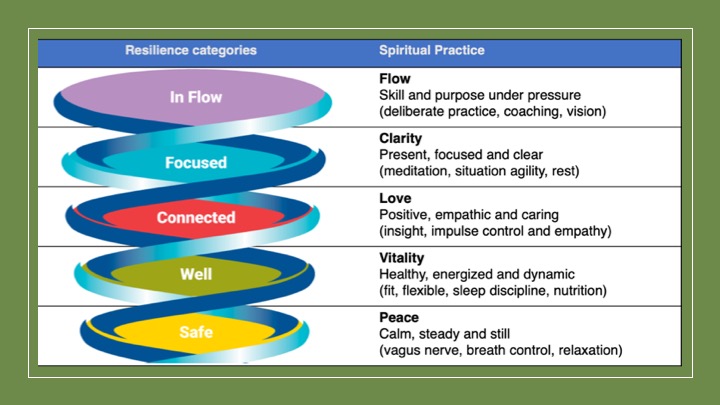
Spirit in Action is a method to frame and guide this journey. If willing and able, here are five deliberate practices that will take you to a much better place.

First, strive to be calm, steady and still in the storms of life. Caught up in the adrenaline surge of fight or flight, we sink to a reptilian level of consciousness. When calm you are healing, moving, feeling and thinking better.

Drill: learn and master contemplative/breathing/relaxing practice 5 min per day

Second, strive to be healthy, energised and dynamic. Illness, fatigue or lethargy makes the experience of enlightenment impossible to sustain. Being able to enjoy vitality is a key part of the experience of connection and joy.

Drill: be non-negotiable in your sleep, activity and nutritional disciplines

Third, strive to be positive, empathic and caring. It is essential to consciously feel and flex your emotions with an orientation towards generosity. The experience of peace, love and joy is diagnostic of enlightenment for many theologians.

Drill: restrain your impulses, generate joy and respect the joy of others

Fourth, strive to be present, focused and clear. Ruminating on the past or fretting about the future causes suffering. When present, we experience each moment in its fullness. Suffering drops away.

Drill: catch your thinking and focus 100% on the present moment

Fifth, live with skill and purpose – particularly in the testing moments. Flow is the state of full engagement with a meaningful challenge. Whether this is in loving prayer, skilled acts of compassion or creative pursuit, your spirit (little self) is in action and you will feel one with Spirit (greater reality).

Drill: define how, where and why you get flow and get a little every day

Accepting wise mentorship on this path of deliberate practice will accelerate your quest. It is very easy to get stuck in eddies when one area consumes too much attention. Many who exercise fanatically clean forget to relax or develop their emotions. Many meditate at the expense of their physical capabilities. Sometimes too much love, can distort our altruism into destructive sympathy.

Our development framework for Spirit in Action

Each of these base categories of discipline can reach levels of enlightenment. Consider the advanced yogi (super-calm), your favourite athlete (grace), Buddhist compassion (love), mathematical brilliance (clarity). They all trend towards flow.

There are many paths available for enlightenment. We live in a wonderfully diverse and creative world because humans courageously pioneer untrodden paths. Use the basic concepts and the lessons of our great spiritual traditions to stabilise and direct your journey. Seek truth, respect and practicality.

At the end of the day you have to choose and walk your own path.

As Gandhi reminds us:

To remake the world, you have to remake yourself.

Original Source: https://resiliencei.com/blog/spirit-in-action-part-3/