


OUR APPROACH
Your team is capable. But can they stay clear, connected, and performing when the pressure is real.
We start with measurement, not assumptions. Every programme we deliver is built from your team’s specific resilience data, trained by a multidisciplinary team of doctors, psychologists, and business leaders, and ends with before-and-after proof. That is our approach to leadership development proven to work.

What Resilience Actually Is
Most people think resilience is grit. Pushing through. Toughing it out. It isn’t.
Resilience is your capacity to recover quickly, adapt, and continue to perform when things are genuinely difficult.
It isn’t a personality trait. It isn’t fixed. The research across neuroscience, psychology, and behavioural science is consistent: resilience is a dynamic, learnable process. It develops through supportive conditions, emotional regulation skills, and a sense of agency; not willpower.
When pressure rises, people respond in one of three ways. Some collapse or withdraw. Some push through but slowly burn out. Others stay calm, recover quickly, and emerge stronger. That difference is resilience.
It is also measurable. And it is what we build.
Resilience is not endless grit
Pushing without recovery doesn’t produce strength. It produces exhaustion. Organisations that confuse pressure with performance eventually lose the people they can least afford to lose.
Resilience is not just positivity
Ignoring reality prevents learning and adaptation. Resilience isn’t optimism on demand. It is the regulated capacity to respond clearly when things are hard.
Resilience is not the same as well-being
Mental health, wellbeing, and resilience are related but distinct. Resilience is the system that makes sustained performance possible. Wellbeing is the outcome when that system is working. We build the system.
The Resilience Spiral
We understand resilience as a spiral, not a straight line.
Life and work moves in cycles. Challenge, then recovery, then growth. Each cycle builds capacity, provided recovery and learning are actually present. Without recovery, performance declines. Without performance, resilience has no purpose.
Our programmes are built around the three phases of this spiral:
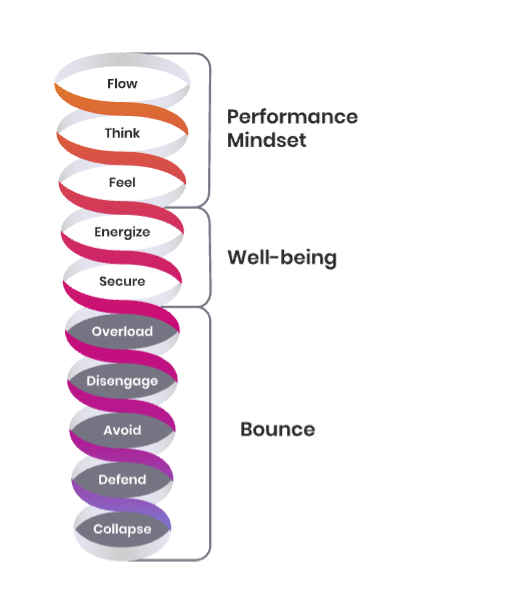
PERFORMANCE MINDSET
The ability to focus attention, connect with others, and enter states of flow and meaning.
This is where resilience translates into impact; where the capacity built in Bounce and Well-being produces the leadership quality, decision-making clarity, and collaborative output that your organisation actually needs.
For your team: Are your leaders performing at the level their capability allows? Or is depleted resilience the ceiling they keep hitting?
The spiral matters because growth follows recovery — and recovery requires deliberate practice, not just intention. This is what separates our approach from a motivational workshop: we measure each phase, identify where the gaps are, and design training that closes them.
SECURE WELL-BEING
The ability to restore energy and rhythm through sleep, movement, nutrition, and recovery practices.
This phase rebuilds capacity rather than depleting it. It is the difference between teams that sustain performance and teams that erode quietly under pressure until the resignation letters start arriving.
For your team: Do your people recover between demands? Or do they arrive depleted on Monday and carry that depletion through to Friday?
BOUNCE
The ability to calm the nervous system, regain perspective, and restore choice under pressure.
This is where stress is absorbed and where agency returns. Bounce is the foundation. Without it, every difficult situation drains rather than develops.
For your team: Can they reset between demands? Do they return to clarity after a hard conversation, a difficult quarter, a major change?
We call it: Precision Training.
It means every programme is shaped by your team’s actual resilience data.
1. Measure
Before any training begins, every participant completes the Resilience Assessment. It measures 50 scientifically validated factors across the Bounce, Wellbeing, and Performance Mindset domains.
You receive individual profiles, team dashboards, risk flags, strength scores, and benchmarks against 500,000+ global participants.
This is your baseline. It shows which of your leaders are functioning but fragile, where your highest burnout risk sits, and which resilience strengths are already strong enough to build on. You cannot close a gap you haven’t measured. This is where every engagement starts.
2. Design
Based on the data, we design a programme targeted at your team’s specific gaps.
If your highest risk is emotional regulation and energy recovery, the programme addresses that. If the primary challenge is change adaptability ahead of a restructure, we build for that context. If psychological safety across a cross-cultural leadership team is the issue, the facilitation reflects that dynamic.
The Assessment data shapes the content, format, facilitation approach, and duration. A Financial Services CHRO in Singapore gets a different programme than an L&D Director at a pharmaceutical company in Jakarta because their data is different.
3. Train
Our facilitators are not trainers reading from a manual. They are a multidisciplinary team of doctors, psychologists, behavioural scientists, and business leaders who have held difficult conversations inside the region’s most demanding organisations.
Training formats range from a 2-hour diagnostic session to a 12-month organisational change journey, delivered in-person, virtually, or blended across your Asia footprint and beyond.
What every programme has in common: participants receive their own resilience data at the start. That makes application personal, not theoretical. It is why 85% of participants in one global pharmaceutical programme confirmed they would implement at least one technique immediately after the session.
4. Sustain
Sustained capability change requires re-assessment, reinforcement, and for organisations that want it we offer internal capability through certified practitioners.
At the close of every programme cycle, we re-assess. Before-and-after data shows exactly what moved, by how much, and where the next focus should be. Clients who go through multiple cycles — like Swisscaution, whose 30-month engagement produced six assessment rounds and resilience scores sustained 20% above corporate average which build something that persists beyond the programme.
For organisations that want to embed this permanently, we offer ICF CCE and SHRM PDC-accredited Resilience Coach and Trainer Certification; qualifying your internal team to deliver the methodology directly.
The Science Behind the Method
Our methodology is backed by 22 years of peer-reviewed research in neuroscience, behavioural science, and preventive medicine initiated by Dr. Sven Hansen, a medical doctor specialising in executive health and high-performing teams.
The methodology is grounded in active academic partnerships with 7 universities globally, including HEC Lausanne since 2021. The 2025 Global Resilience Report drawn from 8,400 professionals across 70+ countries represents the largest proprietary resilience dataset available in Asia Pacific today. No other training provider in Singapore draws on this depth of longitudinal data when designing a programme for your team.

“Only 8% of L&D teams calculate ROI from their training programmes.
With the RI method, we have the data to be in that 8% and show our CFO the number.”

The Science Behind the Method
The methodology is grounded in active academic partnerships with 7 universities globally, including HEC Lausanne since 2021. The 2025 Global Resilience Report drawn from 8,400 professionals across 70+ countries represents the largest proprietary resilience dataset available in Asia Pacific today. No other training provider in Singapore draws on this depth of longitudinal data when designing a programme for your team.
Our methodology is backed by 22 years of peer-reviewed research in neuroscience, behavioural science, and preventive medicine initiated by Dr. Sven Hansen, a medical doctor specialising in executive health and high-performing teams.
Start with the data. The conversation follows.
The Resilience Assessment takes 8 minutes per participant. It produces a 50-factor resilience
profile and once you see it, the programme conversation flows.
Frequently Asked Questions (FAQs)
Resilience is the capacity to recover quickly, adapt, and continue to perform when conditions are difficult. It is not grit or toughness. It is a dynamic, learnable process shaped by biology, behaviour, and environment. At the Resilience Institute, we understand resilience as a spiral of three phases: Bounce (restoring calm and perspective under pressure), Secure Wellbeing (rebuilding energy and recovery capacity), and Performance Mindset (focusing, connecting, and contributing at your best). Each phase builds on the last. Without recovery, performance eventually collapses.
Most leadership training delivers frameworks without data. Our approach begins with the 50-factor Resilience Assessment, which measures exactly where each leader and team sits across Bounce, Wellbeing, and Performance Mindset. Training is then designed to close specific, measured gaps. You begin with a baseline and end with documented change. No other provider in Singapore combines this level of diagnostic precision with structured training and accredited certification pathways.
We work with multinational corporations across Financial Services, Pharmaceuticals, FMCG, Technology, Energy, Healthcare, and Professional Services. Primarily organisations with 500 to 50,000+ employees navigating change, restructuring, or leadership pipeline pressures across Asia.
Programmes range from a 2-hour insight session to a 12-month organisational change journey. Most enterprise engagements run between 3 and 6 months, anchored by the Resilience Assessment at the start and a re-assessment at the close to document what changed.