



Why Measure Resilience
Resilience is a measurable performance indicator,
less a personality trait.
Resilience is not fixed. It responds to training. First by measuring where one stands
and then build resilience training from real-time data.

The 2025 Global Resilience Report, drawn from 8,419 assessments across 70 countries, found that 54% of professionals globally are functioning in the “challenged” zone, which means they are present, delivering, but without the recovery capacity to absorb another cycle of sustained pressure. These are people who have not flagged a problem and believe they are fine.
The organisations that engage the Resilience Assessment do so because they want to know that number for their own teams, before it shows up in attrition data, engagement survey scores, or a key person walking out the door.
54%
In the Challenged Zone
8,419
Assessments Analysed
70
Countries
“The most responsible way to push performance“
Julia Lauricella
Head of Nestle Systems Technology Center
What the Resilience Assessment MEASURES
50 Factors Across Physical, Emotional, Mental and Social Fitness
The Resilience Assessment is powered by ResilienceAI, built on two decades of research, analysing 10 categories and 50 scientifically validated factors that drive sustainable performance, that is fit for change.
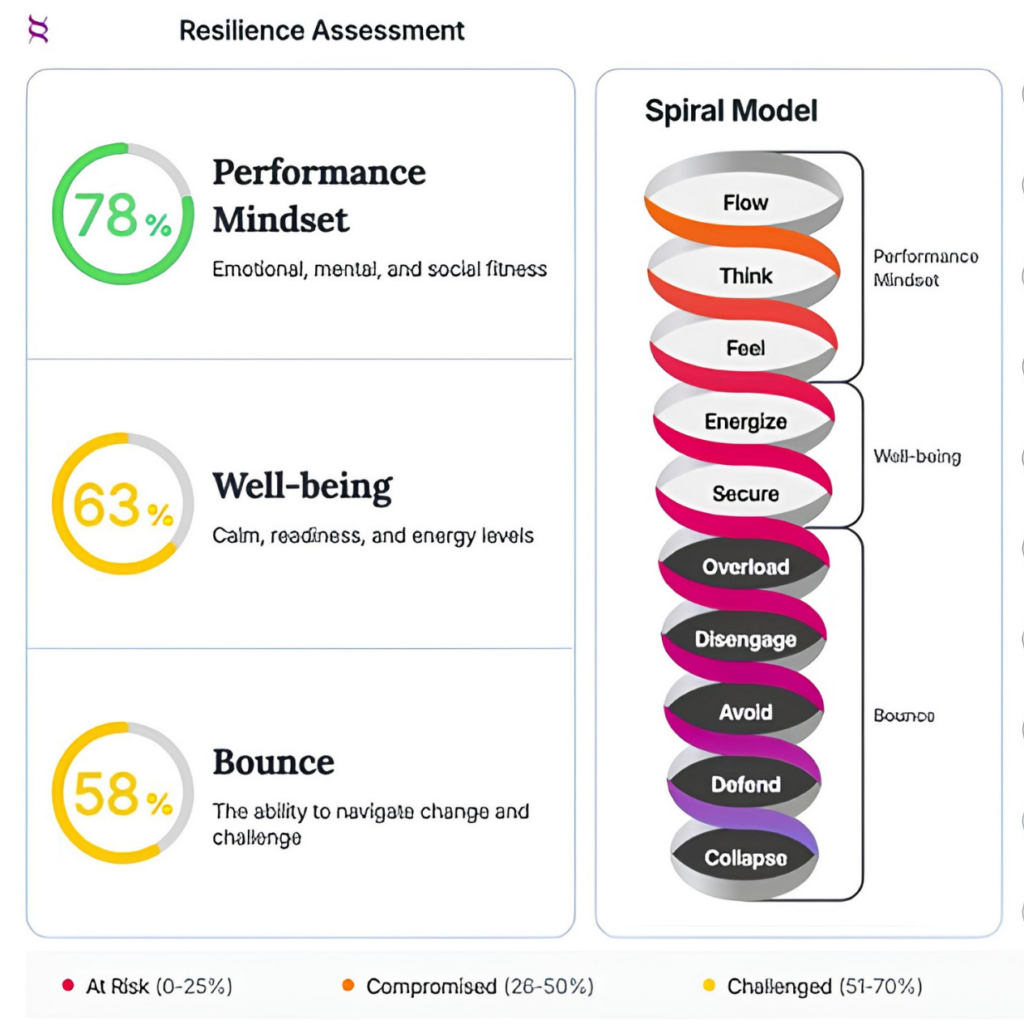

Performance Mindset
Focus, adaptability, decision-making under pressure, and the cognitive markers of high performance

Well-being
Emotional regulation, psychological safety, purpose, relationships, and the factors that protect against burnout

Bounce
Recovery, stress response, sleep, energy, and the physical foundations of sustained performance
What YOU GET
Three Levels Of Data, One Complete Picture.

01
Personalised Report
Each participant receives a personalised report with their scores across all 50 factors, specific growth areas, and a set of targeted action steps with access to a resource library of videos, articles, and worksheets built around their individual profile. People engage with data about themselves. Participation rates average 90%+.

02
Team Dashboard
Leaders receive an interactive dashboard showing team-level resilience scores by factor, domain, and any custom reporting dimensions you configure such as business unit, tenure, function, geography. The dashboard identifies which areas carry the highest risk and where to focus programme investment. It is the output you present to the board.

03
Benchmarking
Every score is benchmarked against 500,000+ professionals across 70 countries and the 8,419 participants in the 2025 Global Resilience Report. You know your team’s scores. You also know what those scores mean relative to a global standard, not just relative to last year.
How it works
Four steps from first conversation to team dashboard.

Request Access Code
Contact the RI Asia team to set up your assessment. We configure custom reporting dimensions, set your team size, and prepare the access link with supporting communications. → Get in touch

Distribute to your team
One link. One set of instructions. For large programmes, we provide custom communication packs and videos so your team understands what they’re completing and why. Average completion time: 7–10 minutes per participant.

Individual Action Plans
Within minutes, each participant receives their personal Resilience Report – 50 factors, individual scores, action steps, and access to the resource library. Specific, personal, and actionable from the first read.

Review Team results
Leaders access the interactive team dashboard filterable by any dimension you set up in Step 1. You can see exactly where your team’s resilience risks sit, which cohorts score lowest, and what a targeted programme would address. Additional assessments can be created on demand for follow-up measurement.
Trusted By People In Organisations

Dinusha Jayamanne

Mia Edin

Mohit Kumar

Hannes Van Role

Anonymous

Carine Schorochoff

Chantal Pankov

Anonymous

Mark Campbell

Mr Renato P Cabati
“Hear From a Client Organisation“
An HR leader shares how the Resilience Assessment helped their organisation move from anecdotal workplace conversations to measurable, board-reportable data.
What the Data Shows
Before-and-after data from organisations that have run the assessment
EDWARDS LIFESCIENCES
41% improvement in resilience scores. SVP committed to deploying across the Critical Care organisation.
FLETCHER BUILDING
334 participants. 44% reduction in at-risk individuals. 25% increase in customer satisfaction scores.
REGIONAL BANK (M&A integration)
22% drop in voluntary attrition in the top-100 leadership tier. 38% increase in resilience scores over 6 months.
SWISSCAUTION
6 rounds of assessment over 30 months. Resilience scores compounded across each cycle.
EDUCATION SECTOR PILOT
150 participants. 44.8% overall resilience improvement recorded at 9-month mark.
These outcomes are not produced by the assessment alone. They are produced by measuring first, training against the gaps, and measuring again. The assessment is the anchor that makes the training accountable.
Pricing
Transparent flat-fee pricing. No hidden costs.
| Organisation Size | Annual Fee | Per-Person Cost |
|---|---|---|
| 1 – 100 users | ~SGD 115 per person | Unit pricing |
| 101 – 500 users | ~SGD 7,300 flat fee | From SGD 15 per person |
| 501 – 1,000 users | ~SGD 12,900 flat fee | From SGD 13 per person |
| 1,001 – 2,000 users | ~SGD 18,400 flat fee | From SGD 9 per person |
| 2,000+ users | Custom quote | Contact us |
| Add Team Reporting | ~SGD 580 per team | Recommended for multi-unit organisations |
All tiers include: 1-year access · unlimited assessment rounds · individual reports · leader dashboard · custom reporting fields · lenses feature · primary support.
Why This Tool
What the Resilience Assessment does that other tools don’t
DISC measures behavioural style. MBTI measures personality type. StrengthsFinder maps talent themes. All three are useful but none of them tell you whether a person or team has the capacity to sustain performance under the kind of sustained pressure your organisation is currently running at.
The Resilience Assessment measures the 50 factors that predict exactly that. It is not a replacement for the tools you already use. It is the layer that tells you whether your team can hold together long enough to use their strengths, their style, and their talent.
It also produces before-and-after data. Every other tool gives you a profile. The Resilience Assessment gives you a baseline you can return to and a score differential that shows what your programme investment actually moved.

Start with a sample report. The data will tell you the rest.
The clearest way to understand what the Resilience Assessment produces is to read one. Download a sample individual report to see what your people would receive or request a no-cost pilot for a team of 5 and get real data on your own organisation within 48 hours.
Frequently Asked Questions
The Resilience Assessment is a 50-factor diagnostic tool developed by the Resilience Institute, built on +22 years of research into what enables individuals and teams to sustain performance under pressure. It measures factors across three domains – Bounce, Well-being, and Performance Mindset – and produces individual reports, team dashboards, and benchmarks against 500,000+ professionals globally. It is used by organisations including Microsoft, Shell, Nestlé, PwC, and HSBC across 70 countries.
The assessment takes 7–10 minutes per participant to complete. Individual reports are returned within 48 hours. Team dashboards are available to leaders as soon as participant responses are submitted.
DISC, MBTI, and StrengthsFinder measure personality, behavioural style, or talent themes. The Resilience Assessment measures the 50 factors that predict whether a person or team can sustain performance under sustained pressure including burnout risk, energy management, emotional regulation, recovery capacity, and cognitive performance under stress. The tools complement each other. The Resilience Assessment adds the performance and risk measurement layer that the others do not provide. It also produces before-and-after data, something no personality assessment does.
Each participant receives a personalised report showing their scores across all 50 factors, specific areas of strength and risk, and a set of targeted action steps. They also receive access to a resource library of videos, articles, and worksheets tailored to their individual profile. Reports are available within 48 hours of completing the assessment.
Leaders receive access to an interactive team dashboard showing resilience scores at team, business unit, and organisational level – filterable by any custom dimension configured at set-up (function, tenure, geography, etc.). The dashboard identifies the highest-risk areas and where programme investment will have the most impact. It is designed to produce board-ready data.
The assessment scales from individual coaching use (SGD 115 per person for under 100 users) to enterprise-wide deployment for 2,000+ users on a custom pricing model. Flat-fee pricing applies from 100 users. There is no upper limit on scale; programmes have been deployed across dispersed organisations of 5,000+ employees across multiple Southeast Asia markets simultaneously.
Yes. Resilience Institute Asia has active delivery infrastructure across Singapore, Indonesia, Philippines, Malaysia, Vietnam, Cambodia, and Thailand. The global Resilience Institute network operates in 70 countries. The assessment can be deployed to teams across multiple markets simultaneously, with custom reporting dimensions that allow you to compare resilience data by country, region, or business unit.