
Women Illustration
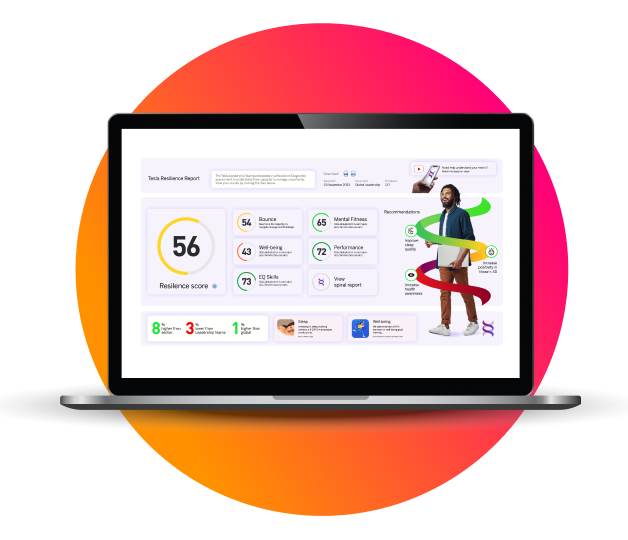
Overview of the personalised Resilience Assessment Report

See how we measure Resilience and the detailed insights into individual strengths and growth areas.

Download Report

Peace, Love, and Joy: The Practices Behind the Words

  • Peace, love, and joy aren’t just pleasant abstractions. Each has a real physiological signature, and each can be deliberately cultivated through specific, practised techniques.
  • Psychologist Barbara Fredrickson’s broaden-and-build research found positive emotions aren’t just pleasant to feel, they measurably expand attention, build lasting psychological resources, and compound over time when practised consistently.
  • These practices complement, rather than replace, appropriate clinical support. Anxiety, prolonged anger, and depression are genuine conditions that sometimes need therapy or medication alongside anything self-directed.

Humans are a forceful species. In a short span of evolutionary time, we’ve reshaped the physical world around us, capable of remarkable brilliance and generosity, and just as capable of destruction. Underneath most of what drives that behaviour sits something simpler: nearly everyone is reaching for more peace, more love, and more joy, whatever form that reaching takes.

Leadership, at its best, moves people toward more of these three states, in a family, a team, or a country. When that direction is lost, real suffering tends to follow. Disruption is inevitable in any life, and under real threat, peace can shatter into fear, love can curdle into anger, and joy can sink into sadness. None of those three feel good, each in its own distinct way, and the discomfort is what drives the search to recover the state underneath it.

Left unaddressed, fear can deepen into anxiety, anger into chronic hostility, and sadness into depression, genuine conditions that often benefit from real clinical support, therapy and medication among them, not just self-directed practice. What follows isn’t a substitute for that support. It’s a set of specific, practical techniques for cultivating peace, love, and joy directly, worth genuine, sustained engagement whether or not clinical support is also part of the picture.

Peace

Peace is a state of calm and felt safety, closely tied to activity in the vagus nerve, the body’s primary channel for shifting out of threat-response mode and into genuine rest. It’s the physiological foundation everything else in this piece builds on. While leaders, parents, organisations, and governments all have a real role in creating environments that feel safe, the actual experience of peace inside any given moment remains an individual, trainable capacity.

When external safety measures aren’t enough, and fear takes over anyway, the path back to peace runs through the body first. Slow, diaphragmatic breathing, muscle relaxation, and a softened gaze all measurably shift the nervous system out of sympathetic activation. Consistent practice makes the return faster and more reliable over time, and being able to generate genuine calm on demand, even inside a real threat, is what allows someone to act with skill instead of reactivity.

1

Cultivating Peace

Exhale and consciously release tension in the face and body. Slow the breath and notice heart rate following it down. Soften the eyes and let attention widen, toward nature if it’s available. Deliberately radiate a sense of calm and steadiness. Bring attention fully into the present moment, and let yourself genuinely register the feeling of peacefulness once it arrives, rather than rushing past it.

Love

Love, in this context, means a state of genuine positive connection, the foundation underneath real collaboration and shared success. Psychologist Barbara Fredrickson’s broaden-and-build theory, one of positive psychology’s more empirically robust contributions, found that positive emotions like love and connection don’t just feel good in the moment. They measurably broaden attention and creativity, and build lasting psychological, social, and even physical resources over time. A randomised trial Fredrickson ran on loving-kindness meditation found participants who practised it regularly showed genuine, compounding increases in positive emotion and life satisfaction over weeks, not just an immediate mood bump.

When connection collapses into anger instead, the physiological cost is real: chronic anger is associated with elevated inflammation and cardiovascular strain, and it tends to drive blame and rupture rather than repair. Love, by contrast, is active and demanding in its own way. It requires genuinely respecting others, staying open to perspectives that differ from your own, and remaining capable of care even when someone has caused real hurt.

2

Cultivating Love

Start from the peace practice above; love builds on that same settled base. Lengthen the spine and open the shoulders and hands. Direct genuine warmth and patience toward yourself first. Actively appreciate whatever is present in your immediate awareness. Deliberately extend a feeling of goodwill outward, to people you know, to people you don’t, to the wider world. This is the same core mechanism behind loving-kindness meditation, and the research suggests it compounds with regular practice rather than staying flat.

Joy

Joy is a state of genuine exuberance, energising and motivating, and it tends to draw other people toward it rather than requiring effort to project. Fredrickson’s broaden-and-build research found joy specifically supports flow, the state of fully absorbed, high-performance engagement, and helps orient people back toward what actually matters to them.

When joy gives way to sustained sadness instead, energy tends to collapse and withdrawal follows, a genuine and difficult experience, and one that, when it persists or deepens, is worth taking seriously as a signal to seek real support rather than something to simply will your way out of. Cultivating joy, like the other two states, takes deliberate, repeated effort. It rarely arrives simply by waiting for good news.

3

Cultivating Joy

Build on the peace and love practices above; joy sits on top of both. Let a genuine smile reach the corners of the eyes, not just the mouth. Let that sense of ease spread through the whole body, not just the face. Focus attention fully on whatever’s genuinely good in view right now, however small. Let yourself register that this specific moment is enough as it is. Share the feeling visibly with whoever’s around, and let yourself actually savour it rather than moving straight past it to the next thing.

Peace, love, and joy aren’t states you wait for. They’re states you practise, the same way any other skill compounds with genuine, repeated attention.


Test Blog Loram Ipsum Generator

The Power of Pausing: Why Doing Nothing Matters

In a world where every spare moment can be filled with notifications, podcasts, videos, and social media, doing nothing can feel surprisingly difficult. Yet moments of quiet can give the brain space to process information, reflect on experiences, and make new connections.

Research into attention, creativity, and wellbeing increasingly suggests that constantly consuming information may leave little room for reflection. Learning to become comfortable with moments of boredom may therefore be a simple but valuable resilience practice.

The Wandering Mind

When we stop actively focusing on a task, the brain does not simply switch off. Instead, different networks become more active, including the Default Mode Network, which has been associated with self-reflection, memory, imagination, and thinking about the future.

Why Quiet Moments Can Be Useful

Some of our most useful ideas appear when we are not deliberately trying to solve a problem. Think about the moments when an answer suddenly appears while walking, showering, driving, or preparing a cup of coffee.

Space for Creative Thinking

Constant stimulation gives the mind very little opportunity to make connections between different ideas.

When there is less incoming information, the brain can revisit previous experiences and combine them in unexpected ways. This can support:

  • Creative problem-solving
  • Reflection and self-awareness
  • Memory processing
  • Planning and decision-making
  • Generating new ideas

Reflection Without Distraction

Quiet time can also help us notice thoughts and emotions that might otherwise remain hidden beneath constant activity.

Rather than immediately reaching for a phone whenever an uncomfortable thought appears, allowing the thought to exist for a moment can create an opportunity to understand it.

Why We Avoid Boredom

Boredom is often treated as something negative. We instinctively look for stimulation because silence can feel uncomfortable, especially when we are used to having something happening around us at all times.

The Habit of Constant Stimulation

Consider how often you check your phone during an ordinary day.

You might reach for it while waiting for an elevator, standing in a queue, sitting on public transport, or waiting for a webpage to load. These tiny moments seem insignificant, but together they can remove much of the natural downtime from our day.

The Notification Cycle

Every notification creates a small invitation to shift attention.

Over time, this can make uninterrupted attention feel increasingly unfamiliar. The problem is not necessarily the phone itself; it is the automatic habit of reaching for stimulation whenever there is a gap.

The Practical Upshot

You do not need to completely disconnect from technology or spend hours sitting in silence. Small changes can create more opportunities for your mind to slow down.

Start With Five Minutes

Try introducing one short period of intentional quiet into your day.

For example:

  1. Take a five-minute walk without headphones.
  2. Leave your phone in your bag during your commute.
  3. Drink your morning coffee without scrolling.
  4. Sit quietly before starting your next task.
  5. Spend a few minutes looking outside instead of opening an app.

What is the Resilience Spiral?

What is the Resilience Spiral?

Resilience is integral to personal and professional growth, and understanding it can significantly enhance our ability to navigate life’s challenges. Dr. Sven Hansen, the founder of the Resilience Institute, developed the Resilience Spiral to provide a structured framework for understanding and enhancing resilience. This model is built on the principles of neurobiology, physiology, and evolutionary biology, aiming to help individuals and organizations thrive in adversity.

__wf_reserved_inherit

The Foundation of the Resilience Spiral

Resilience, as defined by Dr. Hansen, is the learned ability to:

1. Bounce forward fast in adversity

2. Grow physical, emotional, and mental strengths

3. Connect with oneself, others, and nature

4. Discover flow in the application of skill to meaningful challenges

These capabilities are essential for navigating the complexities of life, whether for individuals, businesses, or communities. Resilience is not just about surviving; it is about thriving and evolving through adversity.

Understanding the Resilience Spiral

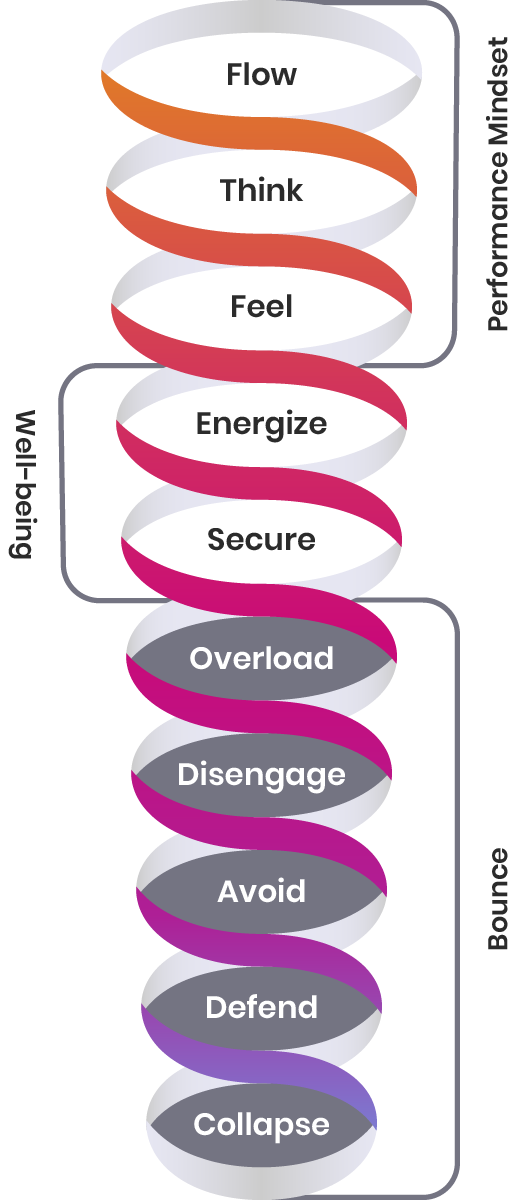
The Resilience Spiral is a diagnostic and development model that describes our quality of experience and altitude in life. Our altitude can be high, where we feel clear, energized, and focused, or low, where we experience pain, suffering, and negativity. The journey through the spiral involves moving up and down these states, influenced by our physical, emotional, and mental conditions.

Integral Approach in the Context of Spiral Models

In the context of the Resilience Spiral, “integral” means incorporating a comprehensive, inclusive approach that accounts for various dimensions of human experience. This concept draws inspiration from other spiral models like Spiral Dynamics and Integral Theory.

Spiral Dynamics, developed by Clare Graves, Don Beck, and Chris Cowan, explores the evolution of human values and consciousness. It has been applied in global negotiations, politics, medicine, and business. Similarly, Integral Theory, proposed by Ken Wilber, is one of the most comprehensive and inclusive frameworks, integrating insights from various fields to create a unified understanding of reality.

Dr. Hansen’s Resilience Spiral integrates these approaches by combining insights from neurobiology, physiology, and evolutionary biology with practical applications for resilience. This integration ensures a holistic understanding of resilience, addressing the physical, emotional, mental, and social dimensions of human experience.

Four Key Perspectives

Dr. Hansen’s model emphasizes four perspectives to enhance resilience:

Insight – Know Yourself

Insight involves understanding your current state by checking your body, emotions, and mind. This self-awareness is crucial for improving your altitude and engaging effectively with others. Accurate terminology and self-assessment tools, like the Resilience Spiral, help in this understanding.

Mastery – Raise Your Altitude

Mastery is about knowing how to improve your state once you have identified it. This involves specific biological adjustments, such as regulating your nervous system to restore calm and readiness. Building physical, emotional, and mental skills through practices like good sleep, emotional control, and focused attention is essential.

Empathy – Understand Others

Empathy is the ability to accurately read and respond to the physical, emotional, and mental states of others. This skill requires deliberate practice and is vital for effective social interactions and leadership. High altitude enables better empathy and connection.

Altruism – Raise the Altitude of Others

Altruism involves actions that help others improve their state, reducing suffering and enhancing quality of life. Effective altruism is built on the foundations of insight, mastery, and empathy, leading to resilient individuals, communities, and ultimately, a resilient planet.

The Resilience Journey

The journey through the Resilience Spiral begins with the foundational state of being secure. This state is characterized by a calm, engaged physiology, typically achieved through practices like slow breathing, meditation, and yoga. Once secure, the focus shifts to physical vitality, emotional agility, and mental skills.

Secure

Achieving a secure state involves calming the body and mind, often through external cues of safety or self-regulation techniques. This state is essential for effective functioning under stress.

Energize

Physical vitality, achieved through fitness, nutrition, sleep, and daily rhythms, is crucial for maintaining energy and resilience. Investing in physical health significantly enhances overall resilience.

Feel

Emotional agility and social engagement are the next steps. Positive emotional states and social connections enhance our ability to think clearly and make effective decisions.

Think

Mental skills like focus, optimism, and agility are most effective when built on a foundation of physical and emotional stability. In this state, the mind becomes a powerful tool for creativity and problem-solving.

Flow

The ultimate state of resilience is flow, where we engage in challenging tasks with skill and productivity. Flow states are deeply fulfilling and require years of dedicated practice to achieve consistently.‍

Practical Application and Leadership

The Resilience Spiral is not just a personal tool; it is also valuable for leaders and organizations. By understanding and applying the principles of the spiral, leaders can enhance the resilience of their teams and create a positive, productive culture. Practical steps include regular self-assessment, practicing bounce tactics, and fostering an environment that supports physical, emotional, and mental well-being.

Leading with the Resilience Spiral

Leaders play a crucial role in shaping the resilience of their teams. By viewing resilience from an integral perspective, leaders can understand the layers of culture and influence positive change. This involves recognizing and addressing the physical, emotional, and mental states that define how people experience work.

For instance, during the COVID-19 pandemic, many organizations witnessed increased fear and anxiety among employees. Leaders who understood the Resilience Spiral could implement strategies to elevate the collective altitude, such as promoting secure states through clear communication, supporting physical vitality with wellness programs, and fostering emotional connections through team-building activities.

Conclusion

The Resilience Spiral, developed by Dr. Sven Hansen, provides a comprehensive framework for understanding and enhancing resilience. By focusing on insight, mastery, empathy, and altruism, individuals and organizations can navigate adversity, grow, and thrive. The journey through the spiral is ongoing, requiring continuous practice and commitment, but the rewards are a life filled with clarity, energy, and meaningful engagement.

Understanding resilience through an integral lens ensures a holistic approach that addresses all dimensions of human experience. By integrating insights from various fields and applying them in practical ways, the Resilience Spiral offers a powerful tool for personal and organizational growth. Embrace the Resilience Spiral and embark on your journey towards a more resilient, fulfilling life.

Original Source: https://resiliencei.com/blog/what-is-the-resilience-spiral/

A Guide to Measuring Resilience

Resilience gives you the strength and courage to continue your journey despite setbacks or unmet expectations. Research indicates that higher levels of resilience correlate with better outcomes when navigating a crisis, managing an illness or chronic pain, and improving physical and mental health. A 2020 Forbes article showed that resilience training reduced the average depression symptoms by 33-44%.

For organizations, resilience means having a stronger team capable of achieving against the odds and weathering change, challenges, and economic storms. As the world shifts further into choppy waters, resilience is the key to your organization staying its course. And, as the saying goes, what is measured is managed. Thankfully, measuring resilience is not only possible but is an effective way to understand the human risks and strengths within a team and an organization. Looking further ahead, it’s the starting block for building a more resilient and adaptable workforce.

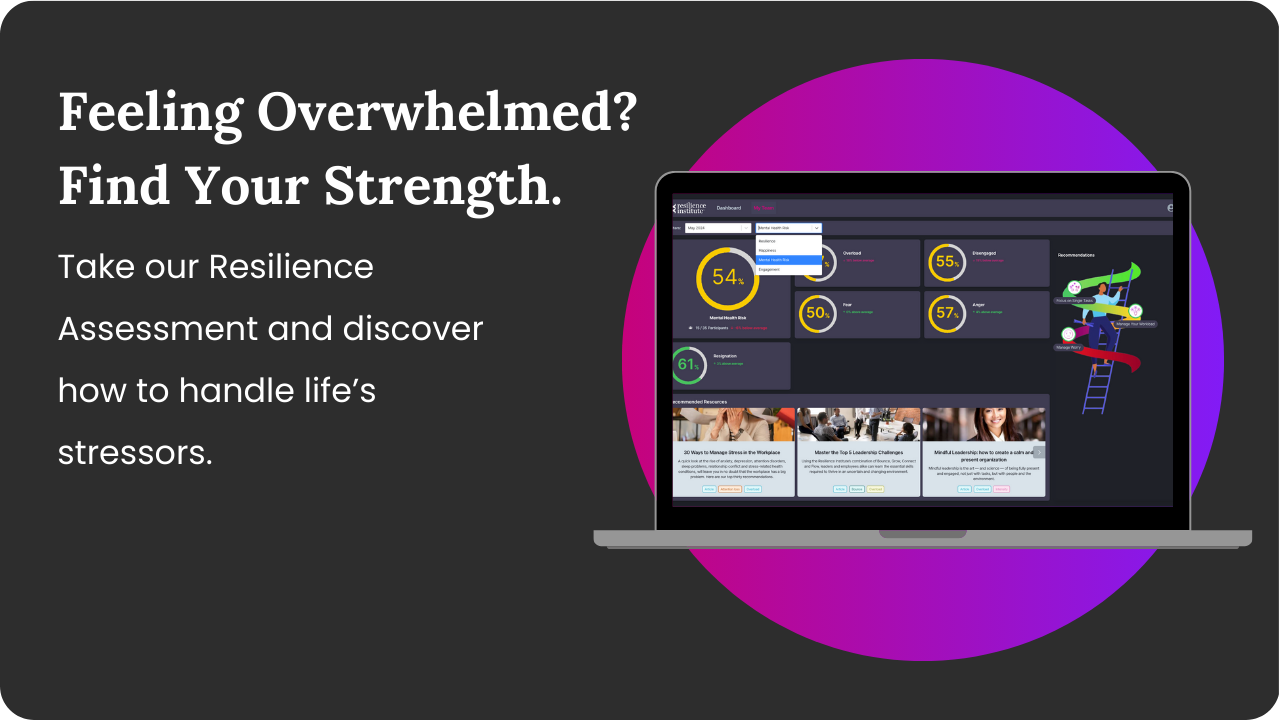
Want to measure your resilience? The Resilience Assessment is a peer-reviewed, psychometrically valid toolkit used by hundreds of thousands of participants worldwide.

__wf_reserved_inherit
Try the Resilience Assessment

What is resilience? Can you measure it?

Resilience is the ability to bounce back after facing a challenging situation without letting adversity affect one’s chances of future happiness or success.

While some people continue to thrive, facing a challenging period of their lives with the confidence that things will get better, others struggle under pressure. From the outside, it can be challenging to grasp what separates these two prevalent but opposite reactions. This is the result of resilience in action.

There is an essential distinction between repression and resilience; resilient people are still likely to be shaken by challenging events. However, they view these events as opportunities for growth. They change their direction and build a new positive path forward, incorporating the challenging situation into a new sense of self and reconsidering priorities.

Resilience research suggests six areas in which resilience can be seen in an individual’s life. These include reframing, using the power of positive emotions, using the power of positive emotions, exercising, engaging in trusted social networks, identifying signature strengths, and being optimistic.

Reframing

An essential aspect of resilience is reframing a challenging situation and developing a refreshed, more constructive, and beneficial perspective. By reframing a problematic situation, an individual can better cope without feeling stuck.

Using the power of positive emotions

Accessing positive emotions even following challenging times is an essential component of resilience. Positive emotions can help us face the problems in our lives while considering solutions to move forward. They also encourage us to connect with others and give us an overall sense of purpose and fulfillment.

Taking part in physical activities

The benefits of exercise are well-established for physical health, but physical activity also does wonders for mental health. By participating in physical activity, individuals can mitigate stress and build a new sense of self-respect and self-worth.

Engaging in trusted social networks regularly

Spending quality time with friends, work pals, and family members can help alleviate the loneliness of challenging situations. In addition, conversations with others about what’s going on can help to take some of the pressure off and help to gain a more holistic view of the situation.

Identifying and utilizing signature strengths

Continuing to recognize strengths despite challenging times is a critical component of resilience. By utilizing strengths, individuals can feel a boost in control and meaning in their lives and take on new responsibilities and challenges.

Being optimistic about the future

A general sense of optimism towards the future is another sign of resilience. Individuals with strong resilience will view challenges or setbacks as temporary, knowing their future path isn’t permanently negative. This outlook can help maintain a hopeful perspective towards the future.

Resilience Assessments: Why are they important?

Resilience tests, also known as scales, examine an individual’s resilience across key areas. Usually, this test is conducted using a questionnaire, which collects information and responses from individuals about how they adapt to difficulties.

Resilience assessments are essential because they help to identify areas of strength and areas where improvement may be needed. This can be beneficial individually and for a business, as it can identify weaknesses and strengths within a company. Resilience assessments can also promote awareness, leading to more effective intervention use.

How do we measure resilience?

Resilience is a complex psychological phenomenon that can be classified by a person’s ability to continue to cope with and recover from adversity. Several assessments or scales have been created in the last 30 years to help researchers, employers, therapists, and even private individuals better understand how resilience functions and, more importantly, how it can be quantified. These different frameworks are primarily conducted via surveys and questionnaires that assess a person’s mindset, coping strategies, and broader support network.

Different tools can be employed in various situations. For example, the Academic Resilience Scale was specifically designed to assess students. While the Resilience Scale for Adults is best utilized when assessing grown adults. The Resilience Diagnostic Assessment, on the other hand, is primarily employed by organizations looking to improve their resilience as a whole. By using these tools, organizations can better understand their ability to handle stress and setbacks while also understanding where points of weakness may lie. Below are several tools and frameworks that can help your business better understand its quantifiable resilience score.

Resilience Assessment

The Resilience Assessment is developed and updated by the Resilience Institute. Recently releasing V5 of this comprehensive tool, the Resilience Institute continues to help businesses and organizations quickly and comprehensively assess their staff and management’s well-being, effectiveness, and resilience.

The diagnostic assessment covers 50 factors within 5-8 minutes, looking at mental health, stress management, well-being, emotional intelligence, and more. Based on peer-reviewed psychometrics, the assessment features 11 categories labeled as strength or risk based on a respondent’s results. One of the benefits of choosing the Resilience Assessment is that it is presented alongside a wealth of interactive resilience training & coaching for individuals and organizations. This means there is a direct way to go beyond measurement towards actively engaging with improving resilience. So, if you’re interested in assessing your organization’s resilience, this is an effective and convenient tool.

__wf_reserved_inherit

Connor-Davidson Resilience Scale

Dr Kathryn Connor and Dr Jonathon Davidson developed the Connor-Davidson Resilience Scale (DC-RISC). It’s a widely adopted assessment designed to help measure resilience in individuals. The scale consists of 25 items, each rated on a five-point scale. These items focus on several areas of resilience, including personal competence, adaptability, tolerance of negative affect, and more. This tool has been used across many cultures and diverse populations, making it a reliable and effective method for measuring resilience.

Predictive 6-Factor Resilience Scale

This innovative assessment tool, the Predictive 6-Factor Resilience Scale (PR6), measures a person’s resilience based on six factors. The PR6 offers a unique approach to understanding resilience, considering several factors contributing to someone’s ability to experience a setback and cope positively. The PR6 assesses self-regulation, optimism, adaptive coping, supportive relationships, and more. Many physicians and therapists use this set of tools to predict resilience in their clients.

Resilience Scale for Adults

The Resilience Scale For Adults (RSA) is a well-established tool for assessing and evaluating resilience, specifically in the adult population. Developed in Norway, the RSA looks at six core dimensions of resilience: perception of self, perception of the future, social competence, family cohesion, and social support. The RSA aims to establish a comprehensive understanding of a person’s resilience and has also been used successfully in clinical practices.

How to improve resilience?

Resilience is a skill that can be cultivated over time by implementing specific strategies into your daily life. If you are looking for ways to improve your resilience, then consider incorporating some of the below methods:

  1. Work on having a positive mindset—Having a positive outlook on life can be immensely beneficial for your everyday life. Still, it is also a direct path to helping build resilience. Stopping negative self-talk and adjusting to a positive mindset can take time, so be patient. Mindfulness activities and meditation can help monitor negative self-talk and move toward a more positive outlook.
  2. Grow a strong support network — A social circle is essential to resilience. Making an effort to maintain relationships with friends and family members can help individuals cope with adversity. Friends can help by providing support, advice, and positivity in challenging periods.
  3. Introduce self-care routines—Practising self-care can help improve resilience. Self-care includes taking care of yourself in all key areas, including sleeping well, exercising regularly, eating a healthy diet, and implementing stress-minimizing techniques like meditation or yoga. Self-care practices can also help individuals overcome self-esteem issues and low confidence.
  4. Learning from the past — By learning from the past and reflecting on past coping methods that have worked or not worked, individuals can work on new strategies for successfully coping in the future.
  5. Seeking help—Everyone needs help sometimes; there’s no shame in reaching out and getting help when needed. Many professional help sources, such as psychology, can help individuals get back on track. Alternatively, reaching out to friends for extra support can be beneficial.

Conclusion

Resilience is an essential aspect of the human experience, and our ability to navigate negative changes and recover from adversity can significantly impact our lives. So, measuring and assessing resilience is the first step in improving our ability to handle life’s challenges. On an organizational level, this can significantly impact a business’s ability to weather downturns and right the ship when needed. Ultimately, by quantifying resilience, using the tools and psychological scales available, we can understand how to improve it and make a difference in our personal and work lives.

Original Source: https://resiliencei.com/blog/a-guide-to-measuring-resilience/

What Resilient Systems Teach Us About Building Resilient Teams

  • Resilient technology systems share five keystones, redundancy, diversity, decentralization, modularity, and adaptability, and each maps directly onto a specific, buildable practice for human teams.
  • In 2022, Patagonia’s founder transferred 100% company ownership to a purpose trust and a climate nonprofit specifically to protect the company’s mission from short-term shareholder pressure and founder succession risk, a genuine structural resilience mechanism, not just a values statement.
  • AI systems can be engineered for resilience, but it isn’t automatic. Left unchecked, human over-reliance on AI outputs, automation bias, can quietly undermine the very resilience an organisation is trying to build.

Resilience is critical in both technology and human performance. A resilient technology system can absorb a network error or power outage without shutting down entirely. The question worth asking directly: can that same concept genuinely apply to human teams? The answer is a resounding yes, and the parallels turn out to be remarkably specific, not just a loose metaphor.

Understanding Resilient Systems in Technology

In technology, resilient systems are synonymous with efficiency, reliability, and robustness, built on five keystones. Redundancy, often viewed negatively in human terms, is a genuine technological safeguard: multiple backups ensuring the system keeps functioning if one part fails. Diversity brings a spectrum of different elements, each performing a distinct task, preventing any single point of failure from taking down the whole system. Decentralization distributes power and control, so the failure of one section doesn’t mean the failure of the whole. Modularity breaks a system into manageable, self-contained units, so disruption stays isolated rather than spreading. Adaptability is the system’s capacity to anticipate, react to, and genuinely learn from disruption, arguably what makes a system resilient rather than merely sturdy.

The Human Parallel

Redundancy in a workforce looks like cross-training and genuinely multifunctional teams, more than one person able to do a given task, creating a real backup for absence or attrition. Diversity means different skills, experiences, and perspectives genuinely coexisting within the same team, which measurably improves problem-solving and adaptability to change. Decentralization empowers team members directly, building autonomy and avoiding over-reliance on any single individual. Modularity shows up as semi-independent, cross-functional teams that can operate on their own while staying in harmony with the wider organisation. Adaptability is fostered through a genuine culture of continuous learning and proactive anticipation of challenges, not just reaction after the fact.

Building These Traits Deliberately

Cross-Training and Skill Development (Redundancy)

This isn’t about replacing employees. It’s about building a team where multiple people can genuinely perform a range of tasks, so one person’s absence doesn’t halt the whole operation. It provides a real safety net while also enhancing individual skill and job satisfaction.

Diversity and Inclusion

A genuinely resilient team, like a well-rounded technology system, needs diverse thought, perspective, and background. This opens the door to more innovative ideas and lets a team approach challenges from multiple angles at once, improving both decision-making and the overall work environment.

Empowerment and Decentralization

Giving individuals genuine decision-making capability mirrors decentralization in a technical system. It reduces bottlenecks, speeds up decisions, and keeps the team functioning even if a key decision-maker is unavailable, while also genuinely improving job satisfaction.

Semi-Independent Teams

This mirrors modular design directly: each team functions independently while still contributing to the whole. Disruption in one department doesn’t have to disrupt the entire organisation if teams can genuinely adjust and respond on their own.

Culture of Learning and Proactive Problem-Solving (Adaptability)

Resilient technology systems need to adapt and upgrade to stay relevant; teams need the same. A genuine culture of learning lets a team not just react quickly to change, but actually anticipate problems and build solutions in advance.

Measurement and Diagnostics: The Core of Both

In technology, measurement and diagnostics are the pillars the whole system rests on. Servers are constantly monitored for CPU usage, memory, and network traffic, with anomalies triggering immediate correction. The same principle applies directly to human teams, shifting focus from hardware and software to what might be called “humanware,” the people themselves. Understanding a team’s genuine strengths and risks, where it shines and where it needs real support, is what allows leaders to make informed decisions that actually enhance effectiveness and resilience, rather than guessing.

Resilience Institute’s Resilience Assessment brings exactly this kind of diagnostic capability to human teams, offering insight that conventional engagement surveys often miss entirely: a data-driven view of individual and team resilience factors that enables genuinely targeted intervention rather than a generic, one-size-fits-all programme.

The Real Benefits

A resilient team, like a resilient system, is robust, adaptable, and genuinely efficient. Redundancy through cross-training removes single points of failure, supporting consistent output even through individual absence. Empowered decision-making reduces bottlenecks and speeds up workflows. Semi-independent teams support genuine work-life balance by distributing workload more evenly, reducing stress and burnout risk directly. Valuing diverse perspectives and continuous learning increases both job satisfaction and innovation, while a resilience-focused culture builds real transparency, collaboration, and mutual support, the kind of environment that signals genuine investment in people, not just output.

What About AI Resilience?

AI is on nearly everyone’s mind, and it’s worth asking directly: is AI actually resilient? AI can be designed to be resilient, but it isn’t inherently so. Resilience in AI means the ability to maintain or quickly regain strong performance under adverse conditions, unfamiliar input data, adversarial attempts to deceive it, or a changed operating environment. Achieving this requires deliberate design: robustness to handle unfamiliar situations, redundancy through backup models, continuous learning that genuinely adapts over time, and real interpretability, understanding how the system actually reaches a decision well enough to predict how it will behave under new conditions.

There’s a second, less obvious risk worth naming directly: even a well-engineered AI system can undermine human resilience if people stop genuinely questioning its output. This pattern, known as automation bias, the tendency to accept an automated system’s recommendation while discounting contradictory information, is well documented, and it tends to worsen under time pressure or after repeated positive experience with a tool. A genuinely resilient team using AI well isn’t one that trusts the system completely. It’s one that stays actively engaged with it, asking what would make this output wrong, the same active-questioning habit that makes a human team resilient in the first place.

Case Studies

Google: Autonomy and Continuous Learning

Google builds technical resilience through systems redundancy and decentralised networks, and mirrors that in its workforce through a genuine emphasis on employee autonomy and continuous learning, encouraging creative thinking and real ownership rather than rigid top-down direction.

Microsoft: Diversity and a Growth Mindset

Microsoft’s technical resilience rests on diversity, adaptability, and redundancy, and the company’s commitment to diverse talent through initiatives like the LEAP Engineering Acceleration Program mirrors that principle directly in its workforce, alongside a genuine cultural shift toward a growth mindset that treats failure as a real basis for improvement.

Patagonia: Structuring Resilience to Outlast Any Single Owner

Patagonia offers a genuinely different, and in some ways more structurally literal, example of organisational resilience than a technical infrastructure metaphor usually allows. In September 2022, founder Yvon Chouinard and his family transferred 100% of the company’s voting stock to the newly created Patagonia Purpose Trust, and 100% of its non-voting stock to the Holdfast Collective, a nonprofit dedicated to fighting climate change. “Earth is now our only shareholder,” Chouinard wrote in the letter announcing the change.

The reasoning behind the structure is itself a genuine case study in resilience thinking. Chouinard explicitly rejected taking the company public, arguing that “even public companies with good intentions are under too much pressure to create short-term gain at the expense of long-term vitality and responsibility.” Rather than leave the company’s mission dependent on a single owner, a family’s future decisions, or public market pressure, the trust structure is designed specifically to survive all three, decentralising control away from any one point of failure and permanently encoding the company’s purpose into its actual governance, not just its stated values. The company continues to donate 1% of sales to grassroots environmental groups and remains a certified B Corporation, and the new structure now directs an estimated $100 million a year in profit toward environmental causes.

This mirrors the modularity and decentralization principles discussed above in a genuinely unusual, structural way: Patagonia built a governance system specifically resilient to the two things that most often derail a values-driven company over time, founder succession and shareholder pressure, rather than simply hoping good culture would hold.

Despite different specific approaches, Google, Microsoft, and Patagonia each embody the same underlying principles, diversity, decentralization, and continuous learning, in how they build organisational resilience. These case studies underline a consistent pattern: investment in genuine resilience, whether in culture, structure, or both, is an investment in an organisation’s long-term survival, not a soft-benefit side project.

Resilient systems and resilient teams share the same underlying architecture, redundancy, diversity, decentralization, adaptability, but a team isn’t a machine to be calibrated. Build the structure like a resilient system. Nurture the people like people.

The Myth of Multitasking: Why Monotasking Wins Every Time

  • The famous “23 minutes to regain focus” statistic is often misattributed to the American Psychological Association. It’s actually Gloria Mark’s research at UC Irvine, and the real number carries real weight regardless of who gets credited.
  • A landmark 2009 Stanford study found heavy multitaskers perform worse, not better, at filtering irrelevant information and switching between tasks, exactly the skills they’d need to multitask well in the first place.
  • Monotasking isn’t a productivity trend. It’s how the brain is actually built to work, and switching that habit back is a specific, learnable skill.

Multitasking is often worn like a badge of honour. “I can juggle several things at once!” an employee might claim, a dozen open browser tabs as proof. Plenty of job ads even list it as a required skill. But what if multitasking is less a strength and more a genuinely silent productivity killer?

Let’s unpack what multitasking actually is, why it may be hurting more than helping, and how to shift toward a more effective approach: monotasking.

What Multitasking Actually Is

Multitasking is the act of juggling multiple tasks at once: checking email during a meeting, replying to messages while writing a report, listening to a podcast while working. It looks efficient on the surface. In reality, the brain isn’t built to genuinely run multiple tasks simultaneously.

What we call multitasking is actually rapid task switching. The switch might feel seamless, but it isn’t; it takes real time, and each shift carries a genuine cognitive cost known as the switch cost.

The Real Risks

The risks of multitasking extend well beyond simple inefficiency, touching mental health, relationships, and workplace dynamics directly.

Reduced focus and productivity. A landmark 2009 study by Eyal Ophir, Clifford Nass, and Anthony Wagner at Stanford compared heavy and light media multitaskers directly and found heavy multitaskers performed measurably worse at filtering out irrelevant information, switching between tasks efficiently, and organising working memory, exactly the cognitive skills someone would need to multitask well in the first place. The result is lower productivity and a genuinely higher error rate, not the efficiency multitasking appears to promise.

Increased stress. Constant task-switching keeps the nervous system in a low-grade state of urgency, and sustained over time, that’s a genuine path toward burnout, not a sustainable operating mode.

Hindered creativity. Creative thought needs real time, space, and depth of focus. Constant switching keeps attention in shallow water, never quite deep enough to reach genuine creative insight.

Weakened group dynamics. Teams that normalise multitasking during meetings and collaboration tend to see real communication breakdowns; when everyone’s attention is genuinely split, aligning on shared goals gets measurably harder.

What the Science Actually Shows

Cognitive science is fairly clear that the brain is wired for genuine focus, not simultaneous streams of tasks. Each switch carries a real lag as the brain readjusts, the switch cost mentioned above, and that cost compounds across a day of constant interruption.

A 2014 study by Kep Kee Loh and Ryota Kanai at the University of Sussex found that people who engaged in heavier media multitasking, using multiple devices or media streams simultaneously, showed lower grey matter density in the anterior cingulate cortex, a brain region involved in cognitive control. It’s worth being precise about what this actually shows: it’s a correlational finding, not proof that multitasking directly causes the change, but it’s a genuinely notable association between habitual media multitasking and structural differences in a region tied to attention and self-regulation.

What Monotasking Actually Is

Monotasking is the practice of doing one thing at a time: giving a task your genuine full attention, completing it with real focus, then moving to the next. It sounds simple. It’s a genuinely significant shift in how most people currently work.

The benefits are real and substantial. Focusing on a single task lowers cognitive load, reduces mistakes, and lets you accomplish more in less time, bringing genuine clarity where multitasking creates mental clutter instead.

Making the Shift

Prioritise Ruthlessly

List tasks in genuine order of importance. Focus on the single most critical one first, and don’t move on until it’s actually done. The Pareto Principle, roughly 80% of results coming from 20% of effort, is worth taking seriously here: find your real 20% and start there.

Block Real Time

Dedicate specific blocks to specific tasks. The Pomodoro technique, 25 minutes of genuinely focused work followed by a 5-minute break, helps maintain deep concentration and builds a real rhythm across the workday.

Eliminate Genuine Distractions

Multitasking thrives in a distraction-rich environment. Turn off notifications, close unnecessary tabs, and build a workspace that actually supports focus rather than undermining it by default.

Build Genuine Mindful Awareness

Notice when your attention drifts or you feel the pull to check your phone. That noticing is the actual skill. Regular mindfulness or meditation practice strengthens the capacity to catch it earlier over time.

The Real Cost of Getting Interrupted

The evidence supporting monotasking is genuinely strong. Gloria Mark’s research at UC Irvine, one of the most cited findings in productivity science, found it takes an average of 23 minutes and 15 seconds to fully regain focus after an interruption, not the few seconds most people assume. Multiply that across a typical day’s interruptions and the lost time becomes genuinely substantial, whatever could otherwise have been accomplished with that reclaimed focus.

On an individual level, monotasking brings real calm and clarity: less stress, more creative capacity, sharper problem-solving, and a genuine sense of accomplishment as accuracy improves. At a team level, it fosters better communication and collaboration; when each person is genuinely focused rather than split across five things, meetings and joint work both function more cohesively, with less miscommunication to untangle afterward.

Why This Compounds Over Time

Monotasking’s benefits aren’t limited to a single afternoon’s productivity. Reducing cognitive overload and building the habit of genuine, deep focus gives the brain real room to process information, create, and problem-solve well. In a world that often rewards raw speed, that clarity is what actually supports better decisions, not just faster ones.

Multitasking feels like productivity while quietly draining it. Monotasking is slower to start and faster to finish, and the research behind that trade-off holds up.

Decisiveness: Turning Choices Into Confidence and Resilience

  • A famous study of parole judges found they became significantly more likely to deny parole as the day wore on, purely from accumulated decision fatigue, not the merits of each case.
  • Decisiveness isn’t about choosing fast. It’s about weighing options efficiently, trusting your own judgement, and actually committing, rather than looping in indecision.
  • Choosing imperfectly and moving forward consistently beats endless deliberation. Five specific, practisable habits build this deliberately.

When faced with genuine uncertainty, do you find yourself stuck in endless cycles of “what ifs”? In a world full of constant choices, the ability to make clear, confident decisions, decisiveness, has never mattered more. It isn’t just about choosing quickly. It’s about having the clarity and resilience to make decisions that genuinely align with your goals and values.

Decisiveness is a skill that transforms doubt into action, letting you navigate real challenges with genuine confidence. It’s the ability to weigh your options, trust your own judgement, and actually move forward, a defining trait of resilient people.

What Decisiveness Actually Is

Decisiveness is more than making choices fast. It’s genuinely assessing information, evaluating real risk, and committing to a course of action with actual confidence. Whether choosing between career paths, managing conflict, or navigating a personal relationship, decisiveness reduces stress and brings real clarity to complex situations.

A genuinely decisive mindset builds resilience because it turns obstacles into real opportunities. Rather than staying paralysed by uncertainty, decisive people focus on the actionable step in front of them, the one that actually moves things forward.

The Real Cost of Indecision

Resilience, at its core, is the ability to bounce back from adversity, and decisiveness is a genuine driver of that process. When life presents a real challenge, being decisive means taking control rather than being controlled by circumstance. Decisive people adapt to change by focusing on solutions rather than being overwhelmed by the problem itself, build confidence with every decision made, however small, and avoid the specific stress that comes from delayed action.

This last point has real, specific research behind it. Psychologist Roy Baumeister’s work on what he termed “ego depletion” found that self-control and decision-making draw on a genuinely limited mental resource, one that depletes with repeated use across a day. The most striking demonstration of this comes from a landmark study by Shai Danziger, Jonathan Levav, and Liora Avnaim-Pesso, which tracked real parole board judges over many months and found they became significantly more likely to deny parole as the day progressed, purely from accumulated decision fatigue, not from anything meaningfully different about the cases themselves. Decisiveness, practised deliberately rather than left to chance, is what protects against exactly this kind of degradation in judgement.

Building Decisiveness Deliberately

1

Clarify Your Actual Priorities

When you genuinely know what matters most, evaluating a choice against it becomes far easier. Take real time to define your values and long-term goals before you’re in the middle of a decision that needs them.

2

Limit Genuine Information Overload

Too much information reliably produces analysis paralysis. Focus on the most genuinely relevant facts, and trust that you don’t need every possible data point to make a good decision.

3

Set a Genuine Time Limit

For everyday choices, give yourself an actual time limit. For bigger decisions, set a real deadline, since this directly counters the overthinking and procrastination that decision fatigue research shows compounds the longer a decision drags on.

4

Embrace Genuine Imperfection

No decision is without real risk. Accept that you might not get everything right, and treat mistakes as genuine information rather than proof you shouldn’t have decided at all.

5

Practise Small Decisions Daily

The more you genuinely practise deciding in small, low-stakes moments, the more naturally that capacity extends to bigger, higher-stakes choices later.

Decisiveness Versus Indecision

Indecision can feel like a genuinely safe space, but it reliably produces stress, regret, and missed opportunity instead. A few real signs of chronic indecision worth watching for: constantly seeking reassurance from others before deciding anything, delaying a decision until circumstances decide it for you, or overthinking choices that genuinely don’t warrant the effort. If these patterns feel familiar, that’s worth taking seriously. Choosing imperfectly is still better than not choosing at all.

Resilience Through Decisiveness

Decisiveness isn’t about making perfect choices. It’s about genuinely taking control of your own path. Every decision, big or small, is a real step forward, and cultivating this skill deliberately builds the resilience to meet whatever comes next, not just today’s specific problem. As it strengthens, the ripple effect shows up across nearly every area of life: more genuine confidence, less overwhelm, and real capacity to handle challenges with focus rather than paralysis.

Decisiveness doesn’t mean always being right. It means moving forward with what you know, trusting yourself enough to adjust later if you need to.

Further reading:
Decisive: How to Make Better Choices in Life and Work, Chip Heath and Dan Heath
The Paradox of Choice: Why More Is Less, Barry Schwartz
Thinking, Fast and Slow, Daniel Kahneman