Across more than 21,000 completed Resilience Assessments, only 2% of the most resilient professionals report frequent exhaustion after work, compared to 54% of the least resilient group.
Research on venting is unusually clear: describing your exhaustion to others doesn’t relieve it. In controlled studies, it often deepens it.
A specific, evidence-backed language shift, dropping “I” in favour of your own name or “you” during self-talk, measurably reduces stress reactivity under pressure.
Someone asks a colleague who’s clearly running on fumes, “You must be exhausted?” There are two common replies. One describes the tiredness in detail, the late night, the early start, the sheer volume of it. The other simply says the night was long, mentions something good that came of it, and moves on.
Both people may be equally tired. What differs is what happens next, in the body and in how the room responds to them. That difference has a real evidence base behind it, and it’s more specific than “just think positive.”
What the Data Actually Shows
Across more than 21,000 completed Resilience Assessments, Resilience Institute’s own research found a stark split. Among the top 10% most resilient respondents, only 2% reported feeling exhausted “very often” or “nearly always” after work. Among the least resilient group, that figure was 54%. The gap isn’t really about how much work either group did. It’s about how each group related to the fatigue once it arrived, and how visibly they carried it.
This tracks with a broader pattern in Singapore right now. A 2025 Ministry of Manpower report found that roughly one in three Singapore workers experienced work-related stress or burnout in 2024, and a separate 2024 industry survey found 47% of Singapore employees feel mentally or physically exhausted by the end of the workday. Fatigue itself isn’t rare here. What varies is what people do with it, including how often they name it out loud.
Why Naming It Doesn’t Always Help
There’s a well-studied idea in psychology called affect labeling, simply putting a feeling into words. For years it was treated as reliably calming, on the theory that naming an emotion helps the brain regulate it. The actual research is messier than that. A 2021 study by Nook and colleagues found that labeling an emotion can sometimes get in the way of reappraising it afterward, and a broader body of work has found that people with a larger vocabulary for negative emotions don’t necessarily report less distress, sometimes the opposite. Labeling seems to help most when it’s paired with genuinely reframing the situation, not when it’s used alone as a running commentary.
University of Michigan psychologist Ethan Kross, who has spent much of his career studying the inner voice, found something similarly counterintuitive about venting specifically. In his research, and in the popular science book Chatter that summarised it, Kross describes venting as “self-defeating”: talking through frustration with someone else can strengthen the relationship in the moment, but it rarely reduces the underlying distress, and often rehearses and reinforces it instead.
That’s a more precise version of what RI’s own data has been showing for years. The professionals who report the least chronic exhaustion aren’t suppressing how they feel. They simply aren’t running a live commentary on it, to themselves or anyone else.
The Technique That Actually Has Evidence Behind It
Kross’s lab has tested a specific alternative: distanced self-talk, dropping first-person language (“I am exhausted”) in favour of your own name or “you” (“you’re running on empty, but you’ve got this next hour”). In a series of studies, participants who used non-first-person language under stress appraised the situation as more of a challenge and less of a threat, showed lower physiological stress markers, and performed better on subsequent tasks than participants using first-person self-talk. A 2017 follow-up combining EEG and fMRI data found this effect happens with almost no extra cognitive effort. It isn’t willpower. It’s closer to a linguistic switch.
This is worth sitting with, because it’s genuinely different advice from “don’t think about it” or “stay positive.” The instruction isn’t to suppress the fatigue. It’s to change the grammar you use to describe it to yourself, which appears to change how threatening it feels.
A Word on Genuine Exhaustion
None of this is an argument for pushing through real exhaustion. Fatigue is a genuine biological signal, and there’s a difference between the everyday tiredness of a demanding week and the kind of depletion that needs actual rest, not a reframe. Singapore’s own workplace data makes the scale of that second category clear: this isn’t a small or occasional problem. The distinction that matters is between fatigue you narrate and re-narrate to everyone around you, which the evidence suggests deepens it, and fatigue you register, act on, and recover from, which is simply good self-management.
Putting This Into Practice
1
Notice the Signal, Don’t Narrate It
Check in with your body and energy honestly. Rate the severity privately. That’s assessment, not the same thing as describing it out loud to three colleagues before lunch.
2
If It’s Genuine Exhaustion, Act on It
Real depletion needs real recovery: sleep, a proper break, a lighter load. No amount of language substitutes for that. This is a priority decision, not a mindset problem.
3
Switch Out of First Person Under Pressure
If you must push through a stretch of fatigue, try coaching yourself the way you’d coach someone else: by name, or with “you.” “Alex, you’ve got one more hour” carries measurably less threat than “I can’t do this.”
4
Anchor the Body Before the Mind Follows
Lengthen your posture, breathe slowly through the nose, and work in short, fully engaged bursts rather than one long grind. None of this fixes real exhaustion, but it changes how the next hour feels while you get to a proper break.
5
Save the Story for After, Not During
Kross’s research is specifically about venting in the moment. Processing a hard stretch afterward, with distance and reflection, is a different and genuinely useful practice. The timing is what changes the effect.
Fatigue is real. The running commentary on it is optional. The evidence suggests that second part is doing more damage than the tiredness itself.
The first 30 to 45 minutes after waking triggers a real, measurable hormone surge, the cortisol awakening response, which prepares your body for the day ahead.
Hitting snooze isn’t the sleep sin it’s made out to be. A 2024 study found brief snoozing had no meaningful effect on mood, alertness, or cortisol for most people, though older research found it can prolong grogginess in others.
What matters more than any single ritual is structure. A consistent sequence, however short, gives your mind fewer decisions to make while it’s least equipped to make them.
The alarm goes off. For a moment, nothing makes sense. The mind is foggy, still tangled in whatever it was doing before waking. A hand reaches out and hits snooze, half out of habit, half out of hope that nine more minutes will fix something sleep alone couldn’t. It rarely does. Nine minutes later, the alarm returns, and so does the same fog.
Almost everyone knows this exact sequence. What’s less well known is what’s actually happening in the body during it, and why the structure of the first hour matters far more than the willpower required to get out of bed.
What Actually Happens When You Wake Up
In the first 30 to 45 minutes after waking, cortisol levels rise sharply, a well-documented phenomenon researchers call the cortisol awakening response. A 2025 review in Endocrine Reviews describes it as a distinct hormonal event layered on top of the body’s normal 24-hour rhythm, believed to help prepare the body and brain for the demands of the day ahead. It isn’t a stress response in the negative sense. It’s closer to an ignition sequence.
That grogginess in the first few minutes has a name too: sleep inertia, the transition period between sleep and full wakefulness, marked by temporarily impaired thinking and reaction time. Most people try to solve it with the snooze button, and for years, conventional wisdom treated that as a mistake. The research is more nuanced. A 2024 study out of Stockholm University and Monash University tracked habitual snoozers in a sleep lab and found that a brief snooze period caused no clear negative effects on cortisol, mood, or overnight sleep quality, and in some cases improved cognitive performance immediately after rising compared to an abrupt, jarring wake-up. Earlier research out of Japan had found the opposite: snooze alarms prolonged the drowsy, low-vigilance state compared to a single alarm.
Both are probably right, for different people. What the evidence agrees on is that abrupt, high-stress wake-ups are worse than a gentler transition, however that transition happens. The snooze button was never really the problem. What happens in the minutes after matters far more.
Where “Win the Morning” Actually Comes From
The idea of a structured morning ritual isn’t new, but its modern popularity owes a great deal to Hal Elrod’s book The Miracle Morning, which has sold more than two million copies and been translated into over 35 languages since it was first published. Elrod’s method, known by the acronym S.A.V.E.R.S., breaks the ritual into six elements: Silence, Affirmations, Visualization, Exercise, Reading, and Scribing (journaling). The specific combination matters less than the underlying idea: a short, repeatable sequence practised before the demands of the day take over.
The appeal isn’t mystical. It’s structural. A morning ritual, whatever form it takes, front-loads a handful of high-value habits into the part of the day when they’re most likely to actually happen, before meetings, notifications, and other people’s priorities start competing for the same window.
Why Morning Structure Works Better Than Morning Willpower
Psychologist Roy Baumeister’s research on self-regulation found that willpower behaves like a depletable resource. Every decision, every act of self-control, draws from the same limited pool across the day. That pool is at its fullest in the morning, before meetings, minor conflicts, and constant small decisions have worn it down. This is precisely why a morning routine tends to succeed where an evening one struggles: it asks for effort at the exact moment the body has the most to give.
There’s a second mechanism working in parallel. Early exposure to natural light helps anchor the body’s circadian rhythm, the internal clock that governs alertness, hormone release, and eventually, sleep quality that same night. A short period outdoors or near a bright window in the first hour after waking reinforces that rhythm far more effectively than the same light exposure later in the day.
Put together, the case for a morning routine isn’t about discipline or virtue. It’s about timing. The same five actions attempted at 6am and at 9pm draw on completely different biological resources, and the morning version has the advantage almost every time.
Building a Version That Actually Fits Your Life
There’s no single correct morning routine, and chasing someone else’s exactly is usually where these rituals fail. What the research points to instead is a small set of ingredients worth including in some form, adapted to fit an actual life rather than an idealised one.
1
Decide the Night Before, Not the Morning Of
Willpower is highest in the morning, so don’t spend any of it deciding what your routine even is. Set out clothes, decide the sequence, and remove every small decision you can the night before.
2
Get Light Before You Get a Screen
Natural light exposure in the first hour helps anchor your circadian rhythm for the whole day. A few minutes by a window or outside, before checking a phone, does more for your body clock than the same light later on.
3
Move, Even Briefly
It doesn’t need to be a workout. A short stretch, a walk, or a few minutes of movement signals wakefulness to the body faster than sitting still does, and it doesn’t require any special equipment or setting.
4
Sit With Stillness Before the Noise Starts
A few quiet minutes, whether that’s breathing, meditation, or simply sitting without a phone in hand, gives the nervous system a calm baseline before the day’s first demand arrives.
5
Name the Three That Matter Today
Before the inbox opens, write down the three things that would make the day genuinely worthwhile if nothing else got done. It takes under a minute and it changes what the rest of the day organises itself around.
None of this requires an hour, incense, or a specific app. The version that lasts is almost always the smallest one that still gets done, expanded slowly once it’s actually a habit rather than an aspiration.
You don’t win the morning by force. You win it by removing enough friction that showing up barely takes any willpower at all, right when your willpower is at its highest for the day.
From FY2025, every SGX-listed company must report Scope 1 and Scope 2 emissions. Straits Times Index constituents add Scope 3 in 2026.
A 2025 meta-analysis found even brief nature exposure lowers salivary cortisol by 21% — but the research on how much time and how often is still genuinely unsettled.
Singapore already runs on green infrastructure most companies never use for work: nearly half the island is green space, connected by a network of park connectors built for exactly this purpose.
54% of the APAC workforce is “functioning but fragile,” according to Resilience Institute’s 2025 Global Resilience Report of 8,400+ professionals across 70 countries — and nature-based recovery is one of the few interventions with data on both sides of the P&L.
A CHRO in a Raffles Place tower has two dashboards open most Monday mornings now. One tracks her division’s Scope 1 and Scope 2 emissions for the sustainability report that’s now a listing requirement, not a nice-to-have. The other tracks engagement scores that keep drifting the wrong way despite three wellbeing initiatives launched this year alone.
She has never once been asked to connect the two. Most CHROs haven’t. That’s the gap this piece is about.
The Two Numbers Now Sitting on the Same Desk
Singapore moved first in Asia on mandatory climate disclosure. From financial year 2025, every SGX-listed issuer — local or foreign-incorporated, REITs and business trusts included — must report Scope 1 and Scope 2 greenhouse gas emissions. Straits Times Index constituents will add Scope 3 disclosure from 2026, with the wider market following in phases through 2030.
This is no longer a comply-or-explain exercise. It’s a listing rule, aligned to the ISSB’s IFRS S2 standard, and it sits on the same governance calendar as the annual report.
At the same time, LinkedIn’s 2025 Workplace Learning Report found 70% of HR professionals are now prioritising training investment in AI, durable human skills, and sustainability — three categories most L&D budgets still treat as separate line items. They’re converging faster than most org charts have caught up with.
Here’s the part almost no one has connected yet: the discipline your finance team is building to report emissions — baseline, measure, verify, disclose — is the same discipline resilience measurement already runs on. One reports the company’s footprint. The other reports its people’s capacity. Put them on the same page and you have something a board actually wants to see: proof that the culture investment and the sustainability investment are the same investment.
What Nature Actually Does to a Stressed Nervous System
Strip away the poster-sized claims and the underlying research is more interesting, and more useful, than “nature is good for you.”
A 2025 meta-analysis published in Behavioral Sciences reviewed nature-exposure studies in adults and cited earlier biomarker research showing that as little as ten minutes outdoors in a setting where someone feels a genuine sense of contact with nature reduced salivary cortisol by 21% and salivary amylase — another stress marker — by 28%. Both are measurable, not self-reported.
But the same review found the dose-response question is still unresolved. Some studies show no relationship between how long someone spends outdoors and how much stress relief they report. A 2024 study at a US medical centre that tracked heart-rate variability during a nature walk found the same pattern split the group in two: roughly half the participants showed a strong physiological recovery signal, and the other half showed increased strain, not less. Nature exposure helps most people, most of the time — but treating it as a guaranteed, one-size intervention overstates what the evidence actually supports.
That nuance matters for anyone designing a programme, not just anyone writing about one. A single mandated “wellness walk” will not move a resilience score. A repeatable practice, built into how people already work, has a much better chance.
Singapore Already Built the Infrastructure. Most Offices Don’t Use It.
This is where the Singapore context does something the global research can’t: it removes the logistics excuse.
NParks maintains green cover across nearly half the island, threaded together by a network of park connectors purpose-built to link housing estates, business districts, and nature reserves on foot or by bike. The city’s “City in Nature” strategy — including a target of one million more trees by 2030 — was designed around exactly the kind of short, repeatable nature contact the research above describes, not weekend hiking trips.
For an office in the CBD, that means the Rail Corridor, the Southern Ridges, or the Botanic Gardens connector network are a fifteen-minute walk from most towers on Raffles Place, Shenton Way, or Marina Bay — not a special outing requiring a coach booking and a half-day out of office.
21%
average drop in salivary cortisol after a single 10-minute exposure to a natural setting — a physiological result, not a self-reported one
A Recovery Protocol That Uses What’s Already There
This isn’t a call to relocate your offsite to a rainforest. It’s a short list of specific, repeatable practices leaders can put into the working week without a procurement cycle.
1
Move one recurring 1:1 outdoors. A weekly manager check-in held on a park connector rather than a meeting room changes the physiology of the conversation, not just the scenery. Harder feedback lands better side by side than face to face.
2
Protect one lunch break a week, actually outdoors. Not a suggestion in the wellbeing newsletter — a calendar block the team sees leadership honour first. Ten minutes counts, according to the research above. Sixty is better, but ten is where most teams should start.
3
Run one high-stakes debrief in daylight, outside. Post-incident reviews, restructuring town halls, and change-fatigue check-ins are exactly the conversations where cortisol is already elevated. Moving them outdoors is a small design choice with a measurable physiological rationale behind it.
4
Measure it, don’t just schedule it. Baseline the team’s resilience score before you introduce any of the above, and re-assess after one quarter. Without a before-and-after number, this stays an anecdote. With one, it becomes evidence you can put in front of a CFO.
The Business Case Isn’t Wellbeing. It’s Retention, and It’s Reporting.
Resilience Institute’s 2025 Global Resilience Report — 8,400 professionals across 70 countries — found 54% of the workforce is “functioning but fragile”: productive today, one disruption from burnout. It also found that only around a quarter of professionals manage attention effectively under multitasking pressure, and that emotional regulation, not raw effort, is now the clearest differentiator between resilient and struggling performers.
Losing a high performer costs 1.5 to 2 times their annual salary to replace. A nature-anchored recovery protocol costs a calendar decision and a park connector that’s already public infrastructure. That asymmetry is the business case, before a single ESG argument gets made.
The ESG argument still matters, though, because it changes who reads the result. When a wellbeing initiative sits only inside HR, it competes for budget against every other HR line item. When the same initiative produces a resilience score that improves alongside a sustainability narrative your board is now legally required to publish, it competes for attention instead — and usually wins it. Clients running our Fostering Team Resilience programme through a change or restructuring period have seen resilience scores improve by up to 41% in a single cycle, with the before-and-after data built into the same reporting cadence their sustainability team already runs.
Before your next town hall on sustainability, or your next engagement survey debrief, ask:
Does our sustainability report and our engagement survey ever cite the same initiative?
If a board member asked how our climate reporting connects to our attrition numbers, could anyone in the room answer in one sentence?
Which of our green-space assets — near the office, not on a company retreat — has never once been used for actual work?
The companies that win the next board conversation on sustainability won’t be the ones with the greenest office plants. They’ll be the ones who can show the same number moving in the emissions report and the resilience report.
Picture this. You are called on stage unexpectedly. Your body reacts before your mind does.
With a trained vagus nerve, you feel the surge, steady your breath, soften your voice, and connect with the moment. With an untrained vagus nerve, panic takes over. Your heart races. Your mind blanks. Your body freezes.
The difference is not confidence. It is nervous system regulation.
What the Vagus Nerve Is
The vagus nerve is the main communication pathway between your brain and body. It runs from the brainstem through the neck into the heart, lungs, and gut. It regulates heart rate, breathing, digestion, inflammation, voice, facial expression, and social connection.
It determines how quickly you recover from stress. It shapes how safe or threatened your body feels. It underpins resilience.
Why It Matters
When the vagus nerve is strong, the body returns to calm faster after pressure. Thinking clears. Emotions stabilise. Connection becomes possible. When it is weak, stress lingers. Anxiety rises. Recovery slows.
This is not mindset. This is biology.
Polyvagal Theory in Simple Terms
Introduced by Stephen Porges, Polyvagal Theory explains how the nervous system responds to threat and safety.
We have three primary responses.
Freeze The body shuts down under overwhelming threat. Energy drops. Thinking fades. This is protective, not failure.
Fight The body mobilises through anger. Blood pressure rises. Focus narrows. Damage follows if sustained.
Flight The body escapes through fear. Anxiety persists. Rest becomes difficult. This is the most common modern stress response.
These reactions are automatic. They are not character flaws.
The Trainable Pathway
The ventral vagus nerve can be strengthened through practice. This changes how quickly the body exits stress and re-enters safety and how we can regain presence during critical situations, presentations of tough conversations.
Firstly, we learn how to fire the ventral fibres. These relax and rejuvenate us restoring peace after freeze, fight and flight.
Second, with repeated practice such as with rehearsal practices, breath training or meditation, the vagal nerve becomes myelinated. A fatty sheath enfolds the ventral fibres accelerating their action on the body – specifically heart, lungs, inflammation and gut.
Once we calm and control the primal reactions, now the vagus connections to the face, ears and voice become active. Heart rate variability increases. We actively seek connection. Myelination of the vagus is more advanced.
Finally, feeling safe and connected we have a strong platform for play, curiosity and performance. Now we have high functioning vagus nerve which is well myelinated and we have rehearsed and practiced tricky situations so much we actually look forward to challenges.
In short, training follows three stages.
Calm and Control Breathing slows. Heart rate variability improves. Inflammation reduces. Thinking becomes clearer.
Control and Connect Eye contact softens. Voice steadies. Empathy increases. Trust forms.
Connect and Flow Play, creativity, and focus emerge. Time passes quickly. Performance feels effortless.
This is the biological foundation of flow, presence, and leadership under pressure.
How strengthening the Vagus Nerve Improves leadership presence?
Leadership presence isn’t just about words or communication tools — it’s rooted in what’s happening inside: leaders with higher vagal tone are calmer, think more clearly under pressure, and regulate their emotions more effectively.
These outcomes are well supported by neuroscience and psychophysiology research.
Practical Ways to Build Vagal Tone
Slow extended exhalations
Diaphragmatic breathing for 8 minutes daily
Gentle cold exposure (splash cold water on your face, swim, few seconds of cold shower)
Whole body, foot or neck massage
Safe face to face connection
Singing or humming
Laughter and play (structured and unstructured)
Small practices done regularly change the nervous system over time.
The Real Insight
In short, leadership presence starts from the body as much as the mind: cultivating vagal tone—through simple practices like slow diaphragmatic breathing, brief humming, posture resets, cold exposure, and regular movement—gives leaders faster recovery from stress, clearer thinking under pressure, and steadier emotional control. These small, repeatable habits create a reliable internal baseline that shows up as calm voice, steady gaze, and confident decision-making.
Quick Tip: Make a 60‑second pre‑meeting ritual and a few daily practices part of your routine, and you’ll build the physiological foundation for consistently stronger presence.
To Learn More:
Stephen Porges, Polyvagal Theory, 2012
Stephen Porges, The Pocketguide to Polyvagal Theory, 2018
Elizabeth Williams, Daily Vagus Nerve Exercise, 2019
How to Build a Daily Rhythm That Strengthens Resilience – Resilience Institute
Rhythm & Resilience
How to Build a Daily Rhythm That Strengthens Resilience
Resilience Institute · Weekly Resilience Brief · 9 minute read
TL;DR — Key Takeaways
Circadian and ultradian rhythms are not a wellness trend. They are hardwired biology, and disrupting them is now directly linked to depression, anxiety, and impaired cognitive performance — a growing field researchers call chronopsychiatry.
A 2022 JAMA Psychiatry study found that people with earlier, more robust daily activity rhythms had significantly fewer depression symptoms and better cognitive performance. Follow-up research through 2026 continues to confirm this link.
You don’t need to overhaul your life. A simple four-part framework — drills, rhythm, cadence, and momentum — gives you a repeatable structure for building resilience day by day.
Great jazz gets your feet tapping and your head bobbing. Musicians call it swing, and for a hundred years nobody could quite explain what created it. In 2022, physicists at the Max Planck Institute finally cracked it: swing comes from a roughly 30-millisecond delay between a soloist’s downbeat and the rhythm section underneath them. The delay is so small that even professional jazz musicians can’t consciously detect it. They just feel that something is working.
30ms
The downbeat delay between a jazz soloist and the rhythm section that produces the feeling of “swing” — too small to consciously detect, but unmistakably felt. Max Planck Institute, 2022.
Rhythm is one of the oldest organising principles in the universe. Planetary cycles create our seasons, our daylight, our tides. We feel it in rainfall, sunlight, wind. Every living creature moves, feeds, reproduces, sleeps, and recovers on some kind of cycle. Inside your own body, thousands of smaller rhythms are running at once: temperature, hormones, digestion, activity, and rest, all dancing together.
Throughout evolution, life organised itself around rhythm. Species found their niche by adapting to work within these cycles, not against them. There was no alternative. Biodiversity itself is, in part, a byproduct of countless different rhythmic strategies for surviving and reproducing.
Then modern life arrived, and many of us quietly stepped outside that framework. Artificial light runs continuously. Heating and cooling flatten the seasons. Noise and constant connectivity override the natural cues that used to shape our days. Sleep, movement, and rest have become optional, something to schedule around work rather than something work is built around.
The problem is that our rhythms are still written into our biology. They haven’t gone anywhere. When circadian, sleep, and ultradian rhythms become chaotic, the research shows it clearly: overall wellbeing — activity, sleep, digestion, rest, and even breath — deteriorates measurably.
What the Research Actually Shows
The link between disrupted rhythms and mental health has moved from a fringe observation to an active, fast-growing field of psychiatric research known as chronopsychiatry. A 2025 editorial in BMJ Mental Health described well-synchronised circadian rhythms as fundamental for human health and particularly mental health, while noting that modern patterns of living — shift work, excess light at night, always-on schedules — are actively working against that synchronisation.
The evidence has been building for years:
A landmark 2022 study in JAMA Psychiatry tracked 24-hour activity patterns in older adults and found that people with earlier, stronger, more consistent activity rhythms had significantly fewer depression symptoms and better cognitive performance than those with irregular or delayed patterns.
A 2024 follow-up in JAMA Psychiatry, using wrist-worn accelerometers on adults in Lausanne, confirmed that combined disruptions across sleep, physical activity, and circadian timing were strongly associated with major depressive disorder, whether current or in remission.
A 2026 one-year actigraphy cohort study, also published in JAMA Psychiatry, found that sleep and rest-activity rhythm irregularity could predict relapse in depression, not just correlate with it, suggesting rhythm disruption may be an early warning sign clinicians can act on.
A 2026 comprehensive review in Brain Sciences examined how circadian misalignment, including the disruption caused by twice-yearly daylight saving time changes, affects cognitive function, mood regulation, and symptom severity across depression, anxiety, bipolar disorder, PTSD, ADHD, and psychotic disorders.
Genetic research published via the UK Biobank has identified specific circadian-regulator genes (BMAL1) linked to both psychiatric and cardiometabolic risk, reinforcing that this isn’t just a lifestyle inconvenience. It’s biological.
The pattern across all of this research is consistent: rhythm disruption isn’t a side effect of a demanding modern life. For a growing number of people, it may be a root cause of the mental health strain that demanding modern life produces.
We face a real choice. Do we keep driving forward, disregarding these rhythms in the name of output and availability? Are we willing to pay the price in burnout, poor sleep, and impaired decision-making? Or do we take deliberate responsibility, individually and as leaders, for the rhythms our own lives run on? Regulation alone won’t solve this. It has to be a personal and organisational choice.
In our work with leaders and teams, the pattern is consistent. The people who sustain high performance over years, not just weeks, take deliberate action to identify, establish, and protect their own rhythm. If you want to build that for yourself, there are four steps: drills, rhythm, cadence, and momentum.
The Four-Step Framework
1
Define Your Drills
Our research into high performers consistently surfaces the same core inputs, but the first rule is to identify what actually works for you. Evolution favours diversity. The basic categories are consistent; the specifics are personal.
Dancers, musicians, athletes, and high-performing teams all rehearse their fundamentals long before a performance. In daily life, your equivalent drills usually fall into six categories: sleep, flow, movement, relaxation, focus, and exercise. These are your raw inputs. On their own, without structure around them, they don’t add up to much. That structure is what the next three steps provide.
2
Establish a Daily Rhythm and Execute It Proficiently
Rhythm is genuinely difficult to hold onto in modern life. Between work pressure, family demands, and constant digital interruption, carving out consistent space is hard. This is exactly where the chronopsychiatry research becomes practical rather than academic: rhythms established earlier in the day are consistently associated with better mood and sharper cognition. By evening, accumulated cognitive fatigue works against you.
Build a basic rhythm that protects three things: sleep, rest, and movement. Treat it as non-negotiable, as automatic as brushing your teeth. There are three key blocks to design around:
A wake-up routine — stretching, movement, quiet reflection, or breakfast.
Periodic breaks through the day — protecting cognitive function by genuinely stepping outside your work, ideally outdoors.
A wind-down routine — disengaging from screens and work with enough runway that your body is genuinely ready for quality sleep, not just horizontal.
3
Regulate Your Cadence
Cadence is what drives rhythm forward. Sometimes it’s slow and quiet. Sometimes the intensity rises. You feel this instinctively in music, dance, and sport, and the same pattern applies directly to how you work and live.
There are times to lean in, executing a workout or a project with real vigour and intensity. And there are times to deliberately soften: rest, reflection, celebration. Most professionals rarely activate that slower cadence enough. Constant intensity without contrast isn’t discipline. It’s a flat line, and flat lines don’t produce flow.
Cadence is what creates the conditions for flow. In the pause, you refresh, prepare, and plan. When it’s time to re-enter focused work, commit fully: clear goal, raised intensity. As a general target, aim to sustain a flowing, focused rhythm for roughly ninety minutes at a time at work, and around sixty minutes in personal pursuits, before deliberately stepping back down.
4
Master Momentum
Once your rhythm is established and you can feel the rise and fall of cadence working, momentum follows. Goals get hit. Flow states show up regularly, not just on lucky days. Rest becomes disciplined and timely rather than something you collapse into out of exhaustion. Life and work both start moving forward under their own weight.
This is the outcome elite athletes chase relentlessly, and it’s exactly why they’re so obsessive about drills, rhythm, and cadence: momentum is the compounding return on all three.
In your personal life, momentum shows up as purpose, meaning, and fulfilment, a reliable signal that things are working. At work, it shows up as innovation, agility, and the ability to adapt under pressure. Momentum can only be sustained when drills are practiced consistently, rhythm is upheld, and cadence is actively regulated rather than left to chance. Protecting that sequence is one of the core responsibilities of leadership, both in your own life, and in how you lead a team.
Reflect on This
What are my non-negotiable drills, the ones I protect regardless of how busy the week gets?
When was the last time I deliberately softened my cadence instead of just pushing through?
Does my team have a rhythm, or are we running on adrenaline and deadlines alone?
What would change if I treated recovery as part of the plan, not an interruption to it?
Aligning with the rhythms of nature is a start, but it isn’t enough on its own. The deeper work, for individuals and for leaders, is building and protecting a rhythm of your own inside a world that no longer builds one for you.
Frequently Asked Questions
What’s the difference between circadian and ultradian rhythms?
Circadian rhythms run on roughly a 24-hour cycle and govern things like your sleep-wake pattern and hormone release. Ultradian rhythms are shorter, repeating cycles within the day, such as the roughly 90-minute focus-and-fatigue cycle referenced in the cadence step above. Both are biologically real and both are disrupted by modern always-on work patterns.
Can disrupted daily rhythms actually cause depression, or just correlate with it?
The research is careful here: most large studies show a strong association, and some, including a 2026 JAMA Psychiatry cohort study, show that rhythm irregularity can predict future relapse in people with a depression history, suggesting the relationship isn’t purely coincidental. Researchers describe it as bidirectional: disrupted rhythms can worsen mood, and mood disorders can further disrupt rhythms, reinforcing each other.
How long does it take to build a new daily rhythm?
There’s no universally agreed number, but the chronobiology research is consistent that earlier, consistent rhythms show benefits within weeks, not months. The four-step framework above (drills, rhythm, cadence, momentum) is designed to be layered in gradually rather than adopted all at once.
Does this apply to shift workers or people without a standard 9-to-5 schedule?
Yes, arguably more so. The research on circadian disruption specifically flags shift work and night-time light exposure as major risk factors for the same mental health outcomes. The principle isn’t “work 9 to 5.” It’s “build in consistent drills, rhythm, cadence, and recovery, whatever your schedule looks like.”
The Resilience Institute Asia partners with organisations across Singapore, Malaysia, Indonesia, the Philippines, Vietnam, Cambodia, and Thailand. Our programmes are grounded in over 22 years of global resilience research and backed by the 50-factor Resilience Assessment.
There are only two ways to live your life. One is as though nothing is a miracle. The other is as though everything is a miracle. – Albert Einstein
How can we not marvel at a sunset, the blue of the ocean, a lush forest, a cherry blossom tree in spring, the majesty of the mountains, the birth of a baby calf, sunflowers turning toward the light, or the colours of a hummingbird? We sometimes overlook nature’s miracles. Preoccupied with our agendas, train schedules, phones, and sales targets, we forget how extraordinary this planet is.
Many astronauts describe the same realisation happening in reverse. Seeing Earth from space for the first time, they instantly grasp how small, fragile, and precious our planet is. Researchers call this the overview effect: a cognitive shock, a sudden clarity, that makes protecting this little blue dot feel urgent and obvious.
In 2017, a few days before the end of his six-month Proxima mission aboard the International Space Station, French astronaut Thomas Pesquet put it simply: “We need all this technology to get here and understand the simplicity of things: the Earth, the cosmos, life as a whole. It’s hard to understand borders, wars, and hatred.”
What if we paused to reflect on the relationship we cultivate with nature, not just as individuals, but as leaders? The resilient leader is aware of the world’s challenges and makes decisions with all stakeholders in mind: employees, customers, shareholders, and the environment. This guide is a state of play: a look at how to connect with nature personally, what the science says about the environmental crisis, and how leading companies are turning environmental responsibility into strategy.
Table of Contents
What Is Nature, and Why Does Our Connection to It Matter?
Asking “what is nature?” isn’t a neutral question. The Western worldview typically separates human beings and human works from nature. In many indigenous cultures, this distinction barely exists. Plants, animals, and people belong to one interconnected sphere. This is a sharp departure from classical Judeo-Christian thought, in which humanity, created by God, sits above nature rather than within it.
Pope Francis’s 2015 encyclical letter Laudato Si’ reconnects with an older biblical message of respect for nature, built on a systemic view of the world that calls for rethinking the relationship between people, society, and the environment. Fittingly, the encyclical takes its inspiration from St. Francis of Assisi, long considered the patron saint of ecologists and a defender of animals.
Historians place a major turning point around the Neolithic Age, roughly 10,000 years ago, when humans began farming and settling permanently. Before that, Paleolithic hunter-gatherers lived by following herds and gathering food. Nomadism discouraged accumulating excess goods; portability mattered more than possession. It’s a reasonable assumption that early human societies lived in closer, more adaptive relationships with other species than we do now, a picture very far removed from a modern economy built on extraction and exploitation.
This broader definition of nature, everything that isn’t human or human-made, naturally includes our own inner nature too. And that inner relationship shapes the outer one. Cultivating a healthy relationship with yourself tends to promote a healthier relationship with the natural world, and vice versa: connecting with nature nurtures humility, responsibility, and gratitude.
walking in nature
It’s also measurably good for your health. A widely cited study of medical records from a 1970s Michigan penitentiary found that visual contact with nature alone produced a real effect: prisoners whose cells happened to face a natural landscape had a 24% lower risk of health problems than those facing a brick wall. Contemporary research confirms that contact with nature is necessary for mental health. In Japan, the practice of shinrin-yoku (forest bathing) is scientifically recognised for its therapeutic effects.
This pull toward nature has a name: biophilia, from the Greek bio (“life”) and philia (“love of”), describing humans’ visceral affinity for living things. Has modern life disconnected us from that instinct? It’s a highly plausible hypothesis.
Reflect on This
When was the last time I marvelled at nature?
What feelings dominate when I’m in nature?
Are environmental issues part of my daily thinking as a leader?
Two Ways of Relating to Nature: Anthropocentrism and Biocentrism
When it comes to picturing humanity’s place in nature, two opposing views dominate.
Anthropocentrism puts humans at the centre of the world, separate from and above nature. Biocentrism is its mirror opposite: nature is sacred, every living being deserves equal respect, and humans hold no special place in the hierarchy of life. Taken to its extreme, biocentrism carries its own problems, just as an extreme anthropocentric worldview does.
French philosopher and sociologist Edgar Morin argues that both positions are, in a sense, forms of intellectual laziness that oversimplify a genuinely complex reality. His alternative is uniduality: holding implication and separation between humans and nature simultaneously. It’s a difficult mental exercise for a Western mind trained to think in binaries, and it echoes Taoism, the Chinese philosophical tradition built around the tao, a unifying principle, and the yin-yang balance of things that are at once distinct and connected.
Psychosociologist Nicole Huybens builds on Morin’s thinking to propose an ecocentric vision: a systemic approach where living and non-living elements interact to form a coherent whole. In this view, protecting biodiversity becomes essential, because losing even one species destabilises the entire ecosystem, and that instability eventually reaches us too. As Huybens puts it:
Contemplating the beauty of the world, thinking of it as a whole and harmonizing human behavior with the laws of nature are the pillars of the ecocentric vision.
A related idea, interdependence, sits at the heart of the Gaia theory, developed from the 1970s Gaia hypothesis proposed by climatologist James Lovelock and microbiologist Lynn Margulis. The theory frames Earth as a self-regulating super-organism in which all living things cooperate to sustain the conditions for life. Global warming, in this framing, threatens the planet’s own capacity to regulate itself, with troubling implications for our species’ future.
Reflect on This
Have I ever discussed environmental issues with my team?
If not, what’s holding me back? If I have, how was it received?
The Scientific Consensus on Climate Change: Facts and Figures
In the professional world, decisions are made on facts. So let’s look at the facts.
The scientific consensus leaves little room for doubt: global warming will have serious consequences. Since the 1950s, global exploitation of natural resources has accelerated at an alarming rate. Our production methods, lifestyles, and broader economic model have driven global warming, ocean acidification, and steep declines in biodiversity on both land and sea. Back in 2014, the IPCC identified greenhouse gas emissions from economic and population growth as the primary driver of these disruptions. A 2018 study published in Science concluded it is now 99.9% certain that humans are the primary cause of global warming. The IPCC’s August 2021 report confirmed it in blunter terms: “Human influence on global warming is unequivocal.”
Yet climate scepticism persists. A study surveying over 24,000 people across 30 countries found that 8% of the population doesn’t believe in global warming at all, and 23% doubt that human activity causes it. Averaged out, roughly 31% of people globally hold some form of climate scepticism, with the highest concentrations in the United States, China, Saudi Arabia, Australia, and Norway.
In 2015, the Paris Agreement formalised a global response. Signed by more than 195 countries at COP21, it commits signatories to keeping the global temperature rise below 2°C above pre-industrial levels by 2100, with continued efforts to limit it to 1.5°C. That half a degree matters enormously: it significantly changes the number of climate refugees, heat-related deaths, disease risks, droughts, and extreme rainfall events the world will face.
To hit that target, CO2 emissions need to fall by 45% by 2030. The current trajectory points to more than 3°C of warming by 2100 instead. Governments are responding, unevenly. In September 2020, China’s President Xi Jinping committed to carbon neutrality by 2060. The UK, Japan, the United States (under President Biden), and the European Union have all pledged carbon neutrality by 2050.
In December 2019, European Commission President Ursula von der Leyen unveiled the European Green Deal, an ambitious plan to decouple economic growth from resource exploitation. By July 2021, this included concrete legislative measures: phasing out gasoline-powered cars and introducing a kerosene tax on aviation. The goals: a 55% cut in greenhouse gases by 2030, and becoming the world’s first carbon-neutral continent by 2050.
If every current pledge is honoured, the Climate Action Tracker estimates global warming could be contained to around 2.1°C by the end of the century, close to, but still above, the Paris Agreement’s target.
The Greta Thunberg generation
In August 2018, a 15-year-old Swedish girl convinced her parents of the urgency of the climate emergency and sat outside her country’s parliament holding a sign that read school strike for climate. Greta Thunberg had no way of knowing the movement she’d started would go global. The Fridays for Future protests, organised by young people, quickly followed, drawing enormous media coverage.
Invited to address heads of state and international conferences, including the 2019 UN Climate Summit in New York, Thunberg has repeatedly held political leaders accountable for doing too little, too slowly. Her direct style, and her now-famous “How dare you?” speech, earned her both fierce criticism and fierce praise. Whatever your view of her methods, Thunberg catalysed an unprecedented wave of awareness and mobilised an entire generation, many of whom are today’s employees, and tomorrow’s leaders. TIME named her Person of the Year in 2019.
From Awareness to Responsibility: How Companies Are Responding
Corporate Social Responsibility (CSR) refers to a company’s voluntary recognition of the economic, social, environmental, and ethical dimensions of its business. A company practising genuine CSR aims for a positive societal impact and environmental respect while remaining economically viable, a balance struck in partnership with employees, customers, suppliers, and shareholders.
This approach is becoming mandatory in some jurisdictions. France’s 2019 Pacte law established a legal baseline for integrating CSR into business conduct. In April 2021, the European Commission adopted the Corporate Sustainability Reporting Directive (CSRD), aiming to harmonise CSR reporting and extend it to more companies, supporting ESG-based (Environment, Social, Governance) investment decisions.
The old model of unlimited growth has ignored negative externalities for decades: pollution, soil depletion, deforestation. None of it shows up in conventional accounting. Oil’s market price reflects extraction costs, not the millions of years nature took to produce it. This is where the case for a regenerative economy grows stronger: an economic model inspired by living systems, built on collaboration rather than competition, favouring local economies, an economy of use, and circularity.
The scale of waste in the current system is striking. In Europe, cars sit parked and unused 92% of the time. 31% of food produced is wasted. Office space sits empty 35–50% of the time, even during working hours (pre-pandemic figures). The circular economy model, reduce, repair, reuse, redistribute, recycle, offers a direct answer. Movements like Circular Economy Switzerland bring private companies and policymakers together around this goal.
Businesses are stepping up. The UN-backed Race to Zero campaign scientifically tracks climate commitments from business, government, finance, and academia. The coalition now represents 708 cities, 23 regions, more than 2,000 companies, 127 major investors, and 571 academic institutions, together covering 25% of global CO2 emissions.
Some concrete examples:
AXA, one of the world’s largest insurers, announced a climate strategy in 2019 aligned with the Paris Agreement, committing to direct financial flows toward investments with a warming potential below 1.5°C by 2050.
Danone is targeting carbon neutrality by 2050 across its entire value chain, from farms to consumers, by cutting emissions, transforming agricultural practices, eliminating deforestation from its supply chain, and offsetting what remains.
In England, 75% of the population believes business bears responsibility for protecting the environment. The proposed Better Business Act could make the UK the first country to legally require companies to operate for the benefit of all stakeholders, not just shareholders, including the climate. Backed by more than 500 companies (The Body Shop, Waitrose, Innocent, Patagonia among them), the bill was initiated by B Lab UK.
As a leader, your everyday choices ripple outward:
“Your climate actions can inspire your team. By choosing to bike to the office instead of driving, by deciding to print only on recycled paper (or not at all), or by switching off air conditioning, you are raising awareness among your employees. When these actions are fully integrated into your strategy, you multiply the impact of your efforts.” — “Small streams make big rivers,” Ovid
Reflect on This
What could I do to be a more environmentally committed leader?
Do we have a CSR policy? Do we factor environmental impact into our choice of suppliers?
Considering Nature as a Stakeholder: The B Corp Movement
Since 2006, the B Corp movement has united companies pursuing what it calls the three Ps: people, planet, and profit. Certification requires passing a rigorous Benefit Impact Assessment (BIA), roughly 200 questions, validated by independent bodies, and remains valid for 36 months. B Corps aim to be the best for the world, not just the best in it.
Rose Marcario, former CEO of Patagonia, was an early pioneer of this movement. Joining in 2008, she overhauled the company’s production processes to eliminate waste and reduce packaging, driven by the belief that business carries responsibility to community and planet, not just shareholders. Certified B Corps sign a Declaration of Interdependence, committing to act responsibly toward all stakeholders and future generations. Becoming a B Corp requires amending company bylaws to legally balance profit and mission, a structure known as the Benefit Corporation in the US, the Società Benefit in Italy, and the Société à mission in France.
Nearly 4,000 companies across 74 countries hold B Corp certification today, most of them SMEs, alongside engaged multinationals. Danone has certified several of its entities. Ben & Jerry’s, a Unilever subsidiary, is also a B Corp. Swiss bank Lombard Odier, with 2,500 employees worldwide, has been B Corp certified since 2019, committing to sustainability criteria across its investments and transparent impact reporting.
Sceptical this is just greenwashing? The rigour of the BIA process, an independent, 200-question audit repeated every three years, argues otherwise.
Can Ecology and Profit Coexist?
Economy and ecology share a Greek root, oikos, meaning “the management of the home.” Reconciling the two is less a contradiction than a return to origins.
Bertrand Piccard was among the first to frame ecology through a profitability lens, convinced the climate crisis can be solved by scaling efficient, innovative technologies that convince governments and businesses to act. Through his Solar Impulse Foundation, a panel of independent experts has evaluated more than 1,000 clean, profitable solutions, from carbon footprint tracking software to reusable diaper washing systems to vertical farms. Compiled into an online guide available since April 2021, these verified solutions span every sector and are designed for large-scale deployment.The concrete examples and disruptive trends above generate collective awareness. This is the necessary step to accelerate the transition to a new economic model, integrating social and environmental impacts. The challenge for all of us is to take part in this transformation.
Becoming a Leader-Actor: Nature Stewardship in Practice
As humans, we have the extraordinary capacity to make conscious choices, and with that capacity comes responsibility, literally, our capacity to respond.
Whatever your sector or company size, from a small store to a multinational, you have a role to play in this fight. The time when a leader’s responsibility began and ended with maximising profit is over. The choice is simple: suffer the consequences, or act.
Environmental initiatives are already flourishing inside companies: carpooling schemes, buying local, cutting single-use plastics, adopting less polluting industrial processes. All useful. But today’s leaders are being called to go further, becoming advocates, influencers, and inspirers.
Concretely, that can mean:
Lobbying for stronger legislation through trade associations or chambers of commerce, as seen with the UK’s Better Business Act.
Using supply chain leverage to require suppliers to assess and improve their own climate impact.
Communicating your environmental efforts openly, which inspires other leaders to follow.
“Courage is the first of the virtues because it makes all the others possible.” — Aristotle
Being a change leader takes courage. It’s not the easiest path, but it is the resilient one, the path that elevates and contributes to the common good.
Sharing this commitment with others who believe the same things helps sustain it. The Regenerative Alliance, launched in 2020, supports private and public sector leaders across industries as they transition toward a regenerative economy, building on peer-to-peer, expert-driven exchange and the collective intelligence of its members.
The transformation of the economic world is already underway, driven by leaders increasingly concerned about the planet’s future. Considering your relationship with the environment as a dynamic opportunity for mutual enrichment, rather than a constraint, gives your leadership role an entirely new scope. And suddenly, the question of what your work means touches something deeper than strategy.
Reflect on This
When I make decisions in my daily work, do I consider their environmental impact?
What eco-actions has my team put in place? Do we communicate our climate commitments, internally and externally?
Frequently Asked Questions
How can I connect with nature in a busy corporate schedule?
Start small and consistent rather than occasional and large. A short walk outside between meetings, eating lunch away from your desk, or simply noticing a view of trees from your window all produce measurable wellbeing benefits, and none require a block of free time you don’t have.
What is biophilia, and why does it matter for leadership?
Biophilia is the innate human affinity for nature and living systems. For leaders, understanding this instinct helps explain why environmental responsibility isn’t just an external obligation, it’s connected to a deeper, evolutionarily wired part of how people relate to their surroundings, their wellbeing, and ultimately their work.
What’s the difference between CSR, B Corp certification, and the regenerative economy?
CSR is a voluntary framework companies adopt to account for their social and environmental impact. B Corp certification is a rigorous, independently audited standard that legally requires a company to balance profit with purpose. The regenerative economy is a broader economic model, inspired by natural systems, that aims to restore rather than merely reduce harm to the environment. They’re complementary, not competing, approaches.
Can a company genuinely be profitable and environmentally responsible?
The evidence increasingly says yes. Patagonia, Danone, AXA, and Lombard Odier are all commercially successful companies operating with credible environmental commitments. The Solar Impulse Foundation alone has verified over 1,000 clean technology solutions that are both environmentally sound and commercially viable.
The Bottom Line
Learning how to connect with nature starts as a personal practice, noticing, marvelling, spending unhurried time outdoors, but for leaders, it doesn’t end there. The same instinct that draws you toward a forest or a sunset is the instinct worth bringing into the boardroom. The science on climate change is unambiguous, the tools for a regenerative, profitable response already exist, and the choice of whether to act sits, as it always has, with the people making decisions today.
Self-compassion isn’t self-indulgence. A 2026 study of healthcare professionals found it was the single strongest factor protecting against burnout and stress, ahead of every other resilience factor measured.
Negative self-talk is self-reinforcing once it starts. Research on rumination shows each repetition tends to spike stress and deepen the spiral, which is why interrupting it early works better than trying to eliminate it entirely.
Self-compassion is trainable. Randomized controlled trials consistently show measurable drops in depression, anxiety, and stress within six to eight weeks of consistent practice.
You make a mistake in a meeting. For the rest of the afternoon, a voice in your head keeps replaying it, sharper and less forgiving each time. Most people know this voice well. What fewer people know is that the way you respond to that voice, not whether you can silence it, is one of the more reliable predictors of how well you handle pressure over the long run.
That’s the terrain self-love and self-compassion research actually covers. Not affirmations in a mirror, but a specific, trainable relationship with yourself that shows up in your resilience, your sleep, and your ability to recover from setbacks.
Is Self-Love Selfish?
It’s a fair worry. Self-love can sound like a conceited or self-absorbed pursuit if you picture it as building a grandiose sense of self. In practice, it’s closer to the opposite: a state of mind built through specific mindsets, actions, and habits, most of which involve honesty rather than flattery.
Before you can genuinely love and accept yourself, you have to know yourself, which is harder than it sounds. Self-knowledge centres on your true identity: the beliefs, traits, and qualities that make you who you are. But a large part of who you are is shaped by other people, whether you notice it or not.
You don’t exist in a vacuum. Humans are social creatures, and identity forms through a loop: how you see yourself, how others see you, and how you act based on those perceptions. Notice how differently you might behave with close friends on a Friday night versus in a Monday morning meeting with your boss. Same person, genuinely different presentation.
The Science of Self-Compassion and Identity
UCLA neuroscientist Matthew Lieberman ran a functional MRI study that found people consistently use different regions of the prefrontal cortex when thinking about themselves compared to when thinking about others. Identity, in other words, isn’t fixed. It’s dynamic, and it shifts depending on whether your attention is turned inward or outward.
When you engage with others, a different set of social rules governs the exchange, which is part of why people so often look outward for affirmation instead of generating it internally. Wharton professor Sigal Barsade’s research on emotional contagion, published in Harvard Business Review, demonstrated how the emotions of people around you measurably influence your own mood and behaviour. If the people near you are calm and warm, that tends to rub off. The same is true of negative emotional states.
#1
Self-compassion ranked as the single most important protective factor against burnout and stress in a 2026 network analysis of 212 healthcare professionals, ahead of every other resilience factor measured. Scientific Reports, 2026.
Putting your entire sense of well-being into the hands of other people’s opinions is a fragile strategy. A 2026 repeated-measures study published in PLOS Mental Health tracked participants over time and confirmed that self-compassion functions as a genuine mechanism for improving mental health, not just a symptom of already being well, by strengthening emotion regulation and resilience directly.
What Is Self-Love, Really?
A useful way to define self-love is to look at three things: how you act towards yourself, how you feel about yourself, and how you think about yourself. People who practice it well don’t just feel and think kindly about themselves. They also take actions that actively support their own growth and health.
Research consistently finds that people who genuinely love themselves hold an overall positive view of themselves, without it being unconditional. There will still be setbacks and hard days. The difference is where attention lands afterward.
Take the meeting mistake from the opening. You can still feel upset about it and offer yourself something kinder by the end of the day instead of continuing to replay it. That’s the second key feature of self-love: it isn’t only the absence of negative thoughts. It’s the active work of building a perspective that aligns with your actual goals and wellbeing, alongside them.
Self-love also includes being honest with yourself so you can actually reach your goals, rewarding real progress, setting boundaries and protecting them, placing your own wellbeing near the top of your priorities, and gradually releasing overly critical judgments about perceived flaws. None of that requires abandoning accountability. You can still look honestly in the mirror and hold yourself to your own standards. Self-love is about doing what’s genuinely good for you, not about excusing behaviour that isn’t.
Self-Compassion vs Self-Love: Is There a Difference?
The two terms are often used interchangeably, and for good reason: the overlap is substantial. The American Psychological Association defines self-compassion as not being excessively self-critical about personal failures or inadequacies, a stance that promotes wellbeing. Self-love, by the APA’s definition, is a broader regard for one’s own wellbeing overall.
In practice, self-compassion is closer to the in-the-moment skill: how you treat yourself immediately after a mistake or setback. Self-love is the wider architecture of habits, boundaries, and choices that support you over time. Most people who build one end up building the other, since they reinforce each other directly. If you need a simple distinction to hold onto: self-compassion is largely about forgiving yourself, while self-love is the broader set of habits that protect your wellbeing.
The Benefits, Backed by Recent Research
People who don’t practice self-compassion tend to default to harsh self-criticism, and that pattern carries real costs. Chronic self-criticism and perfectionism are associated with a range of negative health outcomes, including elevated risk for both physical and mental health conditions.
The research on the other side of the ledger has grown substantially in the past two years. A 2025 randomized controlled trial of a six-week self-compassion group counselling programme for young adults found significant reductions in depression, anxiety, and stress compared to a waitlist control group. A 2026 randomized controlled trial in Japan tested a self-compassion and mindfulness smartphone intervention with working adults and found measurable improvements in mental health and work-related outcomes. And the German healthcare worker study cited above found self-compassion was more strongly linked to protection against burnout than any other resilience factor tested, including social support and self-care behaviours on their own.
The mechanism appears to run largely through stress reduction. Self-compassion is consistently associated with better emotion regulation, and lower baseline stress tends to bring better sleep, steadier mood, and reduced anxiety along with it. It also supports the kind of honest self-assessment that makes it easier to notice your own progress and stay motivated toward genuine goals, rather than deflecting every setback with denial or every success with dismissal.
Breaking the Negative Self-Talk Cycle
Loving yourself isn’t always straightforward, largely because modern life rewards a certain amount of self-neglect. You take on extra work hoping it leads to a promotion. You cover for a colleague again, even though you’re already stretched thin and know you’ll lose sleep over it. Eventually, the inner voice turns critical, precisely because you’ve been running on empty and the results are starting to show.
On the surface, this can look like exactly what success requires. But research on burnout and rumination tells a more complicated story. A 2025 workplace study found that negative rumination consistently mediates the relationship between workplace stressors, incivility, and negative outcomes like burnout, reduced job satisfaction, and spillover into life outside work. Spreading yourself thin enough to damage your own sleep and mental health doesn’t sustainably help the people you’re trying to support. Past a certain point, it means you have less capacity to give them.
The trickier trap is negative self-talk itself, since it’s unrealistic to expect anyone to eliminate it completely. Research on rumination, including a 2026 book-length treatment by science journalist Donna Jackson Nakazawa on the neuroscience of rumination, describes how negative self-talk tends to become self-reinforcing once it starts: the thought triggers anxiety, the anxiety fuels more negative self-talk, and the resulting spiral often produces the exact poorer performance the original thought was worried about.
fMRI research on self-talk backs this up at the neural level. A widely cited neuroimaging study found that self-critical and self-respecting self-talk activate distinct brain networks tied to motivation and reward, with measurably different effects on subsequent cognitive performance. The goal isn’t a mind empty of negative thoughts. It’s catching the cycle early and interrupting it with something more accurate and kinder, rather than letting the loop run.
Five Evidence-Based Ways to Practice Self-Love
1
Set a Firm Boundary Between Work and Home
One of the most common places people lack boundaries is exactly here. Instead of checking work email once you’re home, turn off notifications and protect time for something that genuinely restores you, a hobby, a walk, a conversation that has nothing to do with your inbox.
2
Practice Mindfulness, Even Briefly
Mindfulness is a state of awareness centred on the present moment, letting perceptions arise and pass without judgment. You can build it through breathing exercises, short meditation, or a body scan, simply noticing what you’re sensing and feeling without trying to fix it immediately.
3
Interrupt Rumination Early
Since negative self-talk is self-reinforcing, the highest-leverage moment to intervene is at the start of the loop, not after it’s spiralled. Naming what’s happening (“this is rumination, not fact”) is a simple, evidence-backed way to create distance from the thought.
4
Reward Genuine Progress, Not Just Outcomes
Self-love includes honest accountability. Track progress toward goals that actually matter to you, and acknowledge it when it happens, rather than only registering the moments you fall short.
5
Protect Recovery Like Any Other Priority
Self-compassion research consistently ties back to stress reduction and recovery. Treating rest as optional undermines the very capacity you’re trying to build. Protect it the way you’d protect any other commitment that matters.
How Self-Compassion Builds Resilience
Resilience is a learnable capability, not a fixed trait, and it shows up as the ability to adapt to difficulty with flexibility rather than rigidity. People with strong resilience don’t just recover better from setbacks. They tend to feel more engaged, more inspired, and they perform better through sustained focus and flow.
Self-compassion strengthens resilience largely by changing how setbacks get reframed. Imagine making a mistake, at work or in a relationship. The internal dialogue that follows either compounds the damage or starts building resilience, depending almost entirely on its tone.
Everyone makes mistakes. What defines the outcome is the recovery. Avoiding harsh self-talk and offering yourself genuine forgiveness is the foundation. Layering in some active, specific positive self-talk on top of that is what turns the moment into resilience-building rather than just damage control: noticing real progress made, and recognising that a setback can sometimes be exactly what’s needed to move past a plateau.
Reflect on This
What does my internal voice actually sound like after a mistake, and would I speak to a colleague that way?
Where in my week am I sacrificing rest or boundaries in ways that quietly cost me more than they give?
When negative self-talk starts, what’s my current way of interrupting it, if I have one at all?
What would change if I treated self-compassion as a skill to train, rather than a trait I either have or don’t?
A little self-compassion goes a long way toward sustaining both wellbeing and resilience. Being kind to yourself, setting real boundaries, and still holding yourself accountable for your own goals aren’t in tension. Together, they’re what makes it possible to keep showing up.
We are waking up to the importance of sleep. In our most recent research report on 23,990 resilience assessments, sleep quality ranked as the #1 most important factor in order to be in the top 10% of resilience scores. There is wide acknowledgement that human sleep is disrupted. The consequences are chilling. They undermine every aspect of a good life.
Adults get about an hour a night less than needed. Teenagers get almost two hours less than they require. We go to bed too late and are overstimulated. We sleep in to recover. We live perpetually jet-lagged. Our timing and quality of sleep are disrupted from natural rhythms.
Consequences include weight gain, diabetes, inflammation, heart disease, cancer, mental illness, dementia, and attention disorders. Not to mention crankiness. Along with alcohol, fatigue is a major cause of road accidents, safety violations, and conflict. Sleep causes a loss of productivity estimated at 2-4% of GDP. Walker quotes studies showing costs to businesses of $1,400 USD per person per year as a consequence of sleep disruption. If you don’t secure your sleep, your productivity is punished.
On the positive side, sleep is the ultimate performance and anti-ageing treatment. Get a good night’s sleep, and everything works better. You are a better version of yourself. You can jump higher, run faster, connect better, think smarter, and experience more joy.
Food and water often have been in short supply throughout our evolution. Hunger and thirst became powerful drives. Long, dark, cool nights and the danger of moving about in the dark meant that time for sleep was abundant through evolution. Compared with hunger and thirst, sleep is a weak drive.
When your sleep rhythms are broken, every rhythm of your body, emotion, and mind is disrupted.
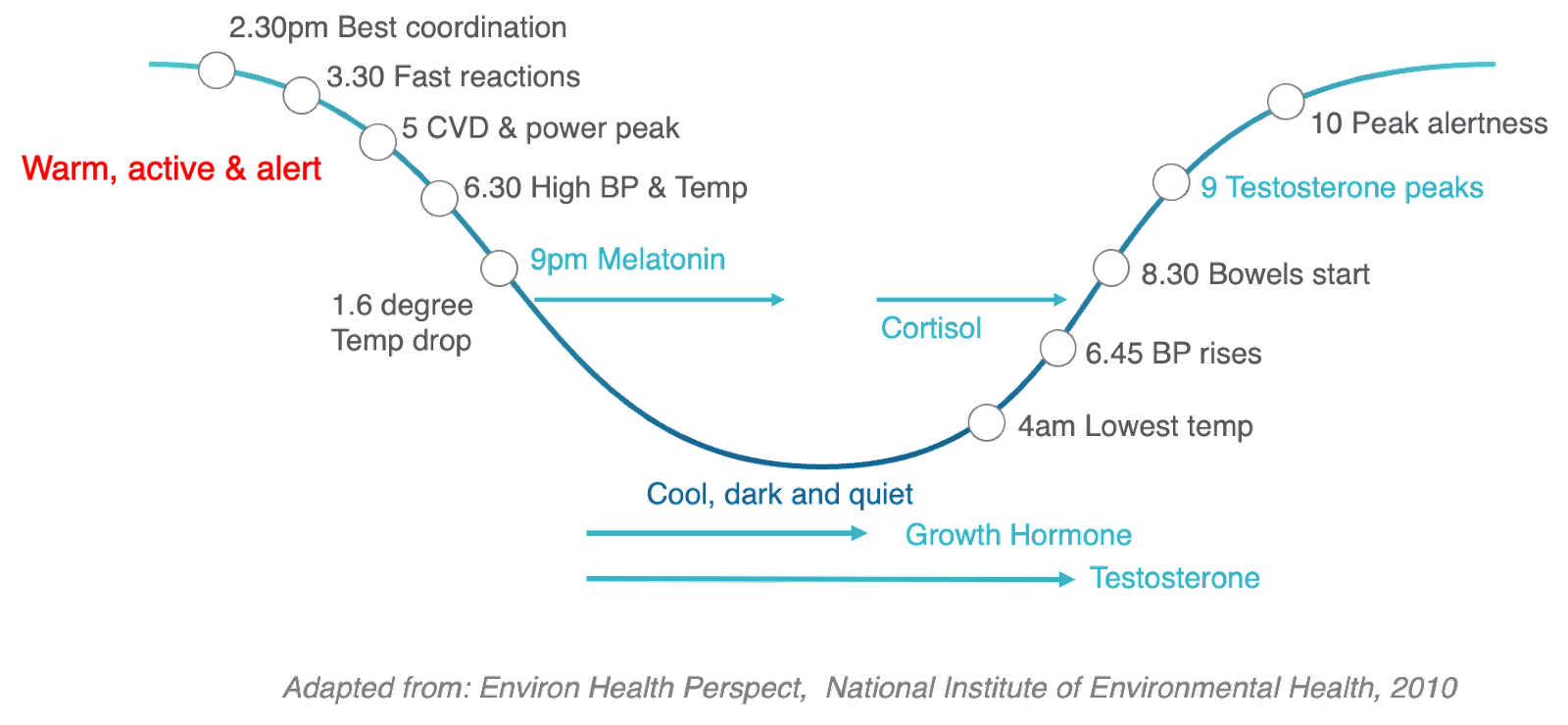
There are three elements to lock in your sleep rhythm. Sleep timing, sleep need, and sleep quality. There is no prescription that will work for everyone. For genetic, environmental, work, and family reasons, you will have to experiment. Once you find what works for you, lock it into a non-negotiable routine.
Table of Contents
Why is Sleep Timing Important?
Sleep timing is the best time to fall asleep and wake up each day. The circadian rhythm establishes the period during which sleep is most effective. When you sleep during the right hours for your personal clock, the quality of your sleep is optimised.
In humans, the circadian clock ranges from 24 hours to 25 hours. Sleep lags behind the 24-hour day-night cycle. There are morning people and night people: larks and owls. A lark tends to have a short clock, thus gets tired early in the evening and is ready to get up early in the morning. The owl, with a longer circadian clock, gets tired later and prefers to sleep in through sunrise.
There is a dynamic relationship between the day-night rhythm and the circadian clock. The primary rhythm is set by pre-sunrise blue light. Blue light reboots the active and alert period of your circadian rhythm through the supra-chiasmatic nucleus behind the eyes.
The best way to stabilise your clock to the day-night rhythm is to get 20 minutes of pre-sunrise blue light. This becomes the foundational rhythm for all other biological rhythms. Physical activity, light, coffee or tea, social activity, refined carbohydrates, and mental habits can also adjust your circadian clock, for better or for worse.
Blue light in the evening will wake you up right when you need to prepare to sleep. We come home to blue LED lighting, TV screens, laptops, and mobile devices. In addition, we socialise, drink, and eat late. Your clock gets pushed toward later sleep onset.
Sleep Phase Delay is a common sleep disorder that pushes us to sleep too late. We are perpetually jet-lagged and pressed into behaving more like an owl. There are established physical and mental health risks for the owl pattern. Recent studies show that there may be benefits to behaving more like a lark. This is certainly true for a lark and looks hopeful for the owl.
Beware of the weekend sleep-in. Roughly 30% of our clients sleep in later through the weekend to catch up on sleep. This is exaggerated in males under 30. After a busy and sleep-deprived week, sleeping into the day allows your circadian clock to “free-run” a couple of hours into the next day. The quality of this “extra” sleep is poor. It leaves you jetlagged through the next week.
The single most effective action to start is to wake up with or before dawn. Ideally, be outside in dawn blue light. This is especially true on weekends. The best blue light is just before sunrise.
Tracey, a participant on a course some years back, argued vehemently against losing the pleasure of a weekend sleep-in. Six months later, she grabbed my shoulder on a flight. She said: “When you explained the importance of wake-up times, I hated you. However, my husband and I have followed your plan. Our energy and our weekends have improved dramatically. Thank you”.
Next, you must take care of the cool-down period. If you rise early and press into the night with blue-light stimulation, you will sleep-deprived. Sadly, many ask me what they can do if they cannot stare at and fidget on a screen.
Our needs are different. I suggest that for 90 minutes before sleep, you read a book, play a game (cards, jigsaws, board games), meditate, write (in a journal or notepad, not via a screen), talk, take a walk, stretch, take a bath, or make time for intimacy.
It is essential to avoid blue light from screens before sleep. Replace LED lighting with soft yellow lighting. Eat dinner early. Limit alcohol.
Figure 1: Schematic illustration of the circadian cycle
During this period, you want to shift heat from your core to your periphery. The body releases melatonin in the evening to help cool your core temperature slightly. When exposed to blue light, melatonin is compromised. An easy walk outside or a cool bedroom will help. Aim for 18 degrees Celsius (about 65 degrees Fahrenheit) or cooler if possible. Intense exercise in the four hours before sleep is not recommended as it increases your core temperature. A cold shower or ice bath is helpful to some.
The final key is to apply your Tactical Calm techniques as you relax into sleep. Lie relaxed and flat on your back. Soften your face and chest. Breathe slowly, with your attention resting peacefully on the rise and fall of your belly.
Sleep Quantity Varies Per Person
Sleep need is widely agreed to be somewhere between six and a half and eight hours. It is based on the S-phase, the requirement for the body to sleep for a period of each day. If we sleep too little or too much, the prospect of a good life declines fast. Every species has its own sleep need. We need more than most mammals our size. Our overdeveloped brain demands it.
Experiment and study your own requirement. The natural way is to go camping, live by natural light for three days and see what happens. Many people now use sleep trackers. Buy or borrow one and watch your sleep for a fortnight.
When you review the data on a sleep tracker, you will notice that your body keeps hunting for a consistent sleep period. Pay attention to how you feel when you get it and when you miss or exceed it. In my case, the magic number is seven hours and twenty-two minutes. When I get it right, I feel refreshed. Too little or too much, and I feel sleepy or lethargic.
The Science Behind Sleep Quality
Once you have established the right timing and protected your sleep need, the next challenge is to get your ultradian rhythm working. Think of this as your sleep-depth rhythm. The ultradian rhythm is a 90-minute cycle that allows for roughly two cycles of deep sleep followed by two or three cycles of dream sleep. When you get this right, the rejuvenation effects of sleep are optimised.
Simple trackers will give you an immediate, rough indication of your deep, light, and dream sleep. For an adult, approximately 25% of sleep is in deep (slow-wave) sleep, 25% in dream or rapid eye movement (REM) sleep, and 50% in light sleep. Your teenager and child need more deep sleep as well as more sleep.
In the cycles of deep sleep that follow falling asleep, the brain and body are both quiet. Core body temperature drops. This is the time for the repair and rejuvenation of cells. Growth hormone and testosterone production activate. The cardiovascular system slows right down. Immunity improves.
In light sleep, the body is more active and in transition.
During the dream cycles through the early morning hours, the brain is active while the body is paralysed. If not, we might act out our dreams and sleepwalk. Dreaming sleep facilitates memory, learning, creativity, emotional intelligence, and recovery from traumatic experiences.
Figure 2: Schematic illustration of the sleep cycles and ultradian rhythm
Deep sleep is prioritised if you are deprived of sleep. The best deep sleep comes in the 10 p.m. to 2 a.m. period. As we get older, deep sleep is less effective. Deep sleep is an effective longevity tactic.
Late nights compromise your dream sleep cycles. To reduce mental illness and anxiety in young people, an obvious first step is to help them get to sleep earlier so that they complete their dream sleep. Quality sleep will reduce the suffering caused by attention disorders, anxiety, and depression. As parents, we have two key responsibilities to our children. First, get devices out of the bedrooms. Second, maintain a regular, blue-light-infused wake-up time.
There will be times when healthy sleep is disrupted. Accept this calmly and make it up quickly. The best solution, if you need to repay sleep debt, is to go to bed the next night an hour or so early. Eat early or eat less at night. Remove all devices, cool the room, and read a book. You may like to test a light surgical tape over the lips to prevent snoring and encourage nasal breathing.
Why You Should Stop Thinking in Bed
In my experience, about a third with sleep difficulty wreck sleep with unhelpful thinking. When you secure a good night’s sleep, there is no conscious thought. It is easy to let a storm of thoughts into your bed. Worry (repetitive thoughts about the future) will generate anxiety and destroy sleep. Rumination (repetitive thoughts about the past) will generate sadness or anger and destroy sleep.
Ban thinking from the bedroom. If thoughts arise, refocus on slow diaphragmatic breathing. Watch the rise and fall of your belly. Feel your body relax and dissolve on the exhalation. With a few weeks of practice, you will be amazed how your mind stops bothering you. Make it a habit and stay committed. Sleep can be very peaceful.
Finally, a short power nap of ninety seconds to fifteen minutes is another effective way to catch up on sleep. Ideally, the best time is just after lunch. Find a private, quiet, cool, and dark place. Set the alarm. Use your breathing to drop off more quickly. If sleep does not come, simply enjoy the rest.
In summary, these 10 tips will help you to improve your sleep:
Explore and track your sleep timing, need and quality.
Wake up and go outdoors for 20 minutes before sunrise.
Never sleep in. Never snooze.
When you wake, get out of bed.
Create a cool, quiet, yellow-light evening environment.
Avoid all screens for 90 minutes before sleep.
Let your body cool before sleep (maybe a cold shower or ice bath?)
Engage in slow diaphragmatic breathing practice.
Enjoy nature’s gift of deep, quality and unbroken sleep.
Be ruthless in forbidding thinking from your bed.
Sources:
Walker, Matthew, Why We Sleep, Penguin, 2107. A very popular and helpful overview of sleep science.
In today’s hyperconnected, hyperproductive workplace, stress has become a silent companion for many professionals. Particularly across Southeast Asia, where long working hours, back-to-back meetings, and a strong culture of high performance often blur the boundaries between ambition and burnout.
But where exactly does stress come from? Can we catch it before it catches us?
The Corporate Pressure Cooker
According to a 2024 Channel News Asia report, Singapore remains among the most overworked countries in the world, with 60% of employees reporting stress-related symptoms. In Malaysia, a 2023 study by JobStreet found that 42% of professionals felt emotionally exhausted due to work-related pressures. Similar trends are emerging in Indonesia, Thailand, and the Philippines, where rapid urbanisation and digital acceleration have made “busy” the default state.
At first, stress may feel like just another deadline to power through. But beneath the surface, unmanaged stress can lead to chronic fatigue, reduced creativity, absenteeism, and even physical illness. The World Health Organization (WHO) has gone as far as to classify burnout as an occupational phenomenon, not just a personal failing.
Mental Health and Work Are Closely Linked
A healthy work environment can be one of the greatest protectors of our mental well-being. It offers routine, purpose, social contact, and financial security. But when the environment turns toxic due to poor leadership, overwork, unclear expectations, or lack of support; it does the opposite.
Poor working conditions not only reduce productivity but directly damage mental health. According to WHO, 15% of working-age adults live with a mental disorder, and more than 12 billion working days are lost annually due to depression and anxiety.
Story from the Ground: Anita’s Wake-Up Call
Take Anita, a 38-year-old marketing lead in Manila. She loved her job but found herself waking up at 3 a.m. with racing thoughts. “I thought I was just being efficient,” she said. But when she started missing family dinners and crying after meetings, she realised something was off.
Her manager, trained in resilience and psychological safety; noticed the shift. Through a team check-in and a 1-on-1 conversation, Anita was encouraged to use her company’s mental health support programme and eventually took a resilience assessment. Within weeks, she began small shifts: mindfulness breaks, clearer task boundaries, and better sleep. Today, she leads with empathy, not urgency.
Three Signals of Workplace Stress to Watch
Physical Exhaustion: Frequent headaches, insomnia, or muscle tension.
Emotional Agitation: Irritability, detachment, or loss of joy in tasks.
Mental Fog: Struggling with focus, memory, or decision-making.
Catching Stress Early
Stress doesn’t have to break us. It can be an early-warning system if we’re willing to listen. Employers play a crucial role by fostering cultures of psychological safety, offering support systems, and building resilience at every level of the organisation.
If you’re a leader, ask yourself: 🟢 When was the last time I checked in; not on performance, but on the person? 🟢 Does my team feel safe to say, “I’m not okay” without fear of judgment?
As we approach World Mental Health Day on 10 October, let’s reflect on how we work; not just how much we work.
Only 16% of employers currently invest in adaptability and continuous-learning programmes, yet 26% of employees say adaptability is the top skill they need. That gap is where most organisational agility problems actually start.
Physical and mental agility share a biological root in the cerebellum, and both improve the same way: through deliberate, repeated practice, not talent alone.
Agile methodology’s most cited practice, the Scrum sprint, has quietly shifted toward much shorter cycles than most people assume, a genuinely useful lesson in how the field itself keeps adapting.
Through play, the lion cubs develop agility.
— David Attenborough, Dynasties
Agility used to describe physical dexterity alone: the footballer dodging a defender, the boxer ducking before a counterpunch, the gymnast sticking a landing after a full rotation. Move quickly, freely, and with coordination, and you’re agile. But the term applies just as directly to cognitive processing. Mental agility is the ability to think and understand new concepts quickly, and it’s every bit as trainable as its physical counterpart.
In a rapidly changing world, particularly around technology, both individuals and teams need this capacity in equal measure. The gap between how much organisations invest in it and how much employees say they need it is worth taking seriously in its own right.
The Investment Gap
McKinsey’s Talent Trends survey found that only 16% of employers currently invest in adaptability and continuous-learning programmes for their workforce, while 26% of employees identify adaptability as one of the skills they most need to develop. That’s not a small mismatch. It suggests a meaningful share of organisations are underprepared for exactly the kind of change their own people already sense is coming, and that the demand for genuine agility training is running well ahead of the supply most companies currently provide.
The Science of Agility
The cerebellum is responsible for physical coordination and complex movement, the part of the brain behind everything from running and dancing to typing and playing a video game. Mental agility draws on a related but distinct set of processes: primarily, the ability to synthesise new information into an existing knowledge framework efficiently. Staying mentally agile over a lifetime takes deliberate, ongoing practice, intentional curiosity, continued learning, and a habit of connecting new ideas to what you already know rather than treating them as isolated facts.
What Sport Teaches About Agility
An agile athlete reacts to obstacles and changing conditions in a genuinely unpredictable environment: a surfer adjusting stance mid-wave, a goalkeeper reacting to a shot that seems to appear from nowhere, a gymnast recovering balance mid-routine. None of this is just fitness and speed. Visual processing, perception, and accurate anticipation all matter as much as raw physical capability, brain and body working in sync rather than either one operating alone. The same underlying principles, reacting to change rather than resisting it, apply directly to anyone navigating a shifting professional environment, athlete or not.
Where Agile Methodology Actually Came From
The version of “agile” now common in business language originated in software development. In February 2001, seventeen software developers met in Snowbird, Utah, to discuss better ways of building software, solutions-focused collaboration designed to reduce wasted effort, boost productivity, and deliver results faster than existing methods allowed. Their conclusions became the Agile Manifesto, built around four core values: prioritising individuals and interactions over rigid processes and tools, working software over exhaustive documentation, customer collaboration over strict contract negotiation, and responding to change over following a fixed plan.
Scrum, one of the most widely adopted agile frameworks that emerged from this movement, operates on its own five core values: commitment, courage, focus, openness, and respect. In Scrum, teams work in fixed periods called sprints to deliver a defined slice of functionality, with brief daily check-ins to track progress and clear blockers along the way. Sprint length is a good example of the field’s own ongoing evolution: the Scrum Guide sets one month as the maximum allowed sprint length, but in current practice, most teams run considerably shorter cycles, commonly one to two weeks, since shorter sprints surface problems faster and shorten the feedback loop considerably. Even the methodology built around adaptability keeps adapting its own defaults over time.
This history originated in software, but the underlying approach transfers well beyond it. No business needs to copy Scrum exactly to benefit from the same core instinct: stay genuinely open-minded, and treat that openness as a practice for both individuals and teams, not a one-time mindset shift.
Agility in the Workplace: Real Benefits, Real Trade-offs
An agile team works at pace, collaborates fluidly, and produces quality results across varied conditions, whether some members work remotely while others sit in an office, without that variation becoming a genuine obstacle. Organisations that prioritise this tend to attract younger, skilled talent more easily, since flexibility and work-life balance rank highly for people currently entering the workforce, and an agile team tends to report higher morale and productivity as a direct result.
There are genuine trade-offs worth naming honestly. Moving too fast, prioritising agility over actual results, can produce lacklustre outcomes despite the appearance of speed. Teams sometimes attempt to adapt without the training or support structures that would make real adaptation possible. And learning new systems and practices, even genuinely better ones, tends to cost real productivity in the short term while the learning curve plays out. None of this argues against building agility. It argues for building it deliberately, with the training and support to back it, rather than assuming speed alone gets you there. Copying another company’s exact playbook rarely works either; the right approach tends to be specific to a given team’s actual constraints and goals.
How to Actually Build More Agility
1
Align on Basics First
Get everyone genuinely aligned on standard operating procedures and communication tools before attempting anything more ambitious. Streamlined collaboration depends on this groundwork being solid first.
2
Practise Patience, Not Just Speed
Rushing forward without reflection isn’t agility, it’s just haste. Genuine workplace agility develops the way any skill does, through sustained practice over real time, not overnight.
3
Stay Focused on Real Results
Agility sometimes means trading perfection for pace, and that’s a legitimate trade when the result is still genuinely good. Actively seek and act on feedback, and recognise that raw speed isn’t always the right response to a given situation.
4
Build Genuine Trust
Moving fast and adapting in real time requires trusting that colleagues are making sound calls without endless deliberation, and trusting your own judgement enough to act on it. Agility, at its core, requires faith in your own decisions and a genuine willingness to learn from the ones that don’t work out.
Agility isn’t a talent some people are simply born with. It’s a practice, physical and mental, built the same way any other skill compounds: through deliberate, repeated attempts, not a single decisive leap.