Women Illustration
Overview of the personalised Resilience Assessment Report

See how we measure Resilience and the detailed insights into individual strengths and growth areas.

Download Report

How to Be Resilient During a Crisis

  • In an acute crisis, your brain prioritises survival above all else. Securing basic needs comes first; everything else, including your usual values, can wait.
  • Collective crisis can genuinely bring people together, but the research is more mixed than the popular “we pull together” narrative suggests. Real psychological harm and real connection can both be true at once.
  • Resilience isn’t about avoiding hardship. It’s a specific, practisable set of responses, accepting what you can’t control, staying cognitively flexible, maintaining basic rhythms, that you can build deliberately.

In times of crisis, life can feel genuinely overwhelming. Uncertainty dominates, emotions run high, and survival becomes the priority. Feeling disoriented is a normal response, and it’s also possible to build real resilience, and even grow, through adversity.

Resilience is more than bouncing back. It’s learning to adapt, connect, and find genuine meaning. With practical tools and the right mindset, a crisis can become an occasion for real growth rather than just something to survive. Here’s how to stay resilient through one, and build a foundation for long-term strength.

Prioritise Survival First

When disaster strikes, survival is your brain’s primary focus. This is why the foundation of the values pyramid in Brad Hook’s book Start With Values is survival itself. Before you can genuinely focus on ideals like purpose or creativity, you need to secure immediate needs, safety, food, water, shelter. Briefly connecting to your values during acute distress can still help re-establish a sense of normality and purpose, even in a small way.

Acting out of alignment with your usual values during this time isn’t a failure. It’s genuinely human nature under real pressure.

Cultivate a Resilient Mindset

Mindset is a genuinely powerful tool for navigating crisis. Instead of asking “why is this happening to me?”, ask “what’s my next best move?” That single shift moves attention toward actionable steps rather than rumination, and reframing the crisis as an opportunity to learn, connect, and grow turns it into a real chance to strengthen character and relationships, rather than just something to endure.

Accept What You Can’t Control

One of the hardest lessons in any crisis is genuinely letting go of what’s outside your control. Acceptance and Commitment Therapy (ACT) teaches acknowledging painful realities honestly, without judgment, while focusing energy on what you can actually influence. Fighting the uncontrollable creates real, unnecessary stress; acceptance frees that same energy for meaningful action instead.

Lean Into Genuine Connection

Crisis often brings people together in real, tangible ways. Acts of kindness, shared struggle, and collective effort can build a genuine sense of purpose and belonging. It’s worth being honest about the fuller research here rather than repeating the popular version of it. Some studies have found short-term suicide rates dip during major collective crises, including wartime, likely tied to a temporary sense of shared purpose and belonging. But that’s a narrow finding about one specific indicator, not evidence that crisis is broadly good for mental health. Research examining the London Blitz specifically has found real, lasting psychological harm for many people exposed to it, and researchers at King’s College London have explicitly cautioned against the popular “Blitz spirit” narrative for understating the genuine mental health toll of that period. Connection during crisis is real and valuable. It doesn’t erase the real cost crisis exacts at the same time.

Normalise Your Emotional Responses

Grief, fear, and frustration are all genuinely normal during a crisis. You might cycle through emotions like denial, anger, or sadness, a pattern popularly described by the Kübler-Ross grief model. Current understanding treats these less as a fixed, linear sequence and more as a set of genuine emotional states people move through in their own order, sometimes revisiting earlier ones, which is worth knowing so you don’t judge your own process against an artificially rigid timeline. Recognising these feelings as a normal part of the process, whatever order they arrive in, helps you actually process them rather than fight them.

Build Genuine Cognitive Flexibility

Cognitive flexibility, the ability to genuinely adapt your thinking to new situations, is central to resilience. Instead of rigidly clinging to an old plan that no longer fits reality, keep asking “what’s my next best move?” This mindset supports navigating real uncertainty with clarity rather than forcing a plan that’s already stopped working.

Maintain Rhythms That Genuinely Support You

When routines are disrupted, sleep, nutrition, and movement are often the first things neglected. These small rhythms anchor you through real chaos, and sleep in particular is genuinely vital for mental clarity and emotional regulation, exactly the resources a crisis demands most.

Reframe Challenges as Genuine Opportunities

Crisis is genuinely painful, and it often reveals strengths you didn’t know you had. It can deepen relationships, test real adaptability, and teach lessons no comfortable period would have offered. Reframing adversity honestly as a chance to grow, without denying the real difficulty involved, is what builds the capacity to thrive through future challenges rather than merely survive them.

Plan for the Future

Resilience is about more than surviving today. It’s building a genuine foundation for whatever comes next. Reflect honestly on what actually helped you through this crisis, and consider how to fold those specific tools into everyday life well before the next one arrives.

Practical Steps for Each Stage

Assess and Act on Immediate Needs

Identify the genuine essentials, shelter, resources, safety. Reach out for help, tap into community resources, or ask loved ones for real support before worrying about anything longer-term.

Reframe and Ask the Right Question

Write down one genuine way this crisis could help you grow. Then ask yourself directly: what’s one small, helpful step I can take right now?

Separate What You Can and Can’t Control

Write two lists: “What I Can Control” and “What I Cannot Control.” Redirect your actual attention to the first. Practise grounding, deep breathing or mindfulness, to help centre your thoughts.

Reach Out and Collaborate

Connect with loved ones or neighbours; simple acts like listening or offering help genuinely foster connection. Join community efforts or volunteer where you can. Helping others often strengthens your own resilience in return.

Make Space for Genuine Feeling

Journaling or talking honestly with someone you trust can be genuinely cathartic. Acknowledge what you’ve actually lost without dwelling in it indefinitely.

Simplify Your Basic Habits

Aim for one genuinely nourishing meal, 15 minutes of movement, and short periods of real rest if sleep is difficult. Create small, predictable moments in your day, morning stretches, evening reflection, that give the day some real shape.

Sometimes you’re directly affected by a crisis; sometimes you watch it unfold from a genuine distance, which brings its own distinct challenges, survivor’s guilt among them, alongside more indirect, practical effects.

Resilience isn’t about avoiding hardship. It’s about adapting, learning, and finding genuine purpose in the face of it. Take it one step at a time. You’ve got this.

Choosing a Workplace Wellbeing App: What to Actually Look For

  • The digital wellbeing app market consolidates fast. Two once-separate major players, Ginger and Virgin Pulse, have each merged and rebranded since 2023, into Headspace Care and Personify Health respectively.
  • Rather than chasing a list of named products, the more durable approach is choosing based on category: mindfulness-building, clinical mental healthcare access, self-guided skill-building, or comprehensive analytics platforms each solve a different problem.
  • A well-designed programme in one 2015 study improved attendance, lowered health risk, and increased every measured productivity metric over two years, evidence that the investment case predates any specific app.

Employees increasingly weigh work-life balance and genuine wellbeing alongside salary when deciding where to work, while anxiety, stress, and burnout keep climbing in parallel. A NIOSH survey found 40% of workers described their job as very or extremely stressful, a figure that predates and has outlasted any single news cycle. Teams that are genuinely engaged and well tend to be more productive, which is exactly why enabling people to handle a complex, fast-moving workload without burning out has become a real competitive question for employers, not just a wellness nicety.

Why This Actually Matters for the Business

Employee wellbeing used to mean physical safety alone, preventing injury and accident. Mental wellbeing was largely absent from the agenda. That’s changed, and the data backs the shift up directly. A study led by Brent Hamar, published in the Journal of Occupational and Environmental Medicine, tracked a medium-sized firm implementing a wellbeing improvement strategy over two years and found employees showed up more reliably, carried lower health risk, and, notably, every measured productivity metric improved. That case for investment doesn’t depend on any specific app or platform. It’s a case for taking the category seriously at all.

Why a Named List Goes Stale Fast

The digital wellbeing market consolidates quickly, more quickly than most “best of” lists account for. Ginger, once a well-known standalone provider of on-demand mental healthcare, merged with Headspace in 2021 and has since been fully absorbed and rebranded as Headspace Care, the same company, not a separate alternative. Separately, Virgin Pulse merged with benefits platform HealthComp and rebranded entirely as Personify Health from January 2025. A workplace wellbeing list built around specific product names risks recommending a company that no longer exists under that name within a couple of years. What holds up instead is understanding the categories these tools fall into and what each one is actually built to solve.

The Categories Worth Understanding

1

Mindfulness and Meditation Apps

Built around guided meditation, breathing, and sleep content, this category is preventative rather than clinical. A workplace mindfulness intervention study led by Wendy Kersemaekers found organisations that built a genuine culture of practising mindfulness saw increased productivity, wellbeing, and cooperation alongside reduced perceived stress. This category won’t suit every employee in a diverse workforce, but the evidence for it at an organisational level is solid.

2

On-Demand Clinical Access

For more serious, ongoing concerns, mindfulness alone isn’t sufficient. With roughly one in five people experiencing a mental illness in a given year, this category connects employees discreetly to coaches, therapists, or psychiatric care, often with tiered levels of support depending on need. Research into app-based clinical interventions in the workplace has found employees reporting lower stress and higher productivity that held up even six weeks after the programme ended, evidence the effect isn’t just a short-term novelty.

3

Self-Guided Skill-Building

Rather than connecting users to a professional, this category walks people through structured activities grounded in cognitive behavioural therapy, positive psychology, and psychoeducation, often organised into goal-based programmes a user works through at their own pace. It’s a strong option for employees not yet ready to talk to a person, and a genuinely evidence-backed alternative rather than a lesser one.

4

Comprehensive Analytics and Benefits Platforms

Aimed squarely at larger enterprises, this category combines coaching, benefits navigation, wellness education, and organisational-level analytics into a single platform, letting employers track engagement and wellbeing trends across the whole company. It’s the heaviest-weight option, best suited to organisations that already run comprehensive benefits schemes and want one system tying it together, rather than a starting point for a smaller team.

5

Resilience-Specific Diagnostic and Coaching Tools

A narrower but distinct category, purpose-built around measuring and building resilience specifically, typically combining a diagnostic assessment with micro-learning content and brief coaching sessions rather than general wellness content. Resilience Institute’s own app falls here: a digitised version of a framework built over two decades of organisational work, measuring resilience across 60 factors and pairing the diagnostic with ongoing coaching content. It’s designed to complement, not replace, in-person workshops and training.

Choosing Between Them

An app-based programme over a traditional Employee Assistance Programme gives employees more privacy and freedom to engage at their own pace, part of why EAPs were historically underused despite being available; workplace stigma kept people away from an in-person referral in a way a private app on their own phone doesn’t trigger. No single category is inherently superior. The right choice depends on what problem you’re actually solving: prevention and culture-building points toward mindfulness tools, acute or ongoing clinical need points toward on-demand clinical access, self-directed employees might prefer skill-building content, and larger organisations wanting a unified system should look at comprehensive platforms. Whichever category fits, verify the current company name and offering directly before committing, given how quickly this market continues to consolidate.

The category you choose will still make sense in five years. The specific brand name might not. Choose based on the problem you’re solving, then verify who’s currently solving it.

Burnout in Healthcare: What the Current Data Shows and What Actually Helps

  • Healthcare burnout didn’t end when pandemic-era crisis conditions eased. Chronic understaffing and rising demand keep the underlying risk factors firmly in place.
  • In Singapore specifically, close to 78% of mental health professionals met burnout thresholds in a recent workforce survey, higher than many other healthcare sub-sectors.
  • Individual interventions like mindfulness-based stress reduction have real evidence behind them, but the strongest research points to organisational change as the intervention that actually moves the needle.

Burnout as a concept was introduced by American psychoanalyst Herbert Freudenberger, who first applied it to the workplace stress he observed in physicians, nurses, and pharmacists. The World Health Organization formally classified it in 2019 as an occupational phenomenon tied specifically to the workplace, not a broader clinical diagnosis. While there’s genuine debate among researchers about exactly how to define and measure it, most people who’ve worked in a demanding role recognise the symptoms when they see them.

What Burnout Actually Looks Like

Burnout typically shows up as three interlocking features: cynicism and negativism, emotional exhaustion, and declining professional productivity. These are frequently accompanied by physical symptoms, gastrointestinal issues, headaches, chronic fatigue, and sometimes an increased risk of substance use as a coping mechanism. Recognising these signals early is the first real step toward addressing whether work stress has moved from manageable to genuinely harmful.

The Risk Factors

Lack of control and autonomy. The less flexibility someone has over their own schedule, tasks, and decisions, the more stressful the role becomes. Emergency and acute care staff, with limited control over hours and assignments, are particularly exposed.

High job demands. Mental health is hit hardest when negative emotion combines with an unmanageable workload or a psychologically unsafe environment. Long hours and intensive tasks, without a genuine counterbalance of recovery, push people into a sustained state of anxiety and fatigue.

Lack of support. Burned-out healthcare workers consistently report feeling disconnected from colleagues and supervisors. Isolation and a lack of safe connection at work compound burnout risk considerably.

Individual vulnerability factors. Research including a study of nearly 300 Indian nurses found neuroticism increases vulnerability to stress and burnout specifically, and prior depression or PTSD have also been identified as precursors.

The Trend Line Is Still Moving in the Wrong Direction

The scale has been rising for well over a decade. A 2019 US National Academy of Medicine report found up to 60% of residents and medical students, and up to 54% of nurses, experiencing burnout and work-related stress, up sharply from roughly 46% of medical staff in 2011. The pandemic pushed prevalence to genuine crisis levels in acute settings, but the underlying pressure driving it, chronic understaffing against rising demand, has not eased in the years since. Population growth, an ageing patient base, and workforce shortages continue to place more demand on fewer available clinicians in most healthcare systems.

In Singapore specifically, a 2022 workforce survey found close to 78% of mental health professionals met clinical burnout thresholds, one of the higher rates recorded across any local healthcare sub-sector. Singapore’s broader healthcare system has also flagged workforce shortage as a structural, ongoing pressure rather than a temporary post-pandemic bottleneck, consistent with the World Health Organization’s global projection of a shortfall approaching 15 million health workers by 2030.

Why It Matters Beyond the Individual

Burnout’s most visible personal cost is decreased productivity, sometimes accompanied by substance use, strained relationships, or in the most severe cases, suicidal ideation. Rising absenteeism and early retirement among healthcare staff jeopardises continuity of patient care directly, and recruitment costs climb as turnover increases to fill the resulting gaps.

The organisational and patient-level stakes are just as real. In healthcare specifically, individual job performance is tightly linked to patient outcomes: fatigued, psychologically depleted staff are measurably more prone to medical error and less likely to consistently follow safety protocol, which carries both clinical and legal risk for the institution.

What Actually Helps: Individual Interventions

Individual-level approaches matter, but they work best paired with organisational change rather than as a substitute for it. Palliative care physician Dr. Balfour Mount’s concept of “healing connections” found that isolated, disconnected patients experience disproportionately higher anguish, and the same principle extends to clinicians: deliberately investing in relationships, with family, friends, and colleagues, has a genuine protective effect. Mindfulness-Based Stress Reduction, an eight-week structured programme, has consistent evidence behind it for reducing burnout specifically, largely through building the capacity to reappraise stressful situations rather than simply enduring them.

What Actually Helps: Organisational Interventions

Addressing burnout at the individual level alone consistently falls short. Physician-researchers Tait Shanafelt and John Noseworthy’s widely cited nine-step framework for healthcare organisations remains one of the most evidence-backed roadmaps available:

  1. Measure staff wellbeing regularly and treat burnout as a real, trackable problem, not an anecdotal complaint.
  2. Actively reduce toxic work relationships by developing healthier leadership behaviour.
  3. Target interventions to the specific problem in each department rather than applying generic, organisation-wide fixes.
  4. Build genuine community and constructive dialogue at work.
  5. Use incentives that drive collective effort toward shared goals, not just individual output.
  6. Align organisational values with an actually healthy, collaborative culture, not just a stated one.
  7. Promote genuine work-life balance and flexible, family-friendly scheduling.
  8. Provide real opportunities for self-care, emotion regulation, and resilience-building, not just a wellness poster.
  9. Fund and act on evidence-based research within the organisation itself, rather than relying solely on external best practice.

A tenth, often-overlooked step matters just as much: actively supporting colleagues returning to work after burnout, so reintegration happens on genuinely sustainable terms rather than a quiet return to the same conditions that caused it.

When healthcare workers burn out, it’s never contained to them alone. Colleagues, families, and patients absorb the cost too, which is exactly why the fix has to operate at the organisational level, not just the individual one.

Singapore’s Safety Record Is Excellent. Psychosocial Risk Is the Next Frontier.

  • Singapore’s workplace fatality rate fell to a record low of 0.96 per 100,000 workers in 2025, placing it among the safest workplaces globally, alongside the Netherlands, UK, Germany, and Sweden.
  • Globally, the ILO estimates psychosocial risk factors alone, excessive workload, job insecurity, long hours, and lack of autonomy, contribute to roughly 840,000 deaths a year from cardiovascular disease and work-related mental health conditions.
  • Physical safety and psychological safety are now governed by parallel international frameworks (ISO 45001 and ISO 45003), but most organisations, even ones with excellent physical safety records, are only beginning to manage the second one with the same rigour as the first.

Singapore’s workplaces are, by the numbers, among the safest in the world. The Ministry of Manpower’s 2025 report recorded a workplace fatal injury rate of 0.96 per 100,000 workers, an all-time low, putting Singapore in the same bracket as the Netherlands, the UK, Germany, and Sweden, countries that have spent decades building this kind of track record.

That’s a genuine achievement, and worth sitting with for a moment before moving to the harder question: what does “safety and health at work” actually cover, and is Singapore’s excellent physical record matched by an equally mature approach to the psychological side of the same equation?

Why This Question Matters Right Now

The International Labour Organization has marked 28 April as World Day for Safety and Health at Work since 2003, growing out of Workers’ Memorial Day, a tradition North American trade unions started in 1989 to commemorate workers killed or injured on the job. In 2022, the ILO amended its Declaration on Fundamental Principles and Rights at Work to formally include “a safe and healthy working environment” as a fundamental right, not just good practice.

The ILO’s own estimates put the scale of the problem in stark terms: roughly 2.93 million workers die each year from work-related causes, the majority from occupational diseases rather than accidents. What’s changed in recent years is which half of that problem is getting the most attention. The ILO’s most recent global campaign is built specifically around psychosocial risk, treating factors like excessive workload, job insecurity, and lack of autonomy as workplace hazards in the same category as physical, chemical, and biological ones, not as a separate, softer concern.

The ILO estimates these psychosocial factors contribute to around 840,000 deaths annually from cardiovascular disease and work-related mental health conditions. Around 35% of workers globally exceed 48 working hours a week. This isn’t a fringe issue being elevated for awareness purposes. It’s being formally recognised as core occupational risk, on the same footing as the hazards Singapore has already gotten very good at managing.

Two Standards, One Gap

Most organisations with a mature safety record are already operating under ISO 45001, the international standard for occupational health and safety management. Since 2021, there’s been a companion standard specifically for the psychological side: ISO 45003, the first global guideline for managing psychosocial risk within an existing occupational health and safety system.

It’s a guideline rather than a certifiable standard, which means adoption is uneven, but the framework itself is instructive. It treats psychosocial hazards, excessive workload, poor role clarity, workplace bullying, lack of autonomy, the same way ISO 45001 treats a faulty guardrail: something to be identified, assessed, and managed systematically, not something to be addressed only after it produces a resignation or a complaint.

There’s also a well-documented link between the two domains that’s easy to miss. Musculoskeletal disorders, the back and joint pain that shows up in most physical safety statistics, are consistently correlated with psychological strain and the quality of relationships within a team, not just posture or repetitive movement. Treating physical and psychological safety as two unrelated reporting lines misses how often they’re actually the same underlying problem, showing up in different places.

Four Places Organisations Get This Wrong

A closer look at how safety and health functions actually operate, drawing on RI’s own consulting work in this area alongside the wider research, points to four recurring gaps.

1

The Slogan Substitutes for the Strategy

“Safety first” on the wall and safety integrated into how decisions actually get made are two different things. When an organisation keeps needing to reassert that health and safety matter, that’s often a sign the function hasn’t been built into the operating model, it’s being asserted instead of demonstrated.

2

The Metrics Only Look Backward

Counting past incidents tells you what already went wrong, not what’s about to. Leading indicators, like ISO 45003’s structured psychosocial hazard assessments, employee perception of whether leadership genuinely cares about their wellbeing, and the quality of safety feedback given and received, predict problems before they become injuries or exits. Singapore’s own steady improvement in physical safety metrics came from exactly this kind of proactive measurement, not from counting fatalities after the fact.

3

The Function Sits Too Low to Matter

Wherever health and safety formally sits in the org chart, HR, Operations, Quality, its seniority signals how seriously it’s actually taken. A function several layers removed from executive decision-making rarely has the standing to influence the decisions that create risk in the first place.

4

The Wrong Skillset Is in the Role

Physical safety expertise and psychosocial risk management draw on genuinely different skills, compliance and engineering rigour on one side, organisational psychology and change management on the other. Many safety functions are still resourced for the first problem while being asked, increasingly, to solve the second one too.

Where to Actually Start

None of this requires solving everything at once. A workable starting sequence looks like this: collect real data on both physical and psychosocial risk rather than relying on impressions, listen directly to line managers and employees rather than only to leadership, resist the urge to fix every minor issue at the expense of the serious ones, and reassess regularly rather than treating any policy as finished. Organisations that already do the first half of this well for physical safety, and Singapore’s national data suggests many do, are usually closer to doing it well for psychosocial risk than they assume. The frameworks and habits transfer. They just haven’t been pointed at the second problem yet.

A record-low injury rate is a genuine achievement. It’s also not the finish line. The organisations that get this right treat psychological safety as seriously, and measure it as rigorously, as they already treat a guardrail or a hard hat.

A Practical Guide to Personal and Organisational Agility

  • Only 16% of employers currently invest in adaptability and continuous-learning programmes, yet 26% of employees say adaptability is the top skill they need. That gap is where most organisational agility problems actually start.
  • Physical and mental agility share a biological root in the cerebellum, and both improve the same way: through deliberate, repeated practice, not talent alone.
  • Agile methodology’s most cited practice, the Scrum sprint, has quietly shifted toward much shorter cycles than most people assume, a genuinely useful lesson in how the field itself keeps adapting.

Through play, the lion cubs develop agility.

— David Attenborough, Dynasties

Agility used to describe physical dexterity alone: the footballer dodging a defender, the boxer ducking before a counterpunch, the gymnast sticking a landing after a full rotation. Move quickly, freely, and with coordination, and you’re agile. But the term applies just as directly to cognitive processing. Mental agility is the ability to think and understand new concepts quickly, and it’s every bit as trainable as its physical counterpart.

In a rapidly changing world, particularly around technology, both individuals and teams need this capacity in equal measure. The gap between how much organisations invest in it and how much employees say they need it is worth taking seriously in its own right.

The Investment Gap

McKinsey’s Talent Trends survey found that only 16% of employers currently invest in adaptability and continuous-learning programmes for their workforce, while 26% of employees identify adaptability as one of the skills they most need to develop. That’s not a small mismatch. It suggests a meaningful share of organisations are underprepared for exactly the kind of change their own people already sense is coming, and that the demand for genuine agility training is running well ahead of the supply most companies currently provide.

The Science of Agility

The cerebellum is responsible for physical coordination and complex movement, the part of the brain behind everything from running and dancing to typing and playing a video game. Mental agility draws on a related but distinct set of processes: primarily, the ability to synthesise new information into an existing knowledge framework efficiently. Staying mentally agile over a lifetime takes deliberate, ongoing practice, intentional curiosity, continued learning, and a habit of connecting new ideas to what you already know rather than treating them as isolated facts.

What Sport Teaches About Agility

An agile athlete reacts to obstacles and changing conditions in a genuinely unpredictable environment: a surfer adjusting stance mid-wave, a goalkeeper reacting to a shot that seems to appear from nowhere, a gymnast recovering balance mid-routine. None of this is just fitness and speed. Visual processing, perception, and accurate anticipation all matter as much as raw physical capability, brain and body working in sync rather than either one operating alone. The same underlying principles, reacting to change rather than resisting it, apply directly to anyone navigating a shifting professional environment, athlete or not.

Where Agile Methodology Actually Came From

The version of “agile” now common in business language originated in software development. In February 2001, seventeen software developers met in Snowbird, Utah, to discuss better ways of building software, solutions-focused collaboration designed to reduce wasted effort, boost productivity, and deliver results faster than existing methods allowed. Their conclusions became the Agile Manifesto, built around four core values: prioritising individuals and interactions over rigid processes and tools, working software over exhaustive documentation, customer collaboration over strict contract negotiation, and responding to change over following a fixed plan.

Scrum, one of the most widely adopted agile frameworks that emerged from this movement, operates on its own five core values: commitment, courage, focus, openness, and respect. In Scrum, teams work in fixed periods called sprints to deliver a defined slice of functionality, with brief daily check-ins to track progress and clear blockers along the way. Sprint length is a good example of the field’s own ongoing evolution: the Scrum Guide sets one month as the maximum allowed sprint length, but in current practice, most teams run considerably shorter cycles, commonly one to two weeks, since shorter sprints surface problems faster and shorten the feedback loop considerably. Even the methodology built around adaptability keeps adapting its own defaults over time.

This history originated in software, but the underlying approach transfers well beyond it. No business needs to copy Scrum exactly to benefit from the same core instinct: stay genuinely open-minded, and treat that openness as a practice for both individuals and teams, not a one-time mindset shift.

Agility in the Workplace: Real Benefits, Real Trade-offs

An agile team works at pace, collaborates fluidly, and produces quality results across varied conditions, whether some members work remotely while others sit in an office, without that variation becoming a genuine obstacle. Organisations that prioritise this tend to attract younger, skilled talent more easily, since flexibility and work-life balance rank highly for people currently entering the workforce, and an agile team tends to report higher morale and productivity as a direct result.

There are genuine trade-offs worth naming honestly. Moving too fast, prioritising agility over actual results, can produce lacklustre outcomes despite the appearance of speed. Teams sometimes attempt to adapt without the training or support structures that would make real adaptation possible. And learning new systems and practices, even genuinely better ones, tends to cost real productivity in the short term while the learning curve plays out. None of this argues against building agility. It argues for building it deliberately, with the training and support to back it, rather than assuming speed alone gets you there. Copying another company’s exact playbook rarely works either; the right approach tends to be specific to a given team’s actual constraints and goals.

How to Actually Build More Agility

1

Align on Basics First

Get everyone genuinely aligned on standard operating procedures and communication tools before attempting anything more ambitious. Streamlined collaboration depends on this groundwork being solid first.

2

Practise Patience, Not Just Speed

Rushing forward without reflection isn’t agility, it’s just haste. Genuine workplace agility develops the way any skill does, through sustained practice over real time, not overnight.

3

Stay Focused on Real Results

Agility sometimes means trading perfection for pace, and that’s a legitimate trade when the result is still genuinely good. Actively seek and act on feedback, and recognise that raw speed isn’t always the right response to a given situation.

4

Build Genuine Trust

Moving fast and adapting in real time requires trusting that colleagues are making sound calls without endless deliberation, and trusting your own judgement enough to act on it. Agility, at its core, requires faith in your own decisions and a genuine willingness to learn from the ones that don’t work out.

Agility isn’t a talent some people are simply born with. It’s a practice, physical and mental, built the same way any other skill compounds: through deliberate, repeated attempts, not a single decisive leap.

A Guide to Positivity at Work

What is positivity?

Positivity at work is more than a personal mindset or attitude. It is part of a bigger movement that influences the individual worker, how the workforce interacts with one another, and how workers align with the organisational goals and culture at large.

Positive workplace cultures ensure beneficial change that ripples from leaders all the way down to individual employees and vice versa. These types of cultures build empathy, optimism, and resilience —  all keys to success. Building a positive workplace culture demands an understanding of the dynamics of the workplace from the top and bottom and the people within it.

From the top, leaders create values, experiences, and rules of engagement that trickle down the organisation to the employees. Employees also hold their own attitudes, beliefs, and perceptions that provide feedback to leadership and influence the overall workplace culture.

Positive vs negative workplace cultures

Do you feel listened to, supported, and included at work? Or do you feel unheard, neglected, and boxed in? The quality of the culture in the workplace plays a significant role not only in overall wellness but also in performance.

In broad terms, workplace cultures fall somewhere between positive and negative. A 2022 report on Workplace Mental Health and Well-Being by the United States Surgeon General reveals that workplace culture has a significant impact on employee well-being, productivity, and organisational performance.

Negative or toxic workplaces can result in a loss of worker productivity, performance, and overall quality of work. On the other side of the coin, a positive work culture can boost engagement and innovation.

Put simply, work is no longer just work. The cultures that form in the workplace have just as much to say about a company’s bottom line as the numbers.

Modern workplace culture

Today, the workplace is more than a space where people gather — either in person, online, or both — to perform their jobs. During the pandemic and the return to the office, I spent time reporting on the work-life. Amid the many interviews of academic experts, industry leaders, and workers, a pattern emerged.

The rapidly changing landscape, from hybrid work to the Great Resignation, caused employers to shift their views on workplace culture radically. While employers strived to meet goals, employees sought a more balanced work-home life.

For example, 2022 research by Ernst & Young found that 54% of workers in the United States left a job due to their boss’ lack of empathy when it came to issues at work. The research also found that 49% of workers left their job because of inadequate sensitivity to home life stress.

While some innovative leaders were onto this approach long before, the idea that the workplace should equally focus on employee expectations came to the forefront. The results have created a more dynamic workplace culture predicated on creating positive workplace cultures and mitigating negative influences.

Toxic positivity

Taken at face value, positivity is simply maintaining a positive perspective on life — the good, the bad, the ugly, and the beautiful. At its extreme, positivity can seem out of touch with reality. Simply putting on the don’t worry, be happy blinders can neglect the challenges and uncertainties that people face in everyday life.

Tabitha Kirkland, a psychologist and associate teaching professor at the University of Washington’s Department of Psychology, says that toxic positivity is devoid of empathy and neglects to recognize the negative things in life. This approach can make people feel invalidated and not listened to, which is critical to employee engagement, performance, and the financial success of the company.

A 2021 survey by the Workforce Institute found that nearly 3 out of 4 employees say that they feel more engaged and perform better at work when they feel heard. This also impacts the overall financial performance of the company, as the survey also found that employees in companies that financially outperform others in their industry feel heard more by a margin of 26%.

Taking an extreme approach to positivity can actually backfire.

Positive leadership and optimism

Positivity starts with a form of leadership approach that plays to people’s skills, gives recognition and encouragement to others, and maintains an optimistic outlook. Positive leadership has been correlated with better employee engagement, optimism, and performance.

Sticking to strengths

Renowned Austrian-American management consultant Peter Drucker believed that individuals could create more impact at work by focusing on developing the skills they excel at. Instead of spending time trying to make a well-rounded skill set, Drucker believed that sharpening the tip of the spear and strategically cultivating one’s strengths and learning styles would serve an individual the best.

Leaders and managers can take a page from Drucker’s book by identifying team members’ skills and enabling them to work within that range. This does not have to be an entirely individual pursuit.

For example, if a project requires data analysis, but must ultimately be presented at a higher level meeting, assemble a team of analysts and designers to work together to find the trends and then present them in a digestible form. The push and pull dynamics can create something more powerful than numbers or graphics would alone.

Recognition and encouragement

Encouragement and recognition are two key spices in the recipe of healthy conversations. Gallup notes that simply recognizing employees not only positively impact engagement and productivity, it also can help keep employees around for longer. The study found that employees who do not feel recognized at work are twice as likely to quit.

Beyond the individual, recognition also impacts teams by painting a transparent picture of what leadership thinks success should look like. But sometimes conversations have to steer towards more difficult subjects, like when things need improvement.

When it comes to difficult conversations, delivering feedback requires a delicate approach. Instead of using harsh criticism, reframing the conversation to focus on what went well and how to pursue future success can go a long way in making a positive impact on the team.

Research on team conversations indicates that high-performing teams have 6 positive interactions for every negative one, while low-performing teams only have 1 positive interaction for every 20 negative ones. While these numbers may seem extreme, there is a potential explanation for why positive interactions dominate better-performing teams.

Optimism and emotional contagion

If positivity is part of the larger cultural framework of an organisation, then optimism certainly plays a role. The American Psychological Association defines optimism as “hopefulness: the attitude that good things will happen and that people’s wishes or aims will ultimately be fulfilled.”

Optimistic leaders provide a necessary positive emotional contribution to the team. They find solutions to problems, help create a vision for the future, and inspire others to reach that goal by reinforcing the positives. Sound familiar? A leader who practices recognition and encouragement is already building an optimistic culture.

This optimism can positively impact teams through emotional contagion. Coined by Sigal Barsade, Professor of Management at Wharton School of the University of Pennsylvania, emotional contagion is the ripple effect that occurs as emotions spread among individuals and groups. Barsade’s innovative research found that positive emotional contagion helped people work together, limited conflict, and boosted performance.

So when optimism becomes the attitude and outlook in the workplace, positive emotions can flow. This is critical because if the team is optimistic, then individuals can begin to harbour a personal sense of optimism — which may be even more valuable.

A 2022 study by Leadership IQ of over 11,000 employees found that while managers that give recognition have a positive impact, employees with a personal sense of optimism are more engaged. In fact, employees higher in self-optimism are more than twice as likely to feel inspired to try their best at work.

The ripple effect of optimism starts at the top but has the potential to create the biggest impact on employees when it is felt at a personal level. The Leadership IQ study also identified another major component of an employee’s inspiration and engagement at work: resilience.

Resilience training, tools, and techniques

Resilience is the use of flexibility to adapt to change and challenges, says the American Psychological Association. Even more critical, resilience skills can be trained. This is important because resilience not only factors into worker engagement, but it can also account for 25% of an employee’s inspiration at work.

Measuring Resilience

The Resilience Institute conducted a global study on resilience levels that spanned from 2018-2021. When the pandemic hit, resilience levels dropped globally. However, people began to bounce back as they adapted to the rapidly changing world. This bounce factor enables people to adapt in the face of change and challenges.

During the pandemic, people have bounced back by learning to connect in new ways during lockdowns, learning to cope with their mental health, and learning how to get better sleep. In fact, the Resilience Insitute’s 2022 Global Report found that sleep is the most important factor for developing resilience.

We measure resilience through the Resilience Diagnostics assessment. Using key psychometrics, the Resilience Diagnostic assessment uses 60 questions that measure specific factors that support or undermine resilience. Individuals and the entire organisation can use the tool via the web or mobile app to view the factors that promote your resilience or hinder it. This is known as the Resilience Ratio.

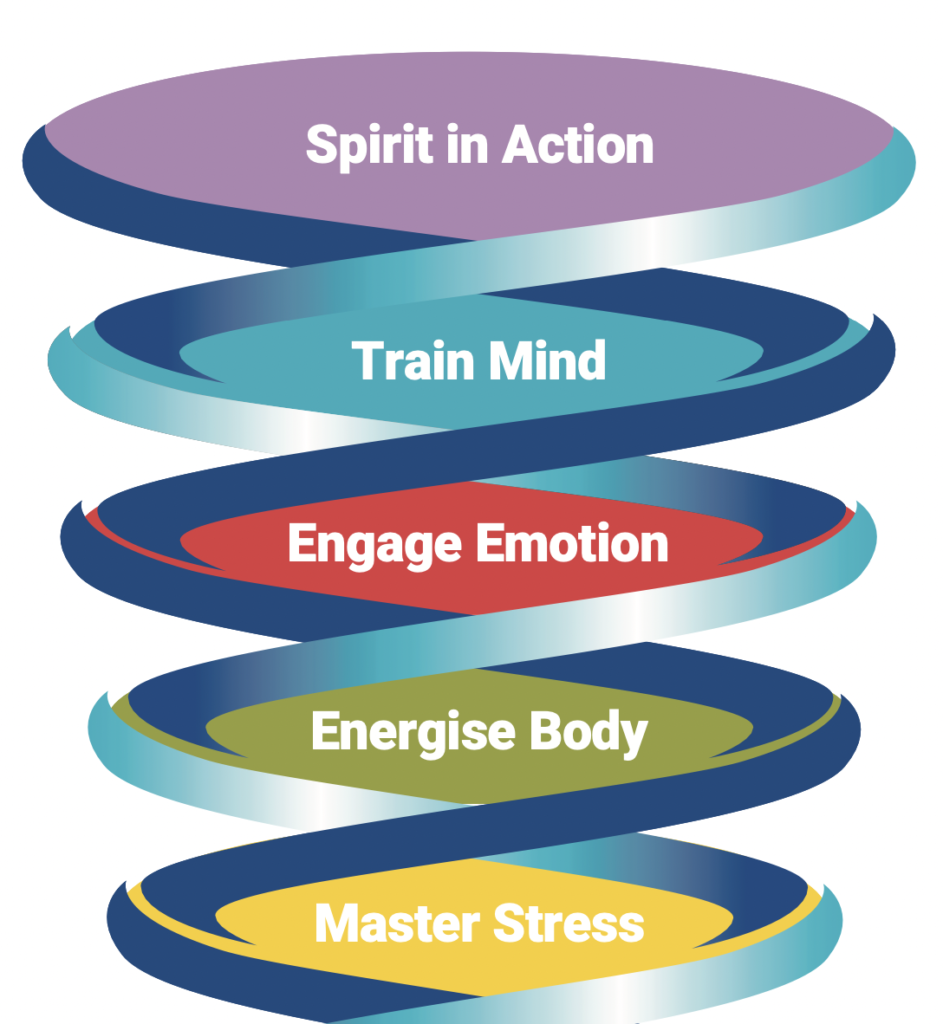
The Resilience Spiral

This visual tool represents the 11 main categories that make up different parts of the 60 questions in the Resilience Diagnostics assessment. Completing the questionnaire provides the user with a map of strengths and risks and practical recommendations to move up the spiral.

The top half of the Resilience Spiral includes the following categories:

  • Spirit in Action
  • Train Mind
  • Engage Emotion
  • Energise Body
  • Master Stress

The upper half helps develop resilience and enables growth, connection, and flow. At the top of the spiral sits Spirit in Action, which represents peak performance. Next sits Train Mind, which relies on the fact that training the brain can combat the effects of ageing and performance.

Engage Emotion uses awareness to harshness the passion and creativity of emotions. The mind and body are intimately connected — energising the body sets the tone for the rest of the spiral. At the base sits Master Stress. Stress is the teetering point between the top and the bottom of the spiral because stress can rule your world when left unmanaged.

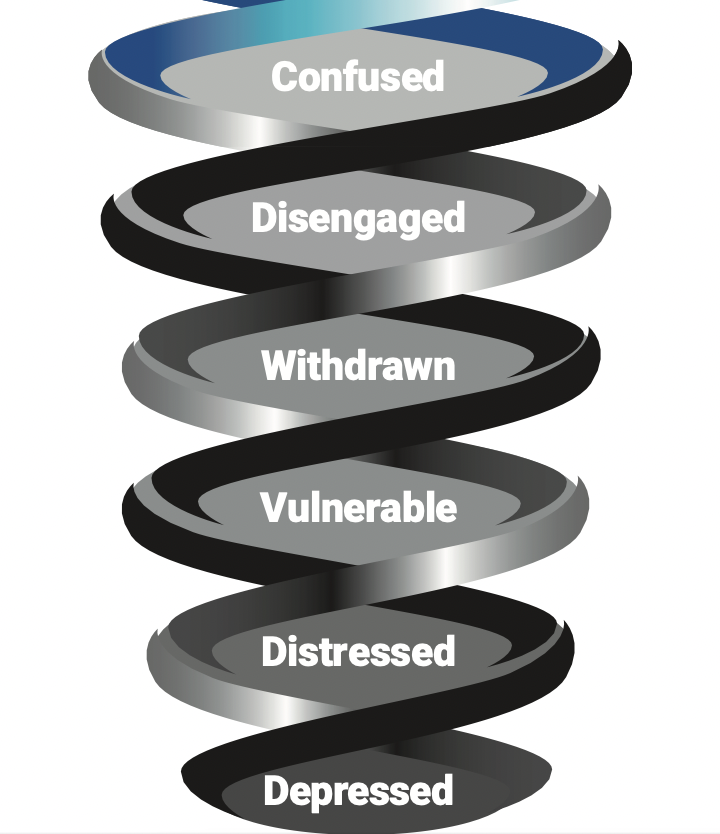
On the other side of the coin, the lower half of the Resilience Spiral includes the categories:

  • Confused
  • Disengaged
  • Withdrawn
  • Vulnerable
  • Distressed
  • Depressed

The lower half represents a lack of resilience. The first step down the spiral is Confused, which leads to a lack of focus. Next is Disengaged, which creates boredom and, eventually, loss of productivity. Progression down the spiral leads to Withdrawn — where the body loses energy and engagement.

Fatigue kicks in at the Vulnerable, as people feel indifferent. Distressed can lead to loss of staff and unhealthy organisational culture. Finally, Depressed signals the end of an organisation.

Resilient people and organisations work at higher levels. When resilience fails, people and organisations drop into the lower levels.

Training Resilience

The Resilience Institute offers resilience training — ranging from the Resilience app to webinars, workshops, and comms support — that can increase performance by 41%, decrease risk by 34%, and boost growth in capability by 38%.

Gain access to a library of information to help you learn more about the resilience factors and your own Resilience ratio, and learn skills for how to bounce back, access flow states,  and increase emotional intelligence. The app also includes goal tracking, over 50 resilience training videos by Dr Sven Hansen, daily meditations, and a support chatbot.

The app is available in English, French, Spanish, Dutch, German and Mandarin. Thousands of organisations use The Resilience Institute to measure and improve individual and organisational resilience. Are you ready for resilience?

Original Source: https://resiliencei.com/blog/positivity-at-work/

What Our 2020 Data Got Right (and Wrong) About Crisis Resilience

  • In March to June 2020, RI’s own diagnostic data found average resilience had risen roughly 7% compared to the same period in 2019, a genuinely counterintuitive early-pandemic finding.
  • That finding makes complete sense in light of the well-established Phases of Disaster framework: the sample was captured during the heroic and honeymoon phases of the crisis, the period of mobilisation and community bonding that reliably comes before a longer, harder decline.
  • The transferable lesson matters more than the specific 2020 numbers: early positive resilience signals during any crisis, a downturn, a restructure, a market shock, often reflect a temporary mobilisation phase, not a resolved trend. Reading them as the final word is a real risk.

In the middle of 2020, a few months into the pandemic, we looked at our own diagnostic data and found something that surprised us. Resilience hadn’t fallen. On average, across a sample of over 1,600 professionals and executives, it had gone up. Six years on, that finding is still worth revisiting, not as current data, but as a genuinely useful case study in how resilience actually behaves during the early phase of a major disruption, and why reading that phase correctly matters.

What the 2020 Data Actually Showed

We compared Resilience Diagnostic results from March to June 2019 (1,599 participants) against the same window in 2020 (1,659 participants), drawn from a similar pool of professionals and executives across comparable organisations. The average resilience ratio rose from 1.51 to 1.61, a roughly 7% increase during the acute early phase of a global crisis, not the decline anyone would have predicted going in.

The pattern wasn’t uniform. Male participants improved more clearly, from an average of 1.57 to 1.70, with the proportion at risk actually falling slightly. Female participants showed no change in the average ratio, but the proportion at risk rose by 15%, with increases specifically in anhedonia, self-doubt, and depressive symptoms. This tracks with separately well-documented research from the same period on the disproportionate caregiving and domestic burden many women carried during pandemic-era lockdowns and school closures, a genuine and important asymmetry inside an otherwise positive headline number.

At a category level, mental strength, physical energy, stress mastery, and related risk categories were slightly better during the crisis window. Emotional engagement, disengagement, and depressive symptoms were slightly worse. Specific strength factors that improved included purpose, integrity, fulfilment, compassion, situational agility, optimism, and sleep quality. Factors that declined included trust, flow, decisiveness, emotional agility, and empathy.

Why This Isn’t as Strange as It Sounds

Psychologists Leonard Zunin and Diane Myers developed a framework, widely used in disaster psychology, describing the emotional phases most communities move through during a prolonged crisis: warning, impact, heroic, honeymoon, disillusionment, and reconstruction. The heroic phase is marked by altruism and mobilisation, first responders, healthcare workers, and communities pulling together with real intensity. The honeymoon phase that often follows brings a genuine, if short-lived, sense of optimism and community bonding, along with a belief that things will return to normal reasonably quickly.

March to June 2020 sits squarely inside that window for most of the world. Our data wasn’t capturing a crisis that had resolved well. It was capturing a population still inside the heroic and honeymoon phases, genuinely mobilised, purposeful, and pulling together, before the far longer disillusionment phase that followed. That later phase, well documented separately across 2020 to 2022, brought the more severe and prolonged mental health decline most people actually associate with the pandemic: rising burnout, anxiety, and depression as the crisis stretched on far longer than the initial mobilisation could sustain.

Seen through that lens, the 2020 finding isn’t really a story about resilience being immune to crisis. It’s a story about which phase of a crisis a snapshot happens to catch, and how easy it is to mistake a heroic-phase mobilisation for a resolved, stable new normal.

The Transferable Lesson

This matters well beyond one pandemic. Any organisation moving through a major disruption, a restructuring, a market downturn, a leadership change, a merger, will likely see something similar in its early resilience or engagement data: a genuine, real mobilisation effect in the first weeks or months, purpose and cohesion measurably up, as people pull together around the immediate challenge. Reading that early signal as evidence the disruption has been successfully absorbed is a real risk. The honest interpretation is closer to: the team is currently in its heroic or honeymoon phase, and the real test comes later, when the mobilisation naturally fades and the underlying, unresolved strain has had time to surface.

Two practical implications follow. First, treat early positive signals during any crisis with appropriate caution rather than as confirmation the hard part is over. Second, plan deliberately for the later phase, the point where disillusionment risk peaks, rather than being caught off guard by a decline that the Phases of Disaster framework would have predicted from the outset.

A crisis rarely announces which phase it’s in. Knowing the shape of the curve in advance is what turns a surprising early number into a useful one.