
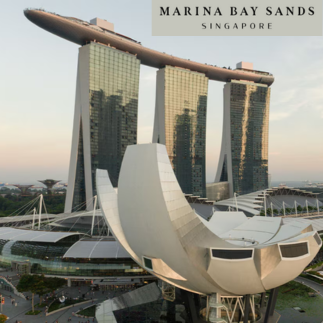
Marina Bay Sands Case Study: Hospitality Staff Resilience Training Across 5 Batches
How frontline hotel teams lifted their resilience by 25% in 3 months
Resilience Mastery for front office, butler, concierge and guest services teams
Marina Bay Sands chose our hospitality staff resilience training to help its frontline hotel teams stay calm, energised and at their best with guests. Each batch was measured with the Resilience Assessment, trained over 2 days, supported for 3 months, then measured again. Across 5 batches from 2019 to 2022, the average Resilience Ratio rose 25%, and participants rated the programme 4.78 out of 5.
- Client
- Marina Bay Sands
- Industry
- Hospitality and integrated resort
- Where
- Singapore
- Who
- Hotel operations teams: Front Office, Butler, Concierge, Guest Services, Groups, Pools and Recreation, Call Centre, Retail, Reservations and Service Management
- Period
- December 2019 to July 2022
Great time to step back and really discover more of yourself and how it affects other people.Team member, Marina Bay Sands Hotel Operations, 2021
World-class service starts with the people who deliver it
In April 2019, Marina Bay Sands agreed a S$4.5 billion expansion with the Singapore government. Like the whole tourism sector, it adapted through the COVID-19 pandemic, and the hotel welcomed guests back in stages from July 2020. For frontline teams, world-class service depends on how people feel and how they recover between shifts.
Guest-facing all day
Staff deliver high-touch service to international guests, often on rotating shifts.
Emotions shape service
How a team member feels shapes how a guest is treated.
Energy for shift work
Sleep, fitness and recovery habits were the clearest areas to build.
A new chapter
Teams returned from the pandemic pause ready to rebuild momentum.
Measure, train, practise, re-measure
Every batch followed the same path. We shaped each workshop around that batch’s own team report.
Measure
A Resilience Assessment before the workshop, with a private report for each person.
Train and practise
A 2-day Resilience Mastery workshop, then 3 months of peer coaching and weekly newsletters.
Re-measure
A half-day Sustaining Change workshop and a second assessment at about 3 months.
| Programme element | Details |
|---|---|
| Measure | Resilience Assessment before the workshop. Each person gets a private report. The facilitator gets a team report. |
| Train | 2-day face-to-face Resilience Mastery workshop, run in-house |
| Key modules | What triggers me, stress physiology with a live heart rate variability (HRV) demonstration, sleep and energy, managing emotions, performance mindset, empathy and flow |
| Practise | 3 months of support: weekly resilience newsletters and 90-day peer coaching in pairs |
| Sustain | Half-day Sustaining Change workshop on habits after 3 months |
| Re-measure | Second assessment at about 3 months, with a pre and post team report |
| Batches | December 2019, July 2021, October 2021, March 2022, July 2022 |
Ready when the teams came back
Batch 1 ran in December 2019. Planned 2020 batches were rescheduled during the pandemic, and the programme restarted in July 2021 with the same design.
- Come back when teams come back: the restart matched teams’ return to full operations.
- Keep practice personal: peer coaching pairs and weekly newsletters kept habits going between the workshop and the re-measure.
- Close the loop: every batch closed with a Sustaining Change session, so staff could see what had moved and set their next habit.
How Marina Bay Sands used Measure, Build, Sustain
Marina Bay Sands used all three steps. Pick the one that matches your own challenge.
Measure
A baseline for each batch, a team report to shape the workshop, and a re-measure after 3 months.
Build
Energy, sleep, stress physiology and daily practice for shift-based teams.
Managing emotions, empathy and staying calm with guests and colleagues.
Sustain
90-day peer coaching, weekly newsletters and a half-day habits workshop.
Stronger resilience in 3 months
explained
The Resilience Ratio is total strengths divided by total risks across 50 factors. Our corporate benchmark sits at 1.71. The target for high-performing teams is 2.5.
| Group | Years | People | Before | After | Change |
|---|---|---|---|---|---|
| Batches 1 to 5, matched | 2019 to 2022 | 68 | 1.64 | 2.05 | +25% |
Most people improved
50 of 68 re-measured staff improved their Resilience Ratio. The group moved above our corporate benchmark.
More staff thriving
Half the group scored 2.0 or more after the programme, and the number in the thriving band (3.0 or more) rose from 2 to 9.
Reflection, sleep and calm
Across the full groups, contemplation rose 42%, health awareness 34% and sleep quality 18%. Worry fell 19% and fatigue 16%.
Business outcomes
| Measure | Result |
|---|---|
| Repeat business | 5 batches over 3 years, including a restart after the pandemic |
| Reach | 108 hotel operations staff measured, from more than 10 teams |
| Participant rating | All out of 5: overall experience 4.78, would recommend 4.78, better understanding 4.76, facilitator 4.71, able to apply at work 4.66 |
What Marina Bay Sands team members said
Learning that little self care habits makes a big difference to my daily performance.Team member, Marina Bay Sands Hotel Operations, 2022
Opening my eyes to how I can be better at work as well as at home.Team member, Marina Bay Sands Hotel Operations, 2022
Three design choices
Two days, not two hours
A full 2 days gave frontline staff space to look at their own data, practise calming techniques and work through real guest situations.
Practice was built in for 3 months
Peer coaching pairs and weekly newsletters kept small habits going after the workshop. That is where sleep, energy and calm moved.
Every batch measured the same way
The same assessment, re-measure and Sustaining Change session gave one clear, comparable result across 5 batches.
Running hotel, retail or other guest-facing teams?
Service quality depends on how your people feel, and shift work asks a lot of their energy. Marina Bay Sands’ experience shows three things you can expect.
A clear read on your frontline
See your team’s strengths and which habits, like sleep and energy, will lift performance most.
Measurable change in 3 months
Resilience, sleep and calm can move in one programme cycle.
A design that repeats
The same format can run batch after batch, with results you can compare.
Measure your frontline team’s resilience
Every Marina Bay Sands batch began with the Resilience Assessment. Run it free for up to 5 people in your guest-facing team. You get a profile across 50 evidence-based factors and a debrief on strengths and the habits that will help most.
Request your free team assessmentPlanning a programme for several frontline teams or shifts? Contact peiying.sim@resiliencei.com.sg
Frequently asked questions
What is the Resilience Ratio?
Does resilience training work for frontline and shift-based staff?
How fast are results?
What happens after the workshop?
Programme details and scores are drawn from The Resilience Institute’s programme records, the Marina Bay Sands Resilience Mastery pre and post group report (Batches 1 to 5) and participant feedback, 2019 to 2022. Individual results are confidential and not disclosed. Company context is drawn from Las Vegas Sands (April 2019).