


How to Become a Resilience Coach: Training, Tools, and Insights
- A structured resilience assessment turns vague client feelings, “I feel stuck,” “I feel off”, into specific, measurable signals across 50 science-based factors.
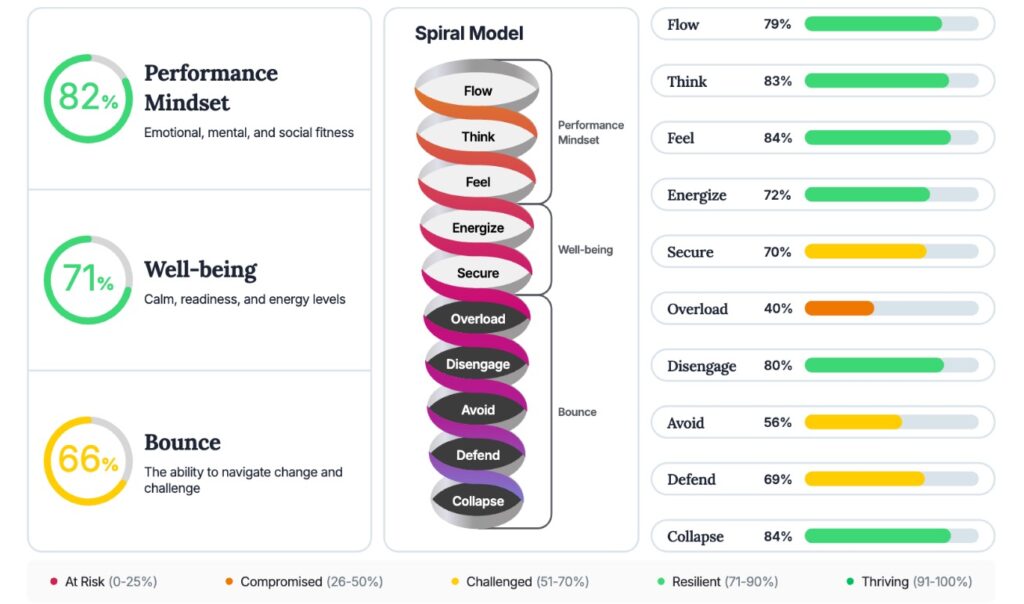
- The Resilience Spiral, now in its fifth iteration, maps the stages between distress and flow, giving coaches a shared, evidence-based language for human performance.
- Coaching outcomes become genuinely measurable: real client progress can be tracked and shown in concrete terms rather than left as an unverifiable impression.
Effective coaching needs more than listening skills. It needs data. It needs clarity. It needs tools that reveal what people often can’t see in themselves. That’s what makes Resilience Institute’s Coaching Certification distinct. It cuts through ambiguity and gets to the heart of what actually makes people thrive.
Why Is Self-Awareness So Hard to Pin Down?
Many clients struggle with self-awareness. They feel stuck, anxious, or disengaged, yet can’t quite explain why. They guess at solutions. Coaches guess too. The Resilience Assessment changes that.
It measures 50 science-based factors driving physical, emotional, mental, and social fitness. It shows real patterns, spots genuine blind spots, and turns vague feelings into clear, specific signals, giving coaches an actual roadmap to work from.
Have you ever coached someone and felt unsure whether they were telling you the whole story? Only in session four do they mention they’re taking sleeping tablets, or medicating for anxiety. Plenty of leaders don’t want to acknowledge they’re short on rest or multitasking all day. Using a holistic assessment to capture a genuine baseline depersonalises the struggle and shifts the conversation to an objective perspective:
“Ah, I see sleep has been a struggle for you recently…”
“So you find yourself juggling many tasks each day…”
“Your hypervigilance score signals that you’re struggling to fall asleep…”
Some leaders still wear sleepless nights or constant multitasking as a badge of honour. Some coaches still overlook the physical dimension entirely when supporting clients. But human performance is genuinely integrated, body, emotion, and mind together, and small, precise adjustments can transform how someone actually experiences their life. That’s where the Spiral comes in.
What Is the Resilience Spiral, and Why Does It Matter?
Since 2002, Resilience Institute has worked with thousands of organisations and more than 100,000 individuals. The Resilience Spiral sits at the core of that work. Now in its fifth iteration, it maps the natural stages of resilience, from distress through to flow.
The Spiral is genuinely practical. It weaves together fields that too often stay fragmented, mental health, stress mastery, emotional intelligence, high performance, and wellbeing, helping people climb toward what RI calls “altitude,” a state of real thriving where purpose, energy, and performance meet.
Isn’t Resilience Just a Buzzword?
No. Resilience is a learned set of skills, genuinely measurable and trainable. It includes sleep, nutrition, and recovery. It includes self-awareness, emotional regulation, and focus. It includes connection, purpose, and optimism.
RI’s model draws from neuroscience, positive psychology, epigenetics, preventative medicine, and behavioural science, refined over decades and tested in boardrooms, classrooms, clinics, and frontline teams alike. The feedback stays consistent: it gives people real language to describe what they’d previously only been able to feel.
What Makes This Certification Different?
Coaches completing the certification gain more than a framework. They gain a genuinely powerful assessment tool, letting them deliver individual reports that spark real insight, benchmark teams and track progress over time, target interventions with real precision, and show a genuine return on investment. That makes coaching not just more effective, but measurably more valuable to client organisations.
How Does It Help Coaches Succeed?
Coaching is a genuinely competitive space. To stand out, coaches need real results and a methodology grounded in science but flexible enough for actual practice. The Resilience Coach Certification offers a clear, structured model, actionable data from real clients, tools for both individuals and groups, and language that genuinely resonates with leaders. It isn’t a script. It’s a system, and it works.
Can Coaching Be Measured?
Most coaching programmes struggle to show clear outcomes. This one doesn’t. Group dashboards let coaches and organisations see genuine shifts in resilience over time, measuring growth, pinpointing pain points, and adjusting strategy accordingly.
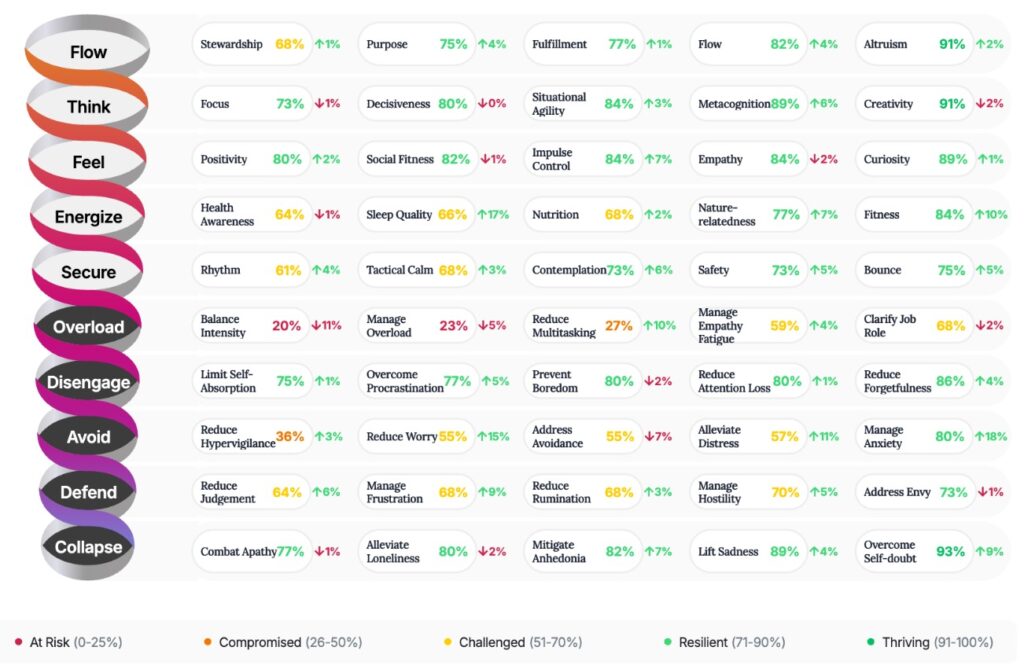
No more “thanks, I think that coaching helped.” Instead: “I improved my sleep quality by 17%, and I’m 18% better at managing anxiety.” That’s why HR teams and executives respond so well to this approach. It brings real credibility and real evidence, turning coaching into a genuine strategic investment. If you’re after referrals from existing or previous clients, give them data worth sharing. They become genuine ambassadors in the market.
What Kind of Coaches Should Apply?
This certification suits coaches working with leaders and executives, teams and departments, healthcare professionals, educators and students, and athletes and performers. It’s built for coaches who want a genuinely deeper impact, who value insight over opinion, and who are ready to work at the intersection of performance and wellbeing.
Why Now?
The world is demanding more from people than it used to. Change is constant. Stress runs high. Plenty of people feel genuinely overwhelmed. Coaches are more needed than ever, but meeting the moment requires the right tools. The Resilience Coach Certification is evidence-based and built to equip coaches to guide others through real complexity with genuine clarity.
What Happens After Certification?
Graduates join a global network of resilience professionals, with access to ongoing learning, group support and mentorship, upgrades as the model evolves, and new insight as the underlying resilience science develops. It’s a living system, not a static course, and it keeps improving. The certification is also approved by the ICF for Continuing Coach Education, offering 4 CCE hours on completion.
The future of coaching isn’t guesswork. It’s grounded, measurable, and genuinely human, and it starts with resilience.