Women Illustration
Overview of the personalised Resilience Assessment Report

See how we measure Resilience and the detailed insights into individual strengths and growth areas.

Download Report

Five Resilience Metrics Every Coach Should Be Tracking

  • 67% of all workers now report burnout symptoms, up sharply from 52% in 2021, and 77% of professionals report having experienced burnout in their current role at some point.
  • Five specific, measurable metrics, burnout risk, emotional agility, sleep quality, focus, and social fitness, give coaches a genuine, evidence-based way to track client resilience rather than relying on impression alone.
  • Average screen-attention span has fallen to just 47 seconds, and a single interruption still costs roughly 23 minutes to fully recover from, making focus one of the most measurably strained metrics on this list.

For executive coaches, resilience has become a genuinely central factor, not just for helping clients manage stress, but for fostering sustainable wellbeing and performance over the long term. Tracking specific resilience metrics gives coaches real, evidence-based insight into client progress, well beyond impression or self-report alone. Here are five essential metrics worth tracking, why each one matters right now, and how they can genuinely elevate a coaching practice.

1. Burnout Risk

Burnout remains a genuinely pervasive workplace issue, and the trend is worsening, not stabilising. Deloitte’s ongoing burnout survey found 77% of professionals report having experienced burnout in their current role, with more than half experiencing it multiple times. Separately, Gallup’s State of the Global Workplace 2025 report found 67% of all workers now report burnout symptoms, up sharply from 52% in 2021, a genuine, measurable rise in just a few years rather than a stable baseline. Monitoring burnout indicators, exhaustion, cynicism, and declining engagement, lets coaches develop early, targeted interventions that reduce overload before it compounds into something harder to reverse.

2. Emotional Agility

Emotional agility, the ability to adapt and manage emotion constructively rather than being run by it, is genuinely central to resilience. Workplace stress data from Spill found 79% of British workers report heightened stress levels in recent years, directly affecting their capacity to handle real challenges well. Tracking this metric lets coaches offer targeted exercises for adaptability, empathy, and emotional regulation, building a client’s capacity to stay skilful under pressure rather than simply enduring it.

3. Sleep Quality and Recovery

CDC data shows approximately 39% of US adults get less than the recommended seven hours of sleep per night, and sleep deprivation has a genuinely significant, well-documented effect on wellbeing and resilience. Coaches who help clients improve sleep and recovery habits directly support their capacity to manage stress and sustain cognitive performance, one of the highest-leverage, most foundational metrics on this list precisely because it affects nearly everything else.

4. Focus and Cognitive Clarity

Maintaining genuine focus in a distraction-saturated environment is harder than ever, and the data on this specific metric has continued to worsen. Gloria Mark’s research at UC Irvine, one of the most cited bodies of work in this field, found it takes an average of 23 minutes and 15 seconds to fully regain focus after a single interruption. Her more recent tracking found something even starker: average screen-attention span, how long someone stays on one screen before switching, has fallen from around two and a half minutes in 2004 to just 47 seconds today. Multiply either figure across a typical day’s interruptions, and the cumulative cost to focus and decision-making becomes genuinely substantial. Tracking this metric and offering concrete techniques to protect focus supports clients in managing real priorities and thinking clearly under pressure.

5. Social and Relationship Fitness

Social connection plays a genuinely vital role in resilience; supportive relationships measurably help buffer stress and support overall wellbeing. Research from the Australian Disaster Resilience Knowledge Hub found social connection directly helps dampen the physiological stress response itself, not just the subjective experience of it. By tracking this metric, coaches can guide clients toward building the kind of relationships that function as a genuine buffer against stress, rather than leaving connection to chance.

How Coaches Can Actually Measure These Metrics

These five metrics are genuinely valuable, but accurately assessing them without a structured tool is difficult. Resilience Institute’s Coach Certification programme provides coaches with the Resilience Assessment, a structured instrument built specifically to measure these exact areas. Equipped with real data on wellbeing, burnout risk, emotional agility, and social fitness, coaches gain a genuinely clear, evidence-based view of where a client actually stands, rather than relying on impression alone.

As a Resilience Coach, that means the ability to assess, track, and respond to resilience indicators in something close to real time, making a genuinely lasting impact. With data-driven insight behind the work, coaches can support clients at a deeper level, helping them build wellbeing, adapt to real challenges, and actually thrive rather than just cope.

Burnout symptoms have risen from 52% to 67% of workers since 2021. Coaches who track resilience with real data, not just conversation, are the ones actually positioned to help clients get ahead of that curve.

How to Become a Resilience Coach: Training, Tools, and Insights

  • A structured resilience assessment turns vague client feelings, “I feel stuck,” “I feel off”, into specific, measurable signals across 50 science-based factors.
  • The Resilience Spiral, now in its fifth iteration, maps the stages between distress and flow, giving coaches a shared, evidence-based language for human performance.
  • Coaching outcomes become genuinely measurable: real client progress can be tracked and shown in concrete terms rather than left as an unverifiable impression.

Effective coaching needs more than listening skills. It needs data. It needs clarity. It needs tools that reveal what people often can’t see in themselves. That’s what makes Resilience Institute’s Coaching Certification distinct. It cuts through ambiguity and gets to the heart of what actually makes people thrive.

Why Is Self-Awareness So Hard to Pin Down?

Many clients struggle with self-awareness. They feel stuck, anxious, or disengaged, yet can’t quite explain why. They guess at solutions. Coaches guess too. The Resilience Assessment changes that.

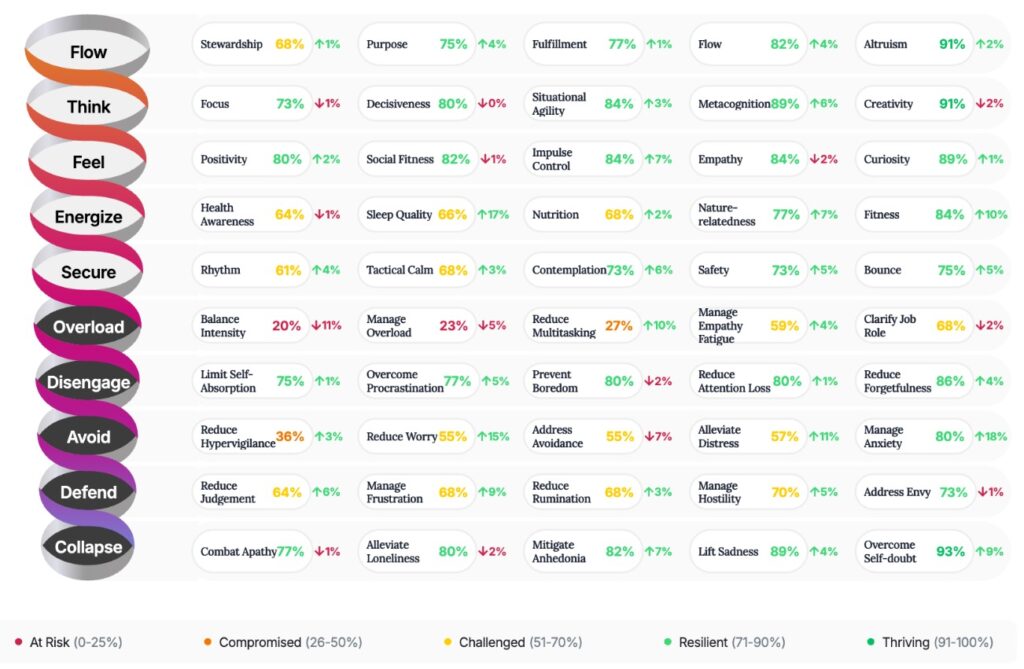
It measures 50 science-based factors driving physical, emotional, mental, and social fitness. It shows real patterns, spots genuine blind spots, and turns vague feelings into clear, specific signals, giving coaches an actual roadmap to work from.

Have you ever coached someone and felt unsure whether they were telling you the whole story? Only in session four do they mention they’re taking sleeping tablets, or medicating for anxiety. Plenty of leaders don’t want to acknowledge they’re short on rest or multitasking all day. Using a holistic assessment to capture a genuine baseline depersonalises the struggle and shifts the conversation to an objective perspective:

“Ah, I see sleep has been a struggle for you recently…”
“So you find yourself juggling many tasks each day…”
“Your hypervigilance score signals that you’re struggling to fall asleep…”

Some leaders still wear sleepless nights or constant multitasking as a badge of honour. Some coaches still overlook the physical dimension entirely when supporting clients. But human performance is genuinely integrated, body, emotion, and mind together, and small, precise adjustments can transform how someone actually experiences their life. That’s where the Spiral comes in.

What Is the Resilience Spiral, and Why Does It Matter?

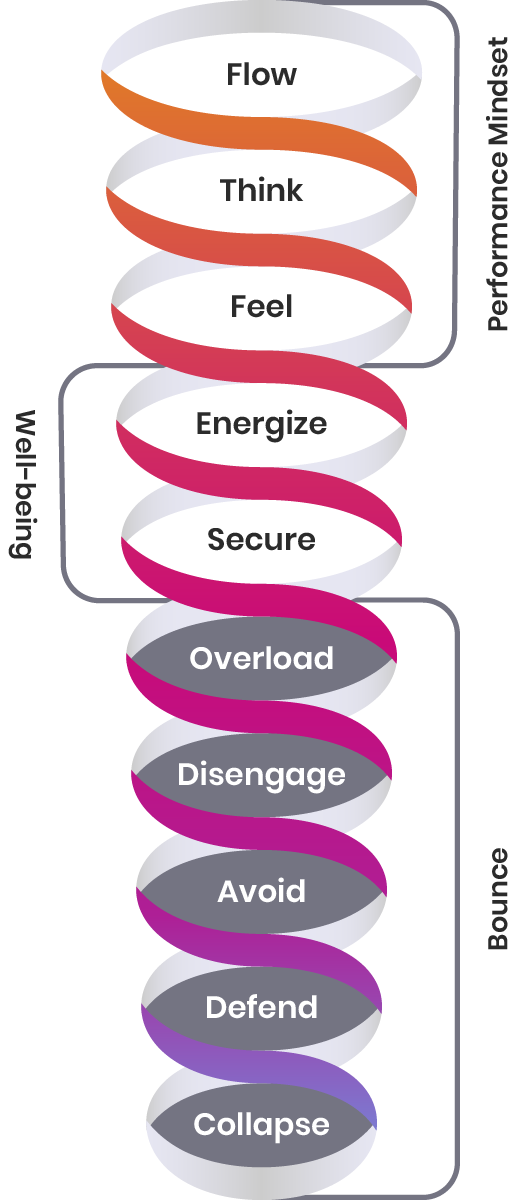
Since 2002, Resilience Institute has worked with thousands of organisations and more than 100,000 individuals. The Resilience Spiral sits at the core of that work. Now in its fifth iteration, it maps the natural stages of resilience, from distress through to flow.

The Spiral is genuinely practical. It weaves together fields that too often stay fragmented, mental health, stress mastery, emotional intelligence, high performance, and wellbeing, helping people climb toward what RI calls “altitude,” a state of real thriving where purpose, energy, and performance meet.

Snapshot of participant scores, mapped to the spiral

Isn’t Resilience Just a Buzzword?

No. Resilience is a learned set of skills, genuinely measurable and trainable. It includes sleep, nutrition, and recovery. It includes self-awareness, emotional regulation, and focus. It includes connection, purpose, and optimism.

RI’s model draws from neuroscience, positive psychology, epigenetics, preventative medicine, and behavioural science, refined over decades and tested in boardrooms, classrooms, clinics, and frontline teams alike. The feedback stays consistent: it gives people real language to describe what they’d previously only been able to feel.

What Makes This Certification Different?

Coaches completing the certification gain more than a framework. They gain a genuinely powerful assessment tool, letting them deliver individual reports that spark real insight, benchmark teams and track progress over time, target interventions with real precision, and show a genuine return on investment. That makes coaching not just more effective, but measurably more valuable to client organisations.

How Does It Help Coaches Succeed?

Coaching is a genuinely competitive space. To stand out, coaches need real results and a methodology grounded in science but flexible enough for actual practice. The Resilience Coach Certification offers a clear, structured model, actionable data from real clients, tools for both individuals and groups, and language that genuinely resonates with leaders. It isn’t a script. It’s a system, and it works.

Can Coaching Be Measured?

Most coaching programmes struggle to show clear outcomes. This one doesn’t. Group dashboards let coaches and organisations see genuine shifts in resilience over time, measuring growth, pinpointing pain points, and adjusting strategy accordingly.

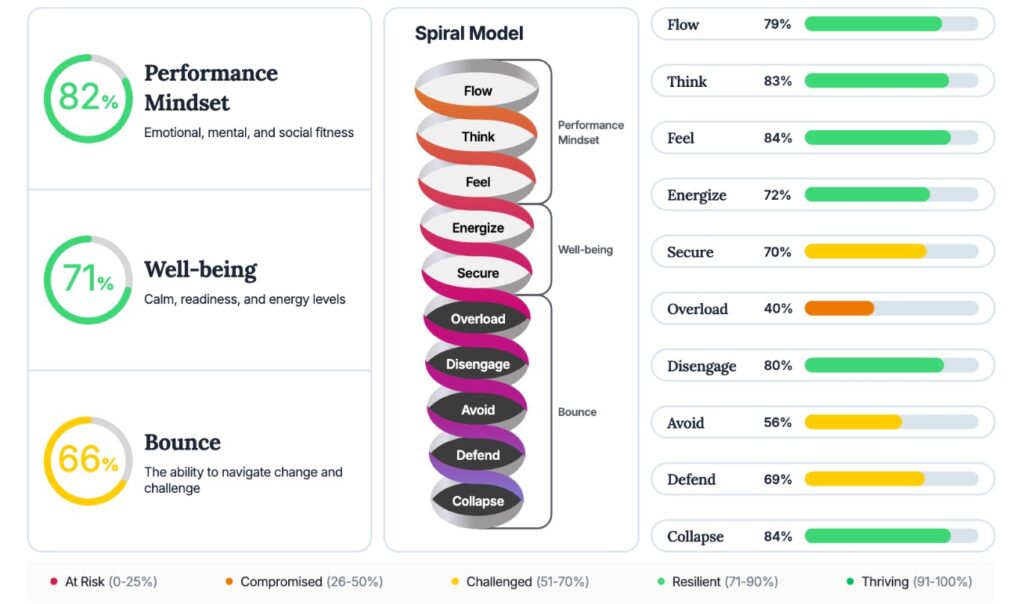
Participant results in a post-assessment

No more “thanks, I think that coaching helped.” Instead: “I improved my sleep quality by 17%, and I’m 18% better at managing anxiety.” That’s why HR teams and executives respond so well to this approach. It brings real credibility and real evidence, turning coaching into a genuine strategic investment. If you’re after referrals from existing or previous clients, give them data worth sharing. They become genuine ambassadors in the market.

What Kind of Coaches Should Apply?

This certification suits coaches working with leaders and executives, teams and departments, healthcare professionals, educators and students, and athletes and performers. It’s built for coaches who want a genuinely deeper impact, who value insight over opinion, and who are ready to work at the intersection of performance and wellbeing.

Why Now?

The world is demanding more from people than it used to. Change is constant. Stress runs high. Plenty of people feel genuinely overwhelmed. Coaches are more needed than ever, but meeting the moment requires the right tools. The Resilience Coach Certification is evidence-based and built to equip coaches to guide others through real complexity with genuine clarity.

What Happens After Certification?

Graduates join a global network of resilience professionals, with access to ongoing learning, group support and mentorship, upgrades as the model evolves, and new insight as the underlying resilience science develops. It’s a living system, not a static course, and it keeps improving. The certification is also approved by the ICF for Continuing Coach Education, offering 4 CCE hours on completion.

The future of coaching isn’t guesswork. It’s grounded, measurable, and genuinely human, and it starts with resilience.

The Best Coaching Tools for Executive and Leadership Coaching

  • Coaches and HR professionals increasingly need tools that go beyond conversation, ones that offer measurable, evidence-based insight into resilience, strengths, and behaviour.
  • Resilience-specific tools (like RI’s own Resilience Assessment and Hello Driven’s CReC platform) measure burnout risk and recovery capacity directly; strengths and personality tools (CliftonStrengths, DISC, MBTI) build shared language for communication and team dynamics.
  • Pricing varies by tool and changes over time; always confirm current pricing directly with the provider rather than relying on a fixed figure from any single article.

Leaders are under pressure to perform, adapt, and inspire, often all at once. Coaches and HR professionals supporting them need tools that go beyond conversation: insights that are measurable, evidence-based, and genuinely relevant to the realities of leadership today.

Whether working with senior executives, cross-functional teams, or emerging leaders, the right coaching tool helps guide genuinely meaningful change. From strengthening resilience and reducing burnout to improving collaboration and communication, these tools bring real clarity to complexity. This guide reviews five of the most trusted and effective coaching assessments used by executive coaches, leadership consultants, and HR leaders worldwide.

Resilience Assessment (Resilience Institute)

A scientifically validated tool measuring 50 key factors across 10 levels of the Resilience Spiral, including focus, adaptability, empathy, recovery, and burnout risk. It provides clear, actionable insight into performance, mental health risk, leadership readiness, and team dynamics, now powered by RI’s own AI platform for individualised recommendations across areas like sleep, vitality, and emotional regulation. Reports are available for both individuals and groups, with benchmarking and trend tracking for repeat use over time.

Certified professionals gain access to a structured framework, preferred pricing, and best-practice guidance for using the tool in coaching engagements. Pricing is tiered per user, with a reduced rate for certified professionals; confirm current rates directly on RI’s assessment page.

Why it benefits executive coaches and HR leaders: it provides a measurable, holistic view of personal and team resilience, ideal for coaching aimed at genuine wellbeing, better decision-making, and sustainable performance.

Hello Driven (CReC Resilience Tools)

A digital platform for tracking and building resilience over time, built around the peer-reviewed Predictive 6 Factor Resilience Model (PR6), which measures six domains and expands to 24 skills through the extended PR6E. It uses AI-supported dashboards and micro-coaching to help users develop awareness and adaptability, with coaches and facilitators able to become certified through the Certified Resilience Coach (CReC) programme, which is ICF-accredited for continuing coach education.

Certification includes a 12-month platform subscription, group and trend-tracking features, and access to specialist follow-on pathways like Resilience First Aid and High Adversity Resilience Training. Confirm current certification pricing directly with Hello Driven, since programme inclusions and cost have been updated more than once since launch.

Why it benefits executive coaches and HR leaders: a solid option for organisations wanting continuous digital engagement with employees and a scalable resilience programme backed by a peer-reviewed model.

CliftonStrengths (Gallup StrengthsFinder)

Identifies an individual’s top 5 or full 34 strengths from a list of 34 themes, Achiever, Strategic, Relator, and others. Widely used in corporate coaching and leadership development, it’s a foundational tool for aligning roles with natural talent and genuinely fostering engagement, priced at a relatively accessible entry point for the Top 5 report and a higher tier for the full 34.

Why it benefits executive coaches and HR leaders: helps leaders build real confidence, deepen self-awareness, and align teams around complementary talents in a positive, genuinely scalable way.

DISC Personality Profile

A behaviour-based assessment categorising individuals into Dominance, Influence, Steadiness, and Conscientiousness. Often used to improve communication and resolve team conflict, particularly in leadership and cross-functional teams, and priced moderately, with cost varying by provider.

Why it benefits executive coaches and HR leaders: gives teams and leaders a shared language for discussing behaviour, genuinely useful for building trust, improving collaboration, and leading with real awareness.

MBTI (Myers-Briggs Type Indicator)

A globally recognised tool for understanding personality preferences, categorising individuals into 16 types. Often used in leadership coaching, communication training, and change management. It has genuine limitations in scientific robustness worth being upfront about, but remains one of the most familiar tools in corporate settings, particularly valuable for introducing personality frameworks and fostering team dialogue, typically administered by a certified practitioner at a moderate to premium price point.

Why it benefits executive coaches and HR leaders: familiar and accessible, ideal for clients who need a basic shared framework for understanding themselves and their teams, especially in cross-cultural or high-stakes environments.

Choosing the Right Tool for High-Impact Leadership

Whether coaching executives, supporting teams, or designing organisational development programmes, the right tool helps turn genuine insight into real action. Resilience-specific tools like RI’s own Resilience Assessment and Hello Driven bring measurable clarity to performance, mental health, and burnout prevention, arguably the most critical areas in modern leadership right now. Others, CliftonStrengths, DISC, and MBTI, offer frameworks for communication, collaboration, and personal growth that complement rather than replace that resilience-specific lens.

The best coaching tools don’t just inform. They empower. Choose the one that genuinely aligns with your coaching goals, your client’s actual needs, and the organisational context you’re working within, and always verify current pricing directly with the provider before committing.

The right assessment doesn’t replace good coaching. It gives good coaching something measurable to actually work with.

What is the Resilience Spiral?

What is the Resilience Spiral?

Resilience is integral to personal and professional growth, and understanding it can significantly enhance our ability to navigate life’s challenges. Dr. Sven Hansen, the founder of the Resilience Institute, developed the Resilience Spiral to provide a structured framework for understanding and enhancing resilience. This model is built on the principles of neurobiology, physiology, and evolutionary biology, aiming to help individuals and organizations thrive in adversity.

__wf_reserved_inherit

The Foundation of the Resilience Spiral

Resilience, as defined by Dr. Hansen, is the learned ability to:

1. Bounce forward fast in adversity

2. Grow physical, emotional, and mental strengths

3. Connect with oneself, others, and nature

4. Discover flow in the application of skill to meaningful challenges

These capabilities are essential for navigating the complexities of life, whether for individuals, businesses, or communities. Resilience is not just about surviving; it is about thriving and evolving through adversity.

Understanding the Resilience Spiral

The Resilience Spiral is a diagnostic and development model that describes our quality of experience and altitude in life. Our altitude can be high, where we feel clear, energized, and focused, or low, where we experience pain, suffering, and negativity. The journey through the spiral involves moving up and down these states, influenced by our physical, emotional, and mental conditions.

Integral Approach in the Context of Spiral Models

In the context of the Resilience Spiral, “integral” means incorporating a comprehensive, inclusive approach that accounts for various dimensions of human experience. This concept draws inspiration from other spiral models like Spiral Dynamics and Integral Theory.

Spiral Dynamics, developed by Clare Graves, Don Beck, and Chris Cowan, explores the evolution of human values and consciousness. It has been applied in global negotiations, politics, medicine, and business. Similarly, Integral Theory, proposed by Ken Wilber, is one of the most comprehensive and inclusive frameworks, integrating insights from various fields to create a unified understanding of reality.

Dr. Hansen’s Resilience Spiral integrates these approaches by combining insights from neurobiology, physiology, and evolutionary biology with practical applications for resilience. This integration ensures a holistic understanding of resilience, addressing the physical, emotional, mental, and social dimensions of human experience.

Four Key Perspectives

Dr. Hansen’s model emphasizes four perspectives to enhance resilience:

Insight – Know Yourself

Insight involves understanding your current state by checking your body, emotions, and mind. This self-awareness is crucial for improving your altitude and engaging effectively with others. Accurate terminology and self-assessment tools, like the Resilience Spiral, help in this understanding.

Mastery – Raise Your Altitude

Mastery is about knowing how to improve your state once you have identified it. This involves specific biological adjustments, such as regulating your nervous system to restore calm and readiness. Building physical, emotional, and mental skills through practices like good sleep, emotional control, and focused attention is essential.

Empathy – Understand Others

Empathy is the ability to accurately read and respond to the physical, emotional, and mental states of others. This skill requires deliberate practice and is vital for effective social interactions and leadership. High altitude enables better empathy and connection.

Altruism – Raise the Altitude of Others

Altruism involves actions that help others improve their state, reducing suffering and enhancing quality of life. Effective altruism is built on the foundations of insight, mastery, and empathy, leading to resilient individuals, communities, and ultimately, a resilient planet.

The Resilience Journey

The journey through the Resilience Spiral begins with the foundational state of being secure. This state is characterized by a calm, engaged physiology, typically achieved through practices like slow breathing, meditation, and yoga. Once secure, the focus shifts to physical vitality, emotional agility, and mental skills.

Secure

Achieving a secure state involves calming the body and mind, often through external cues of safety or self-regulation techniques. This state is essential for effective functioning under stress.

Energize

Physical vitality, achieved through fitness, nutrition, sleep, and daily rhythms, is crucial for maintaining energy and resilience. Investing in physical health significantly enhances overall resilience.

Feel

Emotional agility and social engagement are the next steps. Positive emotional states and social connections enhance our ability to think clearly and make effective decisions.

Think

Mental skills like focus, optimism, and agility are most effective when built on a foundation of physical and emotional stability. In this state, the mind becomes a powerful tool for creativity and problem-solving.

Flow

The ultimate state of resilience is flow, where we engage in challenging tasks with skill and productivity. Flow states are deeply fulfilling and require years of dedicated practice to achieve consistently.‍

Practical Application and Leadership

The Resilience Spiral is not just a personal tool; it is also valuable for leaders and organizations. By understanding and applying the principles of the spiral, leaders can enhance the resilience of their teams and create a positive, productive culture. Practical steps include regular self-assessment, practicing bounce tactics, and fostering an environment that supports physical, emotional, and mental well-being.

‍

Leading with the Resilience Spiral

Leaders play a crucial role in shaping the resilience of their teams. By viewing resilience from an integral perspective, leaders can understand the layers of culture and influence positive change. This involves recognizing and addressing the physical, emotional, and mental states that define how people experience work.

For instance, during the COVID-19 pandemic, many organizations witnessed increased fear and anxiety among employees. Leaders who understood the Resilience Spiral could implement strategies to elevate the collective altitude, such as promoting secure states through clear communication, supporting physical vitality with wellness programs, and fostering emotional connections through team-building activities.

‍

Conclusion

The Resilience Spiral, developed by Dr. Sven Hansen, provides a comprehensive framework for understanding and enhancing resilience. By focusing on insight, mastery, empathy, and altruism, individuals and organizations can navigate adversity, grow, and thrive. The journey through the spiral is ongoing, requiring continuous practice and commitment, but the rewards are a life filled with clarity, energy, and meaningful engagement.

Understanding resilience through an integral lens ensures a holistic approach that addresses all dimensions of human experience. By integrating insights from various fields and applying them in practical ways, the Resilience Spiral offers a powerful tool for personal and organizational growth. Embrace the Resilience Spiral and embark on your journey towards a more resilient, fulfilling life.

‍

Original Source: https://resiliencei.com/blog/what-is-the-resilience-spiral/