Women Illustration
Overview of the personalised Resilience Assessment Report

See how we measure Resilience and the detailed insights into individual strengths and growth areas.

Download Report

Five Resilience Metrics Every Coach Should Be Tracking

  • 67% of all workers now report burnout symptoms, up sharply from 52% in 2021, and 77% of professionals report having experienced burnout in their current role at some point.
  • Five specific, measurable metrics, burnout risk, emotional agility, sleep quality, focus, and social fitness, give coaches a genuine, evidence-based way to track client resilience rather than relying on impression alone.
  • Average screen-attention span has fallen to just 47 seconds, and a single interruption still costs roughly 23 minutes to fully recover from, making focus one of the most measurably strained metrics on this list.

For executive coaches, resilience has become a genuinely central factor, not just for helping clients manage stress, but for fostering sustainable wellbeing and performance over the long term. Tracking specific resilience metrics gives coaches real, evidence-based insight into client progress, well beyond impression or self-report alone. Here are five essential metrics worth tracking, why each one matters right now, and how they can genuinely elevate a coaching practice.

1. Burnout Risk

Burnout remains a genuinely pervasive workplace issue, and the trend is worsening, not stabilising. Deloitte’s ongoing burnout survey found 77% of professionals report having experienced burnout in their current role, with more than half experiencing it multiple times. Separately, Gallup’s State of the Global Workplace 2025 report found 67% of all workers now report burnout symptoms, up sharply from 52% in 2021, a genuine, measurable rise in just a few years rather than a stable baseline. Monitoring burnout indicators, exhaustion, cynicism, and declining engagement, lets coaches develop early, targeted interventions that reduce overload before it compounds into something harder to reverse.

2. Emotional Agility

Emotional agility, the ability to adapt and manage emotion constructively rather than being run by it, is genuinely central to resilience. Workplace stress data from Spill found 79% of British workers report heightened stress levels in recent years, directly affecting their capacity to handle real challenges well. Tracking this metric lets coaches offer targeted exercises for adaptability, empathy, and emotional regulation, building a client’s capacity to stay skilful under pressure rather than simply enduring it.

3. Sleep Quality and Recovery

CDC data shows approximately 39% of US adults get less than the recommended seven hours of sleep per night, and sleep deprivation has a genuinely significant, well-documented effect on wellbeing and resilience. Coaches who help clients improve sleep and recovery habits directly support their capacity to manage stress and sustain cognitive performance, one of the highest-leverage, most foundational metrics on this list precisely because it affects nearly everything else.

4. Focus and Cognitive Clarity

Maintaining genuine focus in a distraction-saturated environment is harder than ever, and the data on this specific metric has continued to worsen. Gloria Mark’s research at UC Irvine, one of the most cited bodies of work in this field, found it takes an average of 23 minutes and 15 seconds to fully regain focus after a single interruption. Her more recent tracking found something even starker: average screen-attention span, how long someone stays on one screen before switching, has fallen from around two and a half minutes in 2004 to just 47 seconds today. Multiply either figure across a typical day’s interruptions, and the cumulative cost to focus and decision-making becomes genuinely substantial. Tracking this metric and offering concrete techniques to protect focus supports clients in managing real priorities and thinking clearly under pressure.

5. Social and Relationship Fitness

Social connection plays a genuinely vital role in resilience; supportive relationships measurably help buffer stress and support overall wellbeing. Research from the Australian Disaster Resilience Knowledge Hub found social connection directly helps dampen the physiological stress response itself, not just the subjective experience of it. By tracking this metric, coaches can guide clients toward building the kind of relationships that function as a genuine buffer against stress, rather than leaving connection to chance.

How Coaches Can Actually Measure These Metrics

These five metrics are genuinely valuable, but accurately assessing them without a structured tool is difficult. Resilience Institute’s Coach Certification programme provides coaches with the Resilience Assessment, a structured instrument built specifically to measure these exact areas. Equipped with real data on wellbeing, burnout risk, emotional agility, and social fitness, coaches gain a genuinely clear, evidence-based view of where a client actually stands, rather than relying on impression alone.

As a Resilience Coach, that means the ability to assess, track, and respond to resilience indicators in something close to real time, making a genuinely lasting impact. With data-driven insight behind the work, coaches can support clients at a deeper level, helping them build wellbeing, adapt to real challenges, and actually thrive rather than just cope.

Burnout symptoms have risen from 52% to 67% of workers since 2021. Coaches who track resilience with real data, not just conversation, are the ones actually positioned to help clients get ahead of that curve.

How to Become a Resilience Coach: Training, Tools, and Insights

  • A structured resilience assessment turns vague client feelings, “I feel stuck,” “I feel off”, into specific, measurable signals across 50 science-based factors.
  • The Resilience Spiral, now in its fifth iteration, maps the stages between distress and flow, giving coaches a shared, evidence-based language for human performance.
  • Coaching outcomes become genuinely measurable: real client progress can be tracked and shown in concrete terms rather than left as an unverifiable impression.

Effective coaching needs more than listening skills. It needs data. It needs clarity. It needs tools that reveal what people often can’t see in themselves. That’s what makes Resilience Institute’s Coaching Certification distinct. It cuts through ambiguity and gets to the heart of what actually makes people thrive.

Why Is Self-Awareness So Hard to Pin Down?

Many clients struggle with self-awareness. They feel stuck, anxious, or disengaged, yet can’t quite explain why. They guess at solutions. Coaches guess too. The Resilience Assessment changes that.

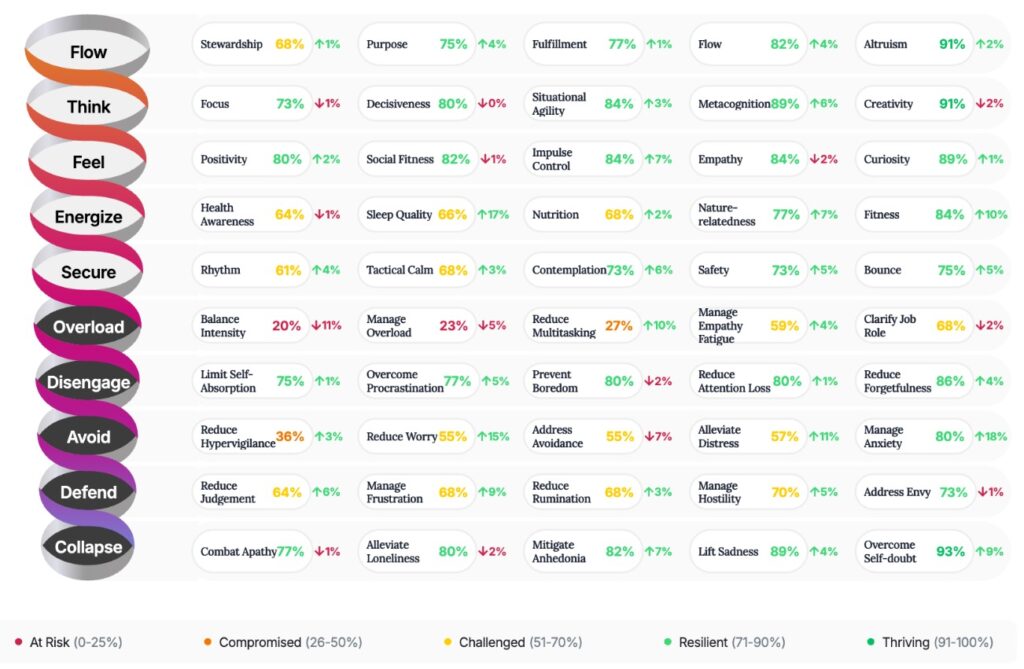
It measures 50 science-based factors driving physical, emotional, mental, and social fitness. It shows real patterns, spots genuine blind spots, and turns vague feelings into clear, specific signals, giving coaches an actual roadmap to work from.

Have you ever coached someone and felt unsure whether they were telling you the whole story? Only in session four do they mention they’re taking sleeping tablets, or medicating for anxiety. Plenty of leaders don’t want to acknowledge they’re short on rest or multitasking all day. Using a holistic assessment to capture a genuine baseline depersonalises the struggle and shifts the conversation to an objective perspective:

“Ah, I see sleep has been a struggle for you recently…”
“So you find yourself juggling many tasks each day…”
“Your hypervigilance score signals that you’re struggling to fall asleep…”

Some leaders still wear sleepless nights or constant multitasking as a badge of honour. Some coaches still overlook the physical dimension entirely when supporting clients. But human performance is genuinely integrated, body, emotion, and mind together, and small, precise adjustments can transform how someone actually experiences their life. That’s where the Spiral comes in.

What Is the Resilience Spiral, and Why Does It Matter?

Since 2002, Resilience Institute has worked with thousands of organisations and more than 100,000 individuals. The Resilience Spiral sits at the core of that work. Now in its fifth iteration, it maps the natural stages of resilience, from distress through to flow.

The Spiral is genuinely practical. It weaves together fields that too often stay fragmented, mental health, stress mastery, emotional intelligence, high performance, and wellbeing, helping people climb toward what RI calls “altitude,” a state of real thriving where purpose, energy, and performance meet.

Snapshot of participant scores, mapped to the spiral

Isn’t Resilience Just a Buzzword?

No. Resilience is a learned set of skills, genuinely measurable and trainable. It includes sleep, nutrition, and recovery. It includes self-awareness, emotional regulation, and focus. It includes connection, purpose, and optimism.

RI’s model draws from neuroscience, positive psychology, epigenetics, preventative medicine, and behavioural science, refined over decades and tested in boardrooms, classrooms, clinics, and frontline teams alike. The feedback stays consistent: it gives people real language to describe what they’d previously only been able to feel.

What Makes This Certification Different?

Coaches completing the certification gain more than a framework. They gain a genuinely powerful assessment tool, letting them deliver individual reports that spark real insight, benchmark teams and track progress over time, target interventions with real precision, and show a genuine return on investment. That makes coaching not just more effective, but measurably more valuable to client organisations.

How Does It Help Coaches Succeed?

Coaching is a genuinely competitive space. To stand out, coaches need real results and a methodology grounded in science but flexible enough for actual practice. The Resilience Coach Certification offers a clear, structured model, actionable data from real clients, tools for both individuals and groups, and language that genuinely resonates with leaders. It isn’t a script. It’s a system, and it works.

Can Coaching Be Measured?

Most coaching programmes struggle to show clear outcomes. This one doesn’t. Group dashboards let coaches and organisations see genuine shifts in resilience over time, measuring growth, pinpointing pain points, and adjusting strategy accordingly.

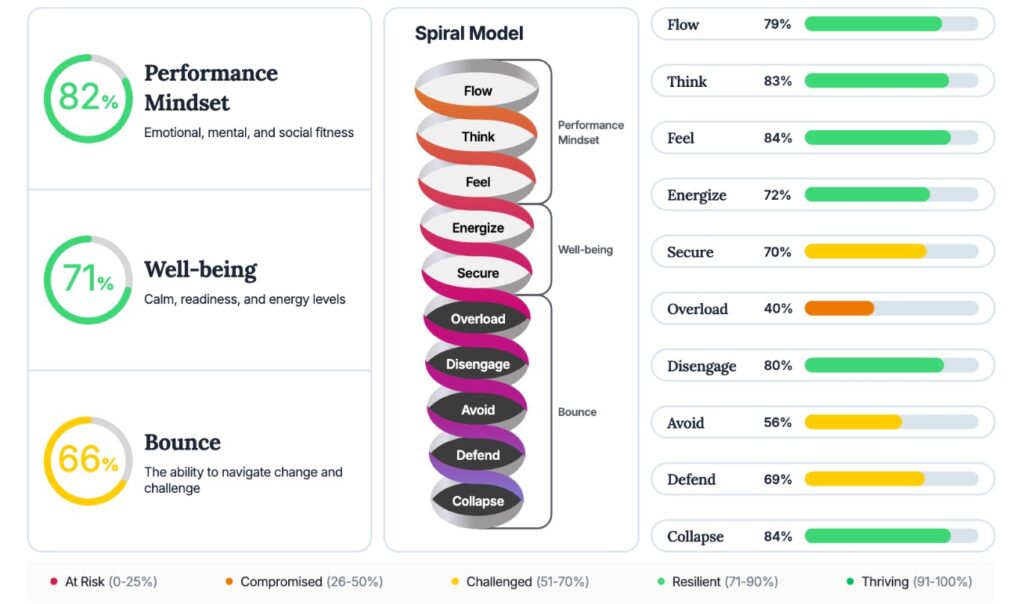
Participant results in a post-assessment

No more “thanks, I think that coaching helped.” Instead: “I improved my sleep quality by 17%, and I’m 18% better at managing anxiety.” That’s why HR teams and executives respond so well to this approach. It brings real credibility and real evidence, turning coaching into a genuine strategic investment. If you’re after referrals from existing or previous clients, give them data worth sharing. They become genuine ambassadors in the market.

What Kind of Coaches Should Apply?

This certification suits coaches working with leaders and executives, teams and departments, healthcare professionals, educators and students, and athletes and performers. It’s built for coaches who want a genuinely deeper impact, who value insight over opinion, and who are ready to work at the intersection of performance and wellbeing.

Why Now?

The world is demanding more from people than it used to. Change is constant. Stress runs high. Plenty of people feel genuinely overwhelmed. Coaches are more needed than ever, but meeting the moment requires the right tools. The Resilience Coach Certification is evidence-based and built to equip coaches to guide others through real complexity with genuine clarity.

What Happens After Certification?

Graduates join a global network of resilience professionals, with access to ongoing learning, group support and mentorship, upgrades as the model evolves, and new insight as the underlying resilience science develops. It’s a living system, not a static course, and it keeps improving. The certification is also approved by the ICF for Continuing Coach Education, offering 4 CCE hours on completion.

The future of coaching isn’t guesswork. It’s grounded, measurable, and genuinely human, and it starts with resilience.

Resilience Coaching for Gen Z and New Leaders

  • 72% of Gen Z report at least one burnout symptom, the highest of any generation currently in the workforce, compared to 62% for Gen X and 38% for Baby Boomers.
  • Resilience isn’t about toughening up. It’s about becoming more self-aware, grounded, and able to pause and choose a response rather than react automatically, and that’s a coachable skill, not a fixed trait.
  • Traditional feedback often backfires with new leaders because it triggers a genuine stress response. Curiosity-based coaching questions work better than critique.

They’re talented. They’re purpose-driven. They want to lead, but they’re doing it during a period of genuine, sustained uncertainty.

Gen Z and early-career professionals are entering management roles at an accelerating pace, with promotion rates rising faster than other generations over the same period, according to ADP Research. At the same time, a growing share of Gen Z workers are actively opting out of management altogether to protect their wellbeing, a trend Business Insider has described as “conscious unbossing.” Both things are true simultaneously, and it’s worth naming directly: some Gen Z professionals are moving into leadership faster than ever, while others are deliberately declining it, often for the same underlying reason, genuine concern about what leadership currently costs.

Either way, this generation isn’t just asking for support. It’s offering something back: a genuine rethinking of how organisations work, lead, and sustain people over time. Their expectations around mental health, purpose, and authenticity aren’t a weakness. They’re a real call to evolve, and a genuine opportunity for every generation to reflect on what leadership should actually look like now.

What Gen Z Leaders Are Up Against, and Why It Matters

Young leaders aren’t just managing tasks. They’re navigating pressure from every direction: expected to lead with confidence, communicate across generations, manage both up and down, and perform at the pace of constant change, all while asking genuine internal questions. What does leadership even look like in a world this uncertain? Is success worth it if it costs real wellbeing to get there? How do you lead in a way that feels authentic rather than performative?

The mental health picture is serious and getting more precisely documented. A 2025 Seramount Burnout Survey found 72% of Gen Z workers report at least one burnout symptom, exhaustion, loss of motivation, or emotional detachment, compared to 62% for Gen X and 38% for Baby Boomers. Separately, Deloitte’s 2025 Gen Z and Millennial Survey found 40% of Gen Z feel stressed or anxious most or all of the time, with a substantial share of that stress tied directly to their work environment. SHRM’s 2025 research found 61% of Gen Z workers would strongly consider leaving their current role for one offering meaningfully better mental health support.

Coaching isn’t a nice-to-have for this generation. It’s a genuine resilience intervention.

Why Building Resilience Isn’t About Toughness

One of the most common mistakes organisations make is expecting younger leaders to simply toughen up, to lead the way previous generations did, to develop a thicker skin. But resilience isn’t about becoming harder. It’s about becoming wiser, more self-aware, more genuinely grounded, and more able to pause and choose a response rather than react automatically.

That’s precisely where coaching makes the real difference. A skilled coach helps young professionals move from anxiety to genuine agency, from reacting to actually reflecting, and that shift changes far more than it might first appear to.

Practical tip: start with a genuine resilience conversation, not a performance review.

Teach Resilience as a Skill, Not a Trait

Resilience isn’t something you’re simply born with. It’s something you build, yet most emerging leaders have never had it genuinely broken down for them, let alone measured. Resilience Institute’s own research frames it as spanning focus, recovery, energy, empathy, adaptability, emotional regulation, and a clearly articulated sense of purpose, measurable, trainable human capacities rather than vague aspirations.

Structured assessment tools let young leaders see directly where they’re genuinely strong, where they’re actually at risk, and how to grow with real intention. Coaching works best paired with this kind of insight. Resilience becomes concrete once it’s visible.

Why Traditional Feedback Often Doesn’t Land

Feedback triggers a genuine stress response. It puts people on the defensive, and instead of encouraging growth, it can trigger withdrawal instead. Executive coach Dr. Marcia Reynolds put it directly on the Resilience Podcast: feedback triggers a stress response not unlike seeing a police car pull up behind you.

Curiosity works better than critique. What are you trying to achieve here? What do you want to do differently next time? How can I actually support you? These land very differently from a verdict handed down after the fact.

Practical tip: stop telling them how they’re doing. Start helping them think more clearly instead.

Coaching Emerging Leaders Through the AI Shift

The last time the world changed this quickly, it was called the Industrial Revolution. For emerging leaders, AI brings genuine opportunity alongside real uncertainty: what happens to a career built on skills that might be automated within a few years? NVIDIA CEO Jensen Huang has put the reframe simply: you’re not going to lose your job to AI, you’ll lose it to someone who uses AI well.

This is where resilience coaching earns its place directly. The capacities AI genuinely can’t replicate, emotional agility, presence, intuition, real trust-building, are exactly the ones organisations will rely on most as more routine work becomes automated.

Practical tip: ask directly, “what strengths do you want to double down on, because no machine can genuinely do them for you?”

How Coaching Builds Genuine Psychological Safety

Emerging leaders don’t want to pretend they have all the answers, and they don’t trust people who act like they do either. Coaching offers a genuinely rare kind of space, one where they don’t have to perform, where they can think out loud, and where they can be real without it reading as weakness.

Psychological safety isn’t just a culture buzzword. It’s a real condition for growth, and coaches function less as mirrors and more as genuine guides through uncertainty.

The Development Gen Z Actually Wants

Forget outdated leadership pipelines. The next generation is asking for something genuinely different: development that’s real, not performative, not perfection-driven, not productivity for its own sake. They want real space to grow, tools that actually work, and coaches who meet them where they genuinely are.

This isn’t about lowering the bar. It’s about raising the relevance. The organisations that understand this will be the ones that attract, retain, and grow the leaders everyone will need in the years ahead.

Gen Z isn’t asking leadership to get easier. They’re asking it to get more honest, and resilience coaching is exactly the tool built for that shift.