


20 Types of Workplace Culture, and What the Research Says Works
- Four of the culture types below, clan, adhocracy, market, and hierarchy, come from Cameron and Quinn’s Competing Values Framework, one of the most studied models in organisational research.
- A 2025 study using the framework’s assessment instrument found that hierarchy culture is often the dominant style in large organisations, even though clan culture, with its focus on people and belonging, is associated with stronger resilience.
- Separate 2025 research found adhocracy culture has the strongest link to digital transformation capability among the four core types, ahead of clan, market, and hierarchy.
- Gallup’s 2026 workplace report found global engagement fell to 20% in 2025, with the sharpest decline among managers, a reminder that culture is carried by daily leadership behaviour, not by a values poster.
Workplace culture gets described in a lot of grand language: the soul of an organisation, its DNA, the thing that eats strategy for breakfast. Most of that language is not wrong, exactly, but it is not especially useful either. What is useful is knowing where these culture types actually come from, what the current research says about which ones support resilience, and having a clear enough picture of your own culture to do something about it.
Where These Culture Types Actually Come From
Four of the categories below, clan, adhocracy, market, and hierarchy, are not marketing labels. They come from the Competing Values Framework (CVF), developed by Cameron and Quinn and built around two tensions every organisation navigates: flexibility versus control, and internal focus versus external focus. It remains one of the most extensively tested models in organisational culture research, with a validated assessment tool, the Organisational Culture Assessment Instrument, used across industries from healthcare to manufacturing.
The other types in this list are not part of that academic framework. They are practical, commonly used descriptions (performance-oriented, well-being, transparent, and so on) that organisations and consultants use to describe cultural emphasis. Both kinds are useful. It just helps to know which is which before you go looking for a study to back up a claim about your “aggressive culture.”
What Recent Research Says About Culture and Resilience
An exploratory study applying the CVF’s assessment instrument to public institutions found that hierarchy culture tends to be the dominant style in practice, even though employees consistently prefer, and organisations benefit more from, a clan culture oriented around unity and belonging. The researchers concluded that resilient cultures are specifically the ones that emphasise cohesion and mutual support, because that is what allows an organisation to absorb a shock and respond rather than fracture under it.
A separate 2025 study published in Information and Management examined all four CVF culture types against digital transformation capability and found adhocracy culture had the strongest positive relationship, followed by clan, then market, then hierarchy. The practical read for leaders is not “pick one culture type and commit forever.” It is that different cultural emphases pay off for different challenges, and a resilient organisation needs enough flexibility in its dominant culture to draw on adhocracy’s adaptability and clan’s cohesion when the moment calls for either.
This is not an abstract concern. Gallup’s State of the Global Workplace 2026 report found global employee engagement fell to 20% in 2025, its lowest point since 2020, with the sharpest single year drop occurring among managers, the people most directly responsible for translating a stated culture into daily behaviour. Culture that exists only in a values document does not show up in that kind of data. Culture that is actually practised does.
Culture and Strategy Are Not Actually in Competition
The idea that “culture eats strategy for breakfast” gets repeated so often it has lost some of its meaning, but the underlying point holds up. Strategy sets the direction. Culture determines whether people actually follow it when no one is watching.
Deloitte’s Core Beliefs and Culture research found 94% of executives and 88% of employees believe a distinct workplace culture is important to business success, though only around 12% of executives believed their own organisation was actually driving the “right” culture, a gap worth sitting with. More recently, Deloitte’s 2024 workplace wellbeing research found 93% of executives and 88% of workers agree a company’s purpose should extend beyond shareholders to include people and society, and that organisations investing in what Deloitte calls human sustainability see stronger engagement, retention, and trust in leadership as a result. The pattern across both surveys is consistent: people already believe culture matters. The gap is in execution, not conviction.
Culture Is Practised, Not Mandated
You cannot mandate culture into existence with a mission statement or a slogan on a wall. It is built through consistently repeated behaviour, starting with leaders. As Gandhi put it, “Be the change you wish to see in the world.” In an organisation, that means leaders modelling the values they want to see before anyone else adopts them, because employees calibrate to what leadership actually does, not what leadership says in a town hall.
Types of Workplace Culture
Most organisations are a blend of several of these. Missing one you recognise from your own workplace? Let us know.
Resilient Culture. Prioritises adaptability and the ability to recover from setbacks. Strong for quick recovery and sustained problem-solving, but can tip into complacency if people assume resilience will always carry them through without addressing root causes. Start by measuring your current resilience levels rather than assuming you know where you stand. This type tends to support and strengthen all the others on this list.
Clan Culture (Competing Values Framework). Resembles an extended family, built on collaboration, loyalty, and shared tradition. Strong for loyalty and a nurturing environment, weaker on incorporating outside ideas and can drift toward excessive consensus-seeking. Build it through genuine interpersonal investment and team-building, not forced fun.
Adhocracy Culture (Competing Values Framework). Encourages risk-taking, innovation, and entrepreneurial behaviour. Strong for agility and pioneering work, weaker on stability, and can tip into chaos without some structural anchor. The 2025 research above found this culture type has the strongest link to digital transformation capability of the four CVF types.
Market Culture (Competing Values Framework). Focused on results, competition, and the external environment. Strong for competitive edge and goal achievement, weaker on long-term thinking and can neglect employee wellbeing if left unchecked.
Hierarchy Culture (Competing Values Framework). Structured, with clear roles and defined procedures. Strong for stability, predictability, and efficiency, weaker on innovation and change readiness. The most common dominant style in large organisations, according to the research cited above, but not the one most associated with resilience.
Purpose Culture. Driven by a shared mission beyond profit. Strong for commitment and alignment, weaker on operational discipline if the mission is not tied to concrete metrics.
Learning Culture. Prioritises growth, knowledge-sharing, and adaptability. Strong for staying current, weaker on decisiveness if constant learning tips into analysis paralysis or change fatigue.
Innovative Culture. Emphasises creativity and new ideas. Strong for market leadership, weaker on focus if novelty is rewarded for its own sake.
Customer-centric Culture. Built around exceeding customer expectations. Strong for loyalty and satisfaction, weaker on internal operations or employee experience if the balance tips too far outward.
Team-first Culture. Centred on collaboration and team dynamics. Strong for cohesion, weaker on individual accountability and can slide into groupthink.
Aggressive Culture. Driven by competition and outperforming rivals. Strong for achieving significant milestones, weaker on sustainability and ethical guardrails need to be explicit and enforced, not assumed.
Performance-oriented Culture. Rewards based on measurable results. Strong for clarity and achievement, weaker if metrics crowd out process quality or ethical behaviour.
Safety-first Culture. Built around protocols and training. Strong for reducing incidents and building trust, weaker on speed, and can breed complacency if audits become routine rather than genuinely scrutinised.
Bureaucratic Culture. Rigid adherence to established policy. Strong for standardisation and compliance, weaker on innovation and change response.
Holacracy. A flatter system without traditional hierarchy, with clear but autonomous roles. Strong for flexibility and empowerment, weaker on accountability if role boundaries are not actively maintained.
Diversity and Inclusion Culture. Prioritises inclusiveness across backgrounds. Strong for wider perspectives and morale, weaker if initiatives stay surface-level rather than structural.
Sustainability and Green Culture. Built around eco-friendly practice. Strong for reputation and long-term thinking, weaker if upfront costs are not budgeted honestly, which invites greenwashing accusations.
Transparent Culture. Built on open communication and shared information. Strong for trust, weaker if information sharing outpaces people’s ability to process it usefully.
Global Culture. Prioritises multicultural operation and global perspective. Strong for reach and adaptability, weaker on complexity and requires genuine cultural sensitivity training, not a single onboarding slide.
Coaching Culture. Built on continuous feedback and mentoring. Strong for development and retention, weaker if it tips into over-management rather than genuine growth support.
Well-being Culture. Focused on holistic employee health, physical, mental, and emotional. Strong for productivity and retention, weaker if wellness initiatives become a substitute for addressing the operational causes of stress in the first place.
If you are a senior HR, L&D, or OD leader working through what a resilient, inclusive culture actually looks like across borders and functions, Resilience Institute and Aperian are co-hosting Fit for Change, Across Difference, a closed-door gathering of 40 to 45 senior leaders in Singapore on 16 October 2026. The session looks at cultural agility, cross-cultural psychological safety, and human-first leadership in an AI-driven world, the same questions this article is built around, worked through directly with peers. It is invite-only with limited seats, RSVP by 30 September 2026. Details are on the event page.
Cultivating the Culture You Want
Look at your own organisation honestly. Which of the types above actually describes it today, not which one you would like to claim in a recruitment deck? Then ask what specific, repeatable behaviours would move you toward the culture you actually want.
Before your next leadership offsite, ask:
- Which culture type would we honestly assess ourselves as today, using a validated instrument rather than a gut feeling?
- Where does our stated culture diverge from what our engagement or resilience data actually shows?
- What is one behaviour our leadership team could model consistently, starting this month, that the culture we want actually requires?
Culture is not a slogan you choose. It is the pattern of behaviour your organisation actually rewards, and the research now gives leaders a real way to measure which pattern they have, rather than guessing from a values poster.

Positivity at Work: What Actually Builds a Resilient Culture
- Nearly 3 in 4 employees report feeling more engaged and performing better when they feel genuinely heard, and companies where employees feel heard financially outperform their industry peers by a meaningful margin.
- A popular claim that high-performing teams have exactly 6 positive interactions for every negative one doesn’t hold up. The underlying mathematical model was formally withdrawn by the journal that published it after a rigorous critique found the equations had no legitimate connection to emotional data.
- The more modest, still-defensible version survives: teams and cultures with a healthier balance of positive to negative interaction do tend to perform better, there’s just no precise magic number behind it.
Positivity at work is more than an individual’s mindset. It’s part of a larger system shaping how a workforce interacts, how people align with organisational goals, and how the culture as a whole either compounds or erodes over time. Leaders set values, expectations, and rules of engagement that flow down through an organisation; employees hold their own attitudes and perceptions that flow back up and shape culture in return. Building a genuinely positive workplace culture requires understanding both directions of that exchange, not just the one leadership controls.
Why Culture Shows Up in the Numbers, Not Just the Vibe
Do you feel listened to, supported, and included at work, or unheard and boxed in? That distinction matters for more than morale. A report on workplace mental health and wellbeing from the US Surgeon General found workplace culture has a substantial, measurable impact on employee wellbeing, productivity, and organisational performance. Toxic or negative cultures reliably show up in lost productivity and declining quality of work; positive cultures show up in stronger engagement and innovation. Culture has become a genuine input to the bottom line, not a soft adjacent concern.
Employer priorities have shifted meaningfully in recent years, driven by a genuine rebalancing of what employees expect from work. Ernst & Young research found 54% of US workers had left a job specifically due to their manager’s lack of empathy toward workplace issues, and 49% left because of inadequate sensitivity to stress from their home life. The organisations that adapted fastest to this shift are now measurably ahead on culture-related metrics; the ones that didn’t are the ones still asking why retention feels harder than it used to.
When Positivity Tips Into Something Toxic
Genuine positivity means holding a constructive outlook while still engaging honestly with the good, the bad, and everything in between. Taken to an extreme, it curdles into something else. Tabitha Kirkland, a psychologist at the University of Washington, describes toxic positivity as an approach devoid of empathy that refuses to acknowledge genuine difficulty. It leaves people feeling invalidated and unheard, which is directly corrosive to the same engagement and performance positivity is supposed to build in the first place.
A Workforce Institute survey found nearly three in four employees feel more engaged and perform better when they feel genuinely heard, and companies that financially outperform their industry peers show employees reporting feeling heard at a 26-percentage-point higher rate than their less successful counterparts. Taking positivity to a forced, unconditional extreme reliably backfires against the very outcomes it’s meant to produce.
What Positive Leadership Actually Looks Like
Positive leadership plays to people’s genuine strengths, gives real recognition, and maintains an authentically optimistic outlook, and it’s been consistently correlated with better engagement, optimism, and performance across the research.
Play to strengths, not roundedness. Management thinker Peter Drucker argued individuals create more impact by deliberately sharpening the skills they already excel at rather than chasing a well-rounded profile. Leaders can apply this at the team level too: pairing a strong analyst with a strong presenter on a single project often produces something neither could deliver alone.
Recognition compounds. Gallup’s research has found employees who don’t feel recognised at work are roughly twice as likely to leave. Recognition also does more than retain people individually; it signals clearly across a team what leadership actually values, which shapes behaviour well beyond the person being recognised. When feedback needs to address something that isn’t working, framing the conversation around what’s going well and how to build forward tends to land far better than leading with criticism.
The ratio claim worth retiring. A once-popular claim held that high-performing teams show exactly six positive interactions for every negative one, while low-performing teams show one positive for every twenty negative. This traces back to research on team dynamics closely tied to the Fredrickson-Losada “critical positivity ratio,” a specific mathematical model that the journal American Psychologist formally, partially withdrew in 2013 after a rigorous critique found the underlying equations, borrowed from fluid dynamics, had no legitimate mathematical connection to emotional or team data. The researcher who built the model chose not to defend it. What survives is a softer, still-defensible point: teams with a healthier balance of constructive to critical interaction do tend to perform better. There’s just no precise number behind it, and it’s worth being skeptical of anyone citing one with false confidence.
Optimism Spreads Through a Team, Literally
The American Psychological Association defines optimism as the attitude that good things will happen and that one’s aims will ultimately be fulfilled. Optimistic leaders contribute something genuinely functional to a team beyond mood: they help generate solutions, build a credible vision forward, and reinforce the behaviours that move a team toward it.
Wharton professor Sigal Barsade’s research on emotional contagion, the documented ripple effect through which emotions spread across individuals and groups, found positive emotional contagion specifically helps teams collaborate better, reduces conflict, and improves performance. When optimism becomes genuinely embedded in a team’s culture rather than performed, individuals within it tend to develop their own personal sense of optimism, which industry research from Leadership IQ, surveying over 11,000 employees, found may matter even more than manager-driven recognition alone: employees with a strong personal sense of optimism were more than twice as likely to report feeling inspired to do their best work.
Resilience: The Skill Underneath the Culture
The American Psychological Association defines resilience as the flexibility to adapt to change and challenge, and critically, it’s a trainable skill rather than a fixed trait. That same Leadership IQ research found resilience accounts for a meaningful share of an employee’s overall sense of inspiration at work, independent of recognition or optimism alone.
Resilience Institute has tracked resilience levels across organisations globally for years, using a Resilience Diagnostic assessment built on 60 psychometric questions that measure the specific factors supporting or undermining resilience, producing what’s known as a Resilience Ratio for individuals and organisations alike.
The Resilience Spiral
This visual framework organises the 60 questions into 11 categories arranged as a spiral, giving each user a map of strengths, risks, and practical next steps. The upper half of the spiral, Spirit in Action, Train Mind, Engage Emotion, Energise Body, and Master Stress, represents the direction of genuine growth, connection, and flow. Spirit in Action, at the top, represents peak performance. Master Stress sits at the base, the pivot point: left unmanaged, stress is what determines whether someone moves up the spiral or down it.
The lower half, Confused, Disengaged, Withdrawn, Vulnerable, Distressed, and Depressed, represents the progression when resilience isn’t sustained. Confusion produces a loss of focus; disengagement leads to boredom and falling productivity; withdrawal costs energy and presence; vulnerability shows up as fatigue and indifference; distress drives attrition and a deteriorating culture. Individuals and organisations operating from the upper half consistently function at a higher level than those sliding into the lower one.
Training It, Not Just Measuring It
Resilience Institute’s own training data, spanning the Resilience app, webinars, workshops, and communications support, has found structured resilience training measurably increases performance, reduces risk, and boosts growth in capability. The app itself provides ongoing access to resilience content, goal tracking, meditations, video training from Dr Sven Hansen, and a support chatbot, alongside the diagnostic that anchors the whole system. Thousands of organisations globally use this combination to measure and actively build both individual and organisational resilience, and the same balance-of-interaction principle discussed above, genuine, not forced, positivity, is exactly what the training is designed to build.
Positive culture isn’t a mood you generate once and coast on. It’s a ratio you keep genuinely honest, with no magic number required, just the discipline to keep it real.

What Resilient Systems Teach Us About Building Resilient Teams
- Resilient technology systems share five keystones, redundancy, diversity, decentralization, modularity, and adaptability, and each maps directly onto a specific, buildable practice for human teams.
- In 2022, Patagonia’s founder transferred 100% company ownership to a purpose trust and a climate nonprofit specifically to protect the company’s mission from short-term shareholder pressure and founder succession risk, a genuine structural resilience mechanism, not just a values statement.
- AI systems can be engineered for resilience, but it isn’t automatic. Left unchecked, human over-reliance on AI outputs, automation bias, can quietly undermine the very resilience an organisation is trying to build.
Resilience is critical in both technology and human performance. A resilient technology system can absorb a network error or power outage without shutting down entirely. The question worth asking directly: can that same concept genuinely apply to human teams? The answer is a resounding yes, and the parallels turn out to be remarkably specific, not just a loose metaphor.
Understanding Resilient Systems in Technology
In technology, resilient systems are synonymous with efficiency, reliability, and robustness, built on five keystones. Redundancy, often viewed negatively in human terms, is a genuine technological safeguard: multiple backups ensuring the system keeps functioning if one part fails. Diversity brings a spectrum of different elements, each performing a distinct task, preventing any single point of failure from taking down the whole system. Decentralization distributes power and control, so the failure of one section doesn’t mean the failure of the whole. Modularity breaks a system into manageable, self-contained units, so disruption stays isolated rather than spreading. Adaptability is the system’s capacity to anticipate, react to, and genuinely learn from disruption, arguably what makes a system resilient rather than merely sturdy.
The Human Parallel
Redundancy in a workforce looks like cross-training and genuinely multifunctional teams, more than one person able to do a given task, creating a real backup for absence or attrition. Diversity means different skills, experiences, and perspectives genuinely coexisting within the same team, which measurably improves problem-solving and adaptability to change. Decentralization empowers team members directly, building autonomy and avoiding over-reliance on any single individual. Modularity shows up as semi-independent, cross-functional teams that can operate on their own while staying in harmony with the wider organisation. Adaptability is fostered through a genuine culture of continuous learning and proactive anticipation of challenges, not just reaction after the fact.
Building These Traits Deliberately
Cross-Training and Skill Development (Redundancy)
This isn’t about replacing employees. It’s about building a team where multiple people can genuinely perform a range of tasks, so one person’s absence doesn’t halt the whole operation. It provides a real safety net while also enhancing individual skill and job satisfaction.
Diversity and Inclusion
A genuinely resilient team, like a well-rounded technology system, needs diverse thought, perspective, and background. This opens the door to more innovative ideas and lets a team approach challenges from multiple angles at once, improving both decision-making and the overall work environment.
Empowerment and Decentralization
Giving individuals genuine decision-making capability mirrors decentralization in a technical system. It reduces bottlenecks, speeds up decisions, and keeps the team functioning even if a key decision-maker is unavailable, while also genuinely improving job satisfaction.
Semi-Independent Teams
This mirrors modular design directly: each team functions independently while still contributing to the whole. Disruption in one department doesn’t have to disrupt the entire organisation if teams can genuinely adjust and respond on their own.
Culture of Learning and Proactive Problem-Solving (Adaptability)
Resilient technology systems need to adapt and upgrade to stay relevant; teams need the same. A genuine culture of learning lets a team not just react quickly to change, but actually anticipate problems and build solutions in advance.
Measurement and Diagnostics: The Core of Both
In technology, measurement and diagnostics are the pillars the whole system rests on. Servers are constantly monitored for CPU usage, memory, and network traffic, with anomalies triggering immediate correction. The same principle applies directly to human teams, shifting focus from hardware and software to what might be called “humanware,” the people themselves. Understanding a team’s genuine strengths and risks, where it shines and where it needs real support, is what allows leaders to make informed decisions that actually enhance effectiveness and resilience, rather than guessing.
Resilience Institute’s Resilience Assessment brings exactly this kind of diagnostic capability to human teams, offering insight that conventional engagement surveys often miss entirely: a data-driven view of individual and team resilience factors that enables genuinely targeted intervention rather than a generic, one-size-fits-all programme.
The Real Benefits
A resilient team, like a resilient system, is robust, adaptable, and genuinely efficient. Redundancy through cross-training removes single points of failure, supporting consistent output even through individual absence. Empowered decision-making reduces bottlenecks and speeds up workflows. Semi-independent teams support genuine work-life balance by distributing workload more evenly, reducing stress and burnout risk directly. Valuing diverse perspectives and continuous learning increases both job satisfaction and innovation, while a resilience-focused culture builds real transparency, collaboration, and mutual support, the kind of environment that signals genuine investment in people, not just output.
What About AI Resilience?
AI is on nearly everyone’s mind, and it’s worth asking directly: is AI actually resilient? AI can be designed to be resilient, but it isn’t inherently so. Resilience in AI means the ability to maintain or quickly regain strong performance under adverse conditions, unfamiliar input data, adversarial attempts to deceive it, or a changed operating environment. Achieving this requires deliberate design: robustness to handle unfamiliar situations, redundancy through backup models, continuous learning that genuinely adapts over time, and real interpretability, understanding how the system actually reaches a decision well enough to predict how it will behave under new conditions.
There’s a second, less obvious risk worth naming directly: even a well-engineered AI system can undermine human resilience if people stop genuinely questioning its output. This pattern, known as automation bias, the tendency to accept an automated system’s recommendation while discounting contradictory information, is well documented, and it tends to worsen under time pressure or after repeated positive experience with a tool. A genuinely resilient team using AI well isn’t one that trusts the system completely. It’s one that stays actively engaged with it, asking what would make this output wrong, the same active-questioning habit that makes a human team resilient in the first place.
Case Studies
Google: Autonomy and Continuous Learning
Google builds technical resilience through systems redundancy and decentralised networks, and mirrors that in its workforce through a genuine emphasis on employee autonomy and continuous learning, encouraging creative thinking and real ownership rather than rigid top-down direction.
Microsoft: Diversity and a Growth Mindset
Microsoft’s technical resilience rests on diversity, adaptability, and redundancy, and the company’s commitment to diverse talent through initiatives like the LEAP Engineering Acceleration Program mirrors that principle directly in its workforce, alongside a genuine cultural shift toward a growth mindset that treats failure as a real basis for improvement.
Patagonia: Structuring Resilience to Outlast Any Single Owner
Patagonia offers a genuinely different, and in some ways more structurally literal, example of organisational resilience than a technical infrastructure metaphor usually allows. In September 2022, founder Yvon Chouinard and his family transferred 100% of the company’s voting stock to the newly created Patagonia Purpose Trust, and 100% of its non-voting stock to the Holdfast Collective, a nonprofit dedicated to fighting climate change. “Earth is now our only shareholder,” Chouinard wrote in the letter announcing the change.
The reasoning behind the structure is itself a genuine case study in resilience thinking. Chouinard explicitly rejected taking the company public, arguing that “even public companies with good intentions are under too much pressure to create short-term gain at the expense of long-term vitality and responsibility.” Rather than leave the company’s mission dependent on a single owner, a family’s future decisions, or public market pressure, the trust structure is designed specifically to survive all three, decentralising control away from any one point of failure and permanently encoding the company’s purpose into its actual governance, not just its stated values. The company continues to donate 1% of sales to grassroots environmental groups and remains a certified B Corporation, and the new structure now directs an estimated $100 million a year in profit toward environmental causes.
This mirrors the modularity and decentralization principles discussed above in a genuinely unusual, structural way: Patagonia built a governance system specifically resilient to the two things that most often derail a values-driven company over time, founder succession and shareholder pressure, rather than simply hoping good culture would hold.
Despite different specific approaches, Google, Microsoft, and Patagonia each embody the same underlying principles, diversity, decentralization, and continuous learning, in how they build organisational resilience. These case studies underline a consistent pattern: investment in genuine resilience, whether in culture, structure, or both, is an investment in an organisation’s long-term survival, not a soft-benefit side project.
Resilient systems and resilient teams share the same underlying architecture, redundancy, diversity, decentralization, adaptability, but a team isn’t a machine to be calibrated. Build the structure like a resilient system. Nurture the people like people.

A Guide to Positivity at Work
Table of Contents
What is positivity?
Positivity at work is more than a personal mindset or attitude. It is part of a bigger movement that influences the individual worker, how the workforce interacts with one another, and how workers align with the organisational goals and culture at large.
Positive workplace cultures ensure beneficial change that ripples from leaders all the way down to individual employees and vice versa. These types of cultures build empathy, optimism, and resilience — all keys to success. Building a positive workplace culture demands an understanding of the dynamics of the workplace from the top and bottom and the people within it.
From the top, leaders create values, experiences, and rules of engagement that trickle down the organisation to the employees. Employees also hold their own attitudes, beliefs, and perceptions that provide feedback to leadership and influence the overall workplace culture.
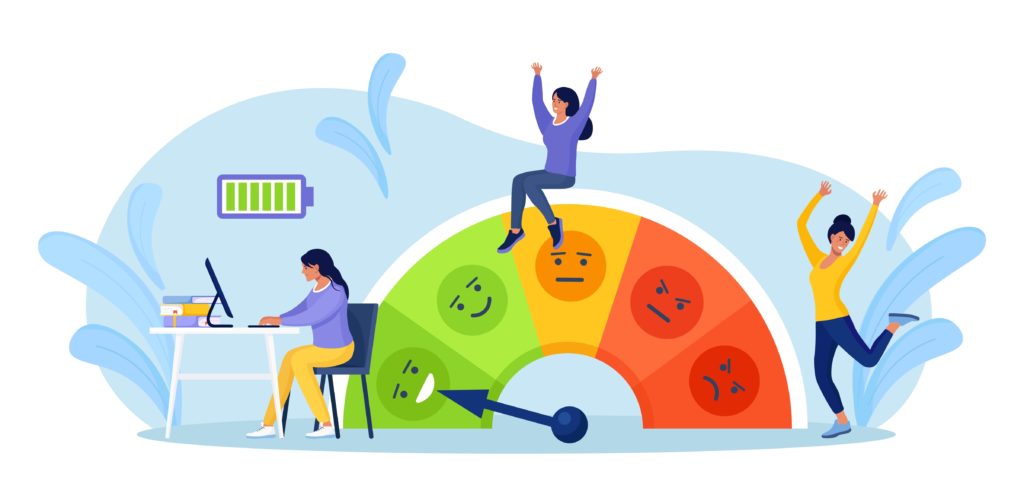
Positive vs negative workplace cultures
Do you feel listened to, supported, and included at work? Or do you feel unheard, neglected, and boxed in? The quality of the culture in the workplace plays a significant role not only in overall wellness but also in performance.
In broad terms, workplace cultures fall somewhere between positive and negative. A 2022 report on Workplace Mental Health and Well-Being by the United States Surgeon General reveals that workplace culture has a significant impact on employee well-being, productivity, and organisational performance.
Negative or toxic workplaces can result in a loss of worker productivity, performance, and overall quality of work. On the other side of the coin, a positive work culture can boost engagement and innovation.
Put simply, work is no longer just work. The cultures that form in the workplace have just as much to say about a company’s bottom line as the numbers.
Modern workplace culture
Today, the workplace is more than a space where people gather — either in person, online, or both — to perform their jobs. During the pandemic and the return to the office, I spent time reporting on the work-life. Amid the many interviews of academic experts, industry leaders, and workers, a pattern emerged.
The rapidly changing landscape, from hybrid work to the Great Resignation, caused employers to shift their views on workplace culture radically. While employers strived to meet goals, employees sought a more balanced work-home life.
For example, 2022 research by Ernst & Young found that 54% of workers in the United States left a job due to their boss’ lack of empathy when it came to issues at work. The research also found that 49% of workers left their job because of inadequate sensitivity to home life stress.
While some innovative leaders were onto this approach long before, the idea that the workplace should equally focus on employee expectations came to the forefront. The results have created a more dynamic workplace culture predicated on creating positive workplace cultures and mitigating negative influences.
Toxic positivity

Taken at face value, positivity is simply maintaining a positive perspective on life — the good, the bad, the ugly, and the beautiful. At its extreme, positivity can seem out of touch with reality. Simply putting on the don’t worry, be happy blinders can neglect the challenges and uncertainties that people face in everyday life.
Tabitha Kirkland, a psychologist and associate teaching professor at the University of Washington’s Department of Psychology, says that toxic positivity is devoid of empathy and neglects to recognize the negative things in life. This approach can make people feel invalidated and not listened to, which is critical to employee engagement, performance, and the financial success of the company.
A 2021 survey by the Workforce Institute found that nearly 3 out of 4 employees say that they feel more engaged and perform better at work when they feel heard. This also impacts the overall financial performance of the company, as the survey also found that employees in companies that financially outperform others in their industry feel heard more by a margin of 26%.
Taking an extreme approach to positivity can actually backfire.
Positive leadership and optimism
Positivity starts with a form of leadership approach that plays to people’s skills, gives recognition and encouragement to others, and maintains an optimistic outlook. Positive leadership has been correlated with better employee engagement, optimism, and performance.
Sticking to strengths
Renowned Austrian-American management consultant Peter Drucker believed that individuals could create more impact at work by focusing on developing the skills they excel at. Instead of spending time trying to make a well-rounded skill set, Drucker believed that sharpening the tip of the spear and strategically cultivating one’s strengths and learning styles would serve an individual the best.
Leaders and managers can take a page from Drucker’s book by identifying team members’ skills and enabling them to work within that range. This does not have to be an entirely individual pursuit.
For example, if a project requires data analysis, but must ultimately be presented at a higher level meeting, assemble a team of analysts and designers to work together to find the trends and then present them in a digestible form. The push and pull dynamics can create something more powerful than numbers or graphics would alone.
Recognition and encouragement
Encouragement and recognition are two key spices in the recipe of healthy conversations. Gallup notes that simply recognizing employees not only positively impact engagement and productivity, it also can help keep employees around for longer. The study found that employees who do not feel recognized at work are twice as likely to quit.
Beyond the individual, recognition also impacts teams by painting a transparent picture of what leadership thinks success should look like. But sometimes conversations have to steer towards more difficult subjects, like when things need improvement.
When it comes to difficult conversations, delivering feedback requires a delicate approach. Instead of using harsh criticism, reframing the conversation to focus on what went well and how to pursue future success can go a long way in making a positive impact on the team.
Research on team conversations indicates that high-performing teams have 6 positive interactions for every negative one, while low-performing teams only have 1 positive interaction for every 20 negative ones. While these numbers may seem extreme, there is a potential explanation for why positive interactions dominate better-performing teams.
Optimism and emotional contagion
If positivity is part of the larger cultural framework of an organisation, then optimism certainly plays a role. The American Psychological Association defines optimism as “hopefulness: the attitude that good things will happen and that people’s wishes or aims will ultimately be fulfilled.”
Optimistic leaders provide a necessary positive emotional contribution to the team. They find solutions to problems, help create a vision for the future, and inspire others to reach that goal by reinforcing the positives. Sound familiar? A leader who practices recognition and encouragement is already building an optimistic culture.

This optimism can positively impact teams through emotional contagion. Coined by Sigal Barsade, Professor of Management at Wharton School of the University of Pennsylvania, emotional contagion is the ripple effect that occurs as emotions spread among individuals and groups. Barsade’s innovative research found that positive emotional contagion helped people work together, limited conflict, and boosted performance.
So when optimism becomes the attitude and outlook in the workplace, positive emotions can flow. This is critical because if the team is optimistic, then individuals can begin to harbour a personal sense of optimism — which may be even more valuable.
A 2022 study by Leadership IQ of over 11,000 employees found that while managers that give recognition have a positive impact, employees with a personal sense of optimism are more engaged. In fact, employees higher in self-optimism are more than twice as likely to feel inspired to try their best at work.
The ripple effect of optimism starts at the top but has the potential to create the biggest impact on employees when it is felt at a personal level. The Leadership IQ study also identified another major component of an employee’s inspiration and engagement at work: resilience.
Resilience training, tools, and techniques
Resilience is the use of flexibility to adapt to change and challenges, says the American Psychological Association. Even more critical, resilience skills can be trained. This is important because resilience not only factors into worker engagement, but it can also account for 25% of an employee’s inspiration at work.
Measuring Resilience
The Resilience Institute conducted a global study on resilience levels that spanned from 2018-2021. When the pandemic hit, resilience levels dropped globally. However, people began to bounce back as they adapted to the rapidly changing world. This bounce factor enables people to adapt in the face of change and challenges.
During the pandemic, people have bounced back by learning to connect in new ways during lockdowns, learning to cope with their mental health, and learning how to get better sleep. In fact, the Resilience Insitute’s 2022 Global Report found that sleep is the most important factor for developing resilience.
We measure resilience through the Resilience Diagnostics assessment. Using key psychometrics, the Resilience Diagnostic assessment uses 60 questions that measure specific factors that support or undermine resilience. Individuals and the entire organisation can use the tool via the web or mobile app to view the factors that promote your resilience or hinder it. This is known as the Resilience Ratio.
The Resilience Spiral
This visual tool represents the 11 main categories that make up different parts of the 60 questions in the Resilience Diagnostics assessment. Completing the questionnaire provides the user with a map of strengths and risks and practical recommendations to move up the spiral.
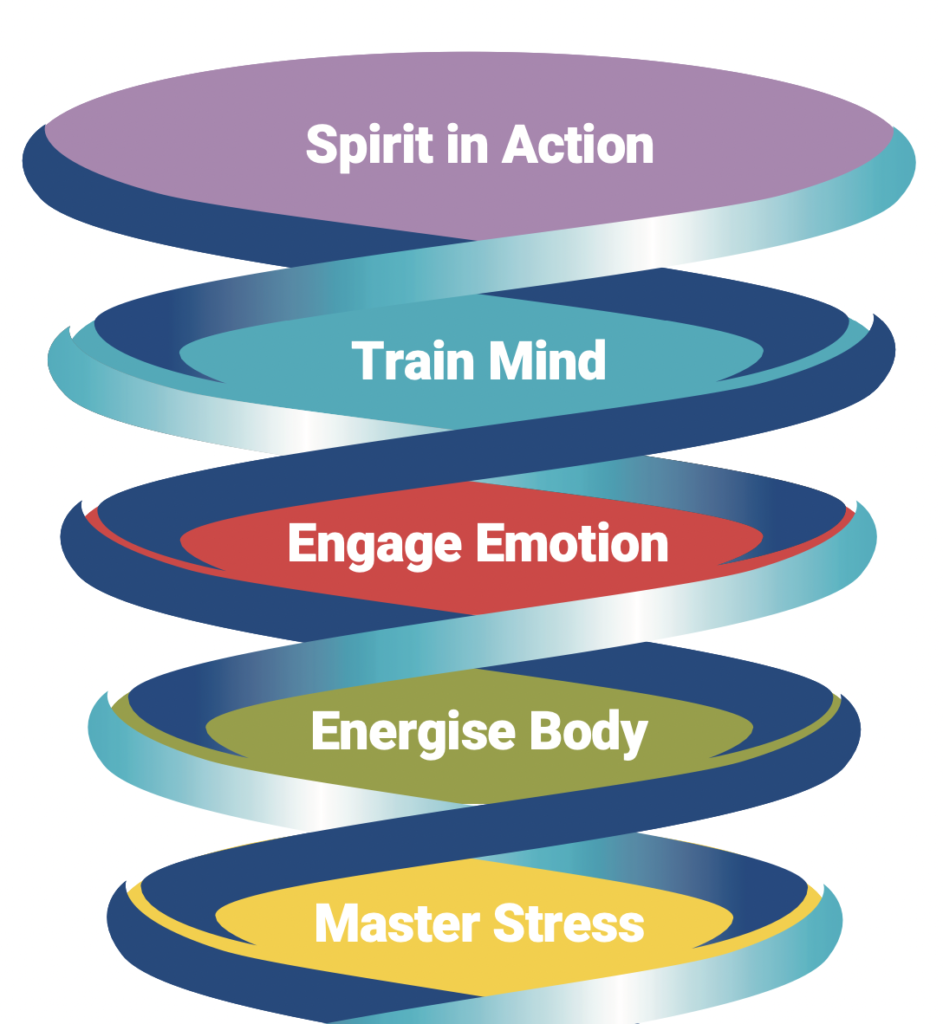
The top half of the Resilience Spiral includes the following categories:
- Spirit in Action
- Train Mind
- Engage Emotion
- Energise Body
- Master Stress
The upper half helps develop resilience and enables growth, connection, and flow. At the top of the spiral sits Spirit in Action, which represents peak performance. Next sits Train Mind, which relies on the fact that training the brain can combat the effects of ageing and performance.
Engage Emotion uses awareness to harshness the passion and creativity of emotions. The mind and body are intimately connected — energising the body sets the tone for the rest of the spiral. At the base sits Master Stress. Stress is the teetering point between the top and the bottom of the spiral because stress can rule your world when left unmanaged.
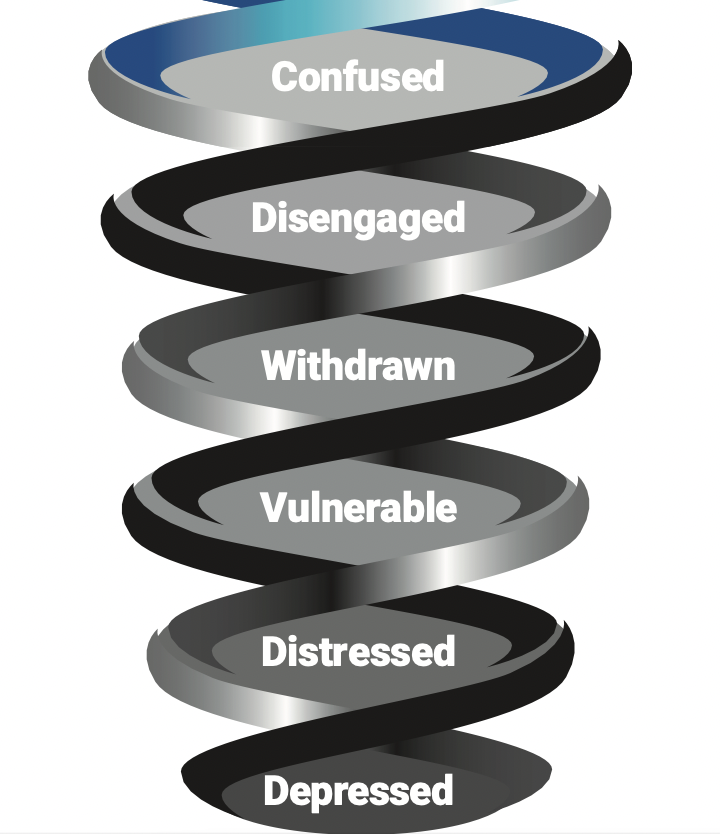
On the other side of the coin, the lower half of the Resilience Spiral includes the categories:
- Confused
- Disengaged
- Withdrawn
- Vulnerable
- Distressed
- Depressed
The lower half represents a lack of resilience. The first step down the spiral is Confused, which leads to a lack of focus. Next is Disengaged, which creates boredom and, eventually, loss of productivity. Progression down the spiral leads to Withdrawn — where the body loses energy and engagement.
Fatigue kicks in at the Vulnerable, as people feel indifferent. Distressed can lead to loss of staff and unhealthy organisational culture. Finally, Depressed signals the end of an organisation.
Resilient people and organisations work at higher levels. When resilience fails, people and organisations drop into the lower levels.
Training Resilience
The Resilience Institute offers resilience training — ranging from the Resilience app to webinars, workshops, and comms support — that can increase performance by 41%, decrease risk by 34%, and boost growth in capability by 38%.
Gain access to a library of information to help you learn more about the resilience factors and your own Resilience ratio, and learn skills for how to bounce back, access flow states, and increase emotional intelligence. The app also includes goal tracking, over 50 resilience training videos by Dr Sven Hansen, daily meditations, and a support chatbot.
The app is available in English, French, Spanish, Dutch, German and Mandarin. Thousands of organisations use The Resilience Institute to measure and improve individual and organisational resilience. Are you ready for resilience?
Original Source: https://resiliencei.com/blog/positivity-at-work/