Women Illustration
Overview of the personalised Resilience Assessment Report

See how we measure Resilience and the detailed insights into individual strengths and growth areas.

Download Report

Five Resilience Metrics Every Coach Should Be Tracking

  • 67% of all workers now report burnout symptoms, up sharply from 52% in 2021, and 77% of professionals report having experienced burnout in their current role at some point.
  • Five specific, measurable metrics, burnout risk, emotional agility, sleep quality, focus, and social fitness, give coaches a genuine, evidence-based way to track client resilience rather than relying on impression alone.
  • Average screen-attention span has fallen to just 47 seconds, and a single interruption still costs roughly 23 minutes to fully recover from, making focus one of the most measurably strained metrics on this list.

For executive coaches, resilience has become a genuinely central factor, not just for helping clients manage stress, but for fostering sustainable wellbeing and performance over the long term. Tracking specific resilience metrics gives coaches real, evidence-based insight into client progress, well beyond impression or self-report alone. Here are five essential metrics worth tracking, why each one matters right now, and how they can genuinely elevate a coaching practice.

1. Burnout Risk

Burnout remains a genuinely pervasive workplace issue, and the trend is worsening, not stabilising. Deloitte’s ongoing burnout survey found 77% of professionals report having experienced burnout in their current role, with more than half experiencing it multiple times. Separately, Gallup’s State of the Global Workplace 2025 report found 67% of all workers now report burnout symptoms, up sharply from 52% in 2021, a genuine, measurable rise in just a few years rather than a stable baseline. Monitoring burnout indicators, exhaustion, cynicism, and declining engagement, lets coaches develop early, targeted interventions that reduce overload before it compounds into something harder to reverse.

2. Emotional Agility

Emotional agility, the ability to adapt and manage emotion constructively rather than being run by it, is genuinely central to resilience. Workplace stress data from Spill found 79% of British workers report heightened stress levels in recent years, directly affecting their capacity to handle real challenges well. Tracking this metric lets coaches offer targeted exercises for adaptability, empathy, and emotional regulation, building a client’s capacity to stay skilful under pressure rather than simply enduring it.

3. Sleep Quality and Recovery

CDC data shows approximately 39% of US adults get less than the recommended seven hours of sleep per night, and sleep deprivation has a genuinely significant, well-documented effect on wellbeing and resilience. Coaches who help clients improve sleep and recovery habits directly support their capacity to manage stress and sustain cognitive performance, one of the highest-leverage, most foundational metrics on this list precisely because it affects nearly everything else.

4. Focus and Cognitive Clarity

Maintaining genuine focus in a distraction-saturated environment is harder than ever, and the data on this specific metric has continued to worsen. Gloria Mark’s research at UC Irvine, one of the most cited bodies of work in this field, found it takes an average of 23 minutes and 15 seconds to fully regain focus after a single interruption. Her more recent tracking found something even starker: average screen-attention span, how long someone stays on one screen before switching, has fallen from around two and a half minutes in 2004 to just 47 seconds today. Multiply either figure across a typical day’s interruptions, and the cumulative cost to focus and decision-making becomes genuinely substantial. Tracking this metric and offering concrete techniques to protect focus supports clients in managing real priorities and thinking clearly under pressure.

5. Social and Relationship Fitness

Social connection plays a genuinely vital role in resilience; supportive relationships measurably help buffer stress and support overall wellbeing. Research from the Australian Disaster Resilience Knowledge Hub found social connection directly helps dampen the physiological stress response itself, not just the subjective experience of it. By tracking this metric, coaches can guide clients toward building the kind of relationships that function as a genuine buffer against stress, rather than leaving connection to chance.

How Coaches Can Actually Measure These Metrics

These five metrics are genuinely valuable, but accurately assessing them without a structured tool is difficult. Resilience Institute’s Coach Certification programme provides coaches with the Resilience Assessment, a structured instrument built specifically to measure these exact areas. Equipped with real data on wellbeing, burnout risk, emotional agility, and social fitness, coaches gain a genuinely clear, evidence-based view of where a client actually stands, rather than relying on impression alone.

As a Resilience Coach, that means the ability to assess, track, and respond to resilience indicators in something close to real time, making a genuinely lasting impact. With data-driven insight behind the work, coaches can support clients at a deeper level, helping them build wellbeing, adapt to real challenges, and actually thrive rather than just cope.

Burnout symptoms have risen from 52% to 67% of workers since 2021. Coaches who track resilience with real data, not just conversation, are the ones actually positioned to help clients get ahead of that curve.

Grindset Is Back. Here Is What the Latest Research Says

  • Grindset did not disappear after the “quiet quitting” backlash. Return to office mandates and the rise of “founder mode” culture in 2024 and 2025 signal it is cycling back, in a new form.
  • Deloitte’s 2025 Gen Z and Millennial Survey found fewer than 6 in 10 millennials rate their mental wellbeing as good, and over a third report feeling stressed or anxious most or all of the time.
  • Gallup’s research puts leader burnout at roughly 25% experiencing it often or always, meaning the people setting the pace for a grindset culture are frequently burning out themselves.
  • The alternative is not working less. It is working with deliberate recovery built in, a pattern the research consistently links to better output than sustained overdrive.

Grindset, a relentless drive to work hard, constantly and excessively, once looked like the golden path to success. Then it did not. Then, in 2024 and 2025, some of it quietly came back. Understanding why matters more than picking a side in the debate.

Grindset Never Fully Left. It Cycled Back.

Around 2022 and 2023, hustle culture faced a real and visible backlash. “Quiet quitting,” “lazy girl jobs,” and “bare minimum Mondays” climbed social platforms as young workers pushed back against burnout being treated as a badge of honour. A 2022 Prudential survey found 70% of American workers had prioritised, or were considering prioritising, their personal life over their career, with 20% willing to take a pay cut for better balance.

That backlash was real, but it was not the end of the story. Through 2024 and 2025, return to office mandates spread across major employers, and “founder mode,” a term describing an intensely hands on, always available leadership style, gained real traction in start up and tech circles. Some commentators now describe this as hustle culture 2.0, arriving under new branding rather than actually disappearing. Economic pressure, layoffs, and anxiety about AI displacing roles are widely cited as the reasons people feel compelled to prove their value through visible overwork again, even while burnout rates remain high.

Defining Grindset

Grindset is not simply working hard. It is working constantly. It is a mindset fixated on achieving goals at all costs, marked by an inability to switch off or step back. Never enough, always more, regardless of the toll.

It shows up across culture in familiar ways: the tireless workaholic portrayed as the hero in film and television, “crunch” culture worn as a badge of honour in start ups, hashtags like #hustle and #grind across social platforms, and a long shelf of motivational literature arguing that rest is for the weak. Grant Cardone’s The 10X Rule, Gary Vaynerchuk’s Crush It!, and similar titles have sold millions of copies on some version of this promise. None of that makes the promise accurate.

What Current Data Actually Shows About the Cost

Deloitte’s 2025 Gen Z and Millennial Survey found fewer than 6 in 10 millennials rate their mental wellbeing as good or very good, and over a third report feeling stressed or anxious all or most of the time, with their job frequently cited as the major source. This is not a generational quirk. It is a direct signal about the environment grindset culture creates.

The pattern extends up the org chart. Gallup’s workplace research finds roughly a quarter of leaders report experiencing burnout often or always, and nearly two thirds say they experience it at least sometimes. A leader modelling grindset behaviour is frequently doing so from inside their own burnout, not from a position of sustainable strength, which is exactly how the pattern replicates down through a team.

The paradox holds up under scrutiny too. Extended overwork without sufficient recovery reliably degrades decision making, memory, and creativity, producing a cycle of diminishing returns where more hours worked does not translate into better output. Working constantly is not the same as working effectively, and the research gap between those two things has only become clearer as more recent data has come in.

Common Characteristics of Grindset

Workaholism, perfectionism, chronic stress, and an avoidance of leisure are the clearest hallmarks. A few others worth naming specifically: an inability to switch off, leading to constant checking of messages and normalised late night or weekend work. Depersonalisation, a cynical detachment from colleagues and clients under sustained stress. And, less discussed but real, reliance on substances to turn productivity on and stress off, a pattern that became particularly visible with off label stimulant use in some tech and finance circles.

Who Is Most at Risk

Ambitious professionals in competitive fields like finance, law, or tech, where long hours are normalised. Entrepreneurs and start up founders, who often feel every hour not spent working is a lost opportunity. High achievers and perfectionists, who fear that slowing down equals failure. People under genuine financial pressure, working multiple jobs out of necessity rather than ambition. Anyone in a culture, organisational or societal, that equates busyness with status. And, perhaps counterintuitively, people with a previous burnout history, who can fall back into old patterns without new coping strategies in place.

Balancing Grindset With Kindset

The alternative is not working less for its own sake. Call it Kindset: a deliberate shift toward self-compassion, care for others, and a genuinely multidimensional view of success. Kindset is not soft. It involves fiercely focusing on what actually matters, being purposeful, and practising real self-discipline about recovery, not just about output.

1
Take a mindful break. Step away from your desk. Exhale slowly for six seconds. A five minute walk resets both body and mind more effectively than pushing through.
2
Practise self-compassion deliberately. Treat yourself with the same understanding you would offer a close friend struggling with the same workload.
3
Set and guard real boundaries. Define your work hours clearly, and protect personal time with the same seriousness you would protect a client deadline.
4
Treat recovery as a performance tool, not a luxury. Exercise, sleep, and nutrition are fundamental inputs to peak performance, backed directly by the research on cognitive decline under sustained overwork above.
5
Regularly reflect and reassess. Check in with yourself honestly. If you are feeling constantly strained, that is data, not weakness, and it is worth adjusting your habits and workload in response before burnout does it for you.

Before your next planning cycle, ask:

  • Is our leadership team modelling grindset from a place of genuine strength, or from inside their own burnout?
  • Are we quietly rewarding visible overwork, even while our stated values say otherwise?
  • Where could deliberate recovery actually be built into the way our teams work, not just talked about?

Grindset promises that more hours equal more success. The data keeps showing the opposite past a certain point. Kindset is not the soft option. It is the one the research actually supports.

How to Become a Resilience Coach: Training, Tools, and Insights

  • A structured resilience assessment turns vague client feelings, “I feel stuck,” “I feel off”, into specific, measurable signals across 50 science-based factors.
  • The Resilience Spiral, now in its fifth iteration, maps the stages between distress and flow, giving coaches a shared, evidence-based language for human performance.
  • Coaching outcomes become genuinely measurable: real client progress can be tracked and shown in concrete terms rather than left as an unverifiable impression.

Effective coaching needs more than listening skills. It needs data. It needs clarity. It needs tools that reveal what people often can’t see in themselves. That’s what makes Resilience Institute’s Coaching Certification distinct. It cuts through ambiguity and gets to the heart of what actually makes people thrive.

Why Is Self-Awareness So Hard to Pin Down?

Many clients struggle with self-awareness. They feel stuck, anxious, or disengaged, yet can’t quite explain why. They guess at solutions. Coaches guess too. The Resilience Assessment changes that.

It measures 50 science-based factors driving physical, emotional, mental, and social fitness. It shows real patterns, spots genuine blind spots, and turns vague feelings into clear, specific signals, giving coaches an actual roadmap to work from.

Have you ever coached someone and felt unsure whether they were telling you the whole story? Only in session four do they mention they’re taking sleeping tablets, or medicating for anxiety. Plenty of leaders don’t want to acknowledge they’re short on rest or multitasking all day. Using a holistic assessment to capture a genuine baseline depersonalises the struggle and shifts the conversation to an objective perspective:

“Ah, I see sleep has been a struggle for you recently…”
“So you find yourself juggling many tasks each day…”
“Your hypervigilance score signals that you’re struggling to fall asleep…”

Some leaders still wear sleepless nights or constant multitasking as a badge of honour. Some coaches still overlook the physical dimension entirely when supporting clients. But human performance is genuinely integrated, body, emotion, and mind together, and small, precise adjustments can transform how someone actually experiences their life. That’s where the Spiral comes in.

What Is the Resilience Spiral, and Why Does It Matter?

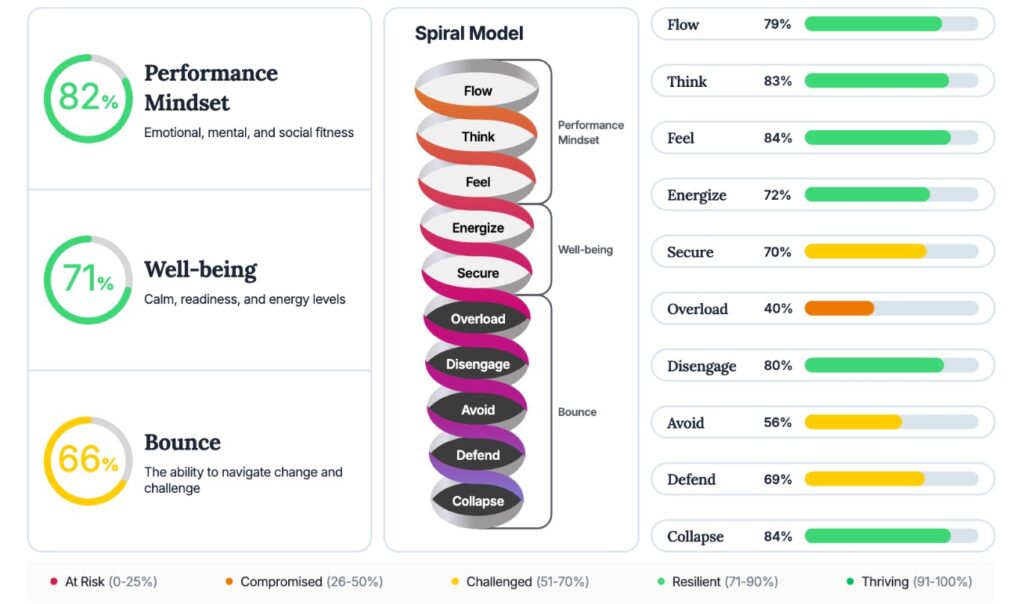
Since 2002, Resilience Institute has worked with thousands of organisations and more than 100,000 individuals. The Resilience Spiral sits at the core of that work. Now in its fifth iteration, it maps the natural stages of resilience, from distress through to flow.

The Spiral is genuinely practical. It weaves together fields that too often stay fragmented, mental health, stress mastery, emotional intelligence, high performance, and wellbeing, helping people climb toward what RI calls “altitude,” a state of real thriving where purpose, energy, and performance meet.

Snapshot of participant scores, mapped to the spiral

Isn’t Resilience Just a Buzzword?

No. Resilience is a learned set of skills, genuinely measurable and trainable. It includes sleep, nutrition, and recovery. It includes self-awareness, emotional regulation, and focus. It includes connection, purpose, and optimism.

RI’s model draws from neuroscience, positive psychology, epigenetics, preventative medicine, and behavioural science, refined over decades and tested in boardrooms, classrooms, clinics, and frontline teams alike. The feedback stays consistent: it gives people real language to describe what they’d previously only been able to feel.

What Makes This Certification Different?

Coaches completing the certification gain more than a framework. They gain a genuinely powerful assessment tool, letting them deliver individual reports that spark real insight, benchmark teams and track progress over time, target interventions with real precision, and show a genuine return on investment. That makes coaching not just more effective, but measurably more valuable to client organisations.

How Does It Help Coaches Succeed?

Coaching is a genuinely competitive space. To stand out, coaches need real results and a methodology grounded in science but flexible enough for actual practice. The Resilience Coach Certification offers a clear, structured model, actionable data from real clients, tools for both individuals and groups, and language that genuinely resonates with leaders. It isn’t a script. It’s a system, and it works.

Can Coaching Be Measured?

Most coaching programmes struggle to show clear outcomes. This one doesn’t. Group dashboards let coaches and organisations see genuine shifts in resilience over time, measuring growth, pinpointing pain points, and adjusting strategy accordingly.

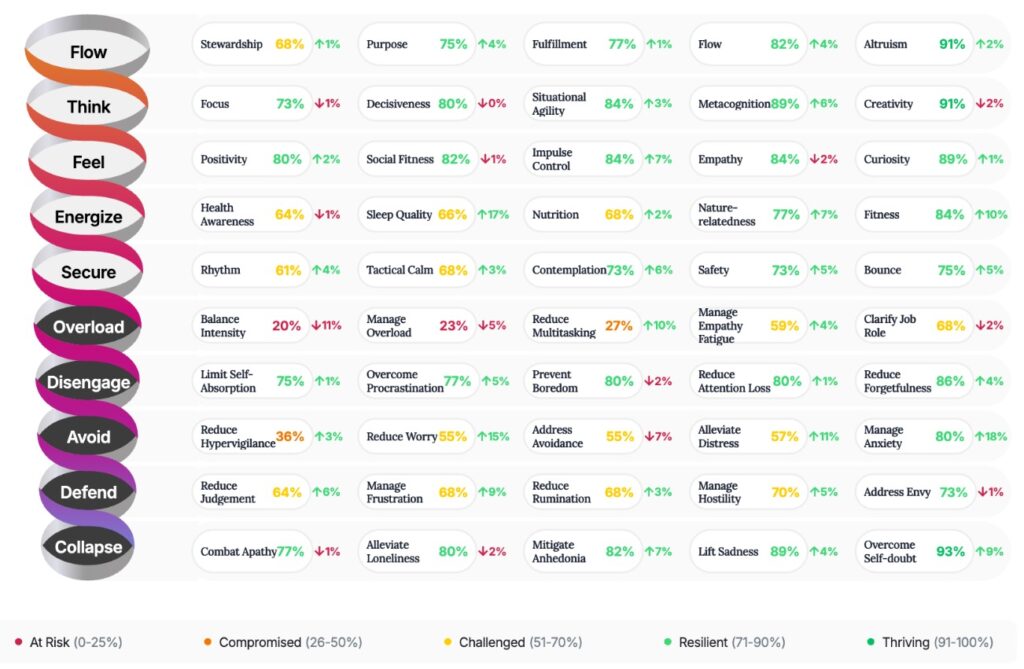
Participant results in a post-assessment

No more “thanks, I think that coaching helped.” Instead: “I improved my sleep quality by 17%, and I’m 18% better at managing anxiety.” That’s why HR teams and executives respond so well to this approach. It brings real credibility and real evidence, turning coaching into a genuine strategic investment. If you’re after referrals from existing or previous clients, give them data worth sharing. They become genuine ambassadors in the market.

What Kind of Coaches Should Apply?

This certification suits coaches working with leaders and executives, teams and departments, healthcare professionals, educators and students, and athletes and performers. It’s built for coaches who want a genuinely deeper impact, who value insight over opinion, and who are ready to work at the intersection of performance and wellbeing.

Why Now?

The world is demanding more from people than it used to. Change is constant. Stress runs high. Plenty of people feel genuinely overwhelmed. Coaches are more needed than ever, but meeting the moment requires the right tools. The Resilience Coach Certification is evidence-based and built to equip coaches to guide others through real complexity with genuine clarity.

What Happens After Certification?

Graduates join a global network of resilience professionals, with access to ongoing learning, group support and mentorship, upgrades as the model evolves, and new insight as the underlying resilience science develops. It’s a living system, not a static course, and it keeps improving. The certification is also approved by the ICF for Continuing Coach Education, offering 4 CCE hours on completion.

The future of coaching isn’t guesswork. It’s grounded, measurable, and genuinely human, and it starts with resilience.

The Best Coaching Tools for Executive and Leadership Coaching

  • Coaches and HR professionals increasingly need tools that go beyond conversation, ones that offer measurable, evidence-based insight into resilience, strengths, and behaviour.
  • Resilience-specific tools (like RI’s own Resilience Assessment and Hello Driven’s CReC platform) measure burnout risk and recovery capacity directly; strengths and personality tools (CliftonStrengths, DISC, MBTI) build shared language for communication and team dynamics.
  • Pricing varies by tool and changes over time; always confirm current pricing directly with the provider rather than relying on a fixed figure from any single article.

Leaders are under pressure to perform, adapt, and inspire, often all at once. Coaches and HR professionals supporting them need tools that go beyond conversation: insights that are measurable, evidence-based, and genuinely relevant to the realities of leadership today.

Whether working with senior executives, cross-functional teams, or emerging leaders, the right coaching tool helps guide genuinely meaningful change. From strengthening resilience and reducing burnout to improving collaboration and communication, these tools bring real clarity to complexity. This guide reviews five of the most trusted and effective coaching assessments used by executive coaches, leadership consultants, and HR leaders worldwide.

Resilience Assessment (Resilience Institute)

A scientifically validated tool measuring 50 key factors across 10 levels of the Resilience Spiral, including focus, adaptability, empathy, recovery, and burnout risk. It provides clear, actionable insight into performance, mental health risk, leadership readiness, and team dynamics, now powered by RI’s own AI platform for individualised recommendations across areas like sleep, vitality, and emotional regulation. Reports are available for both individuals and groups, with benchmarking and trend tracking for repeat use over time.

Certified professionals gain access to a structured framework, preferred pricing, and best-practice guidance for using the tool in coaching engagements. Pricing is tiered per user, with a reduced rate for certified professionals; confirm current rates directly on RI’s assessment page.

Why it benefits executive coaches and HR leaders: it provides a measurable, holistic view of personal and team resilience, ideal for coaching aimed at genuine wellbeing, better decision-making, and sustainable performance.

Hello Driven (CReC Resilience Tools)

A digital platform for tracking and building resilience over time, built around the peer-reviewed Predictive 6 Factor Resilience Model (PR6), which measures six domains and expands to 24 skills through the extended PR6E. It uses AI-supported dashboards and micro-coaching to help users develop awareness and adaptability, with coaches and facilitators able to become certified through the Certified Resilience Coach (CReC) programme, which is ICF-accredited for continuing coach education.

Certification includes a 12-month platform subscription, group and trend-tracking features, and access to specialist follow-on pathways like Resilience First Aid and High Adversity Resilience Training. Confirm current certification pricing directly with Hello Driven, since programme inclusions and cost have been updated more than once since launch.

Why it benefits executive coaches and HR leaders: a solid option for organisations wanting continuous digital engagement with employees and a scalable resilience programme backed by a peer-reviewed model.

CliftonStrengths (Gallup StrengthsFinder)

Identifies an individual’s top 5 or full 34 strengths from a list of 34 themes, Achiever, Strategic, Relator, and others. Widely used in corporate coaching and leadership development, it’s a foundational tool for aligning roles with natural talent and genuinely fostering engagement, priced at a relatively accessible entry point for the Top 5 report and a higher tier for the full 34.

Why it benefits executive coaches and HR leaders: helps leaders build real confidence, deepen self-awareness, and align teams around complementary talents in a positive, genuinely scalable way.

DISC Personality Profile

A behaviour-based assessment categorising individuals into Dominance, Influence, Steadiness, and Conscientiousness. Often used to improve communication and resolve team conflict, particularly in leadership and cross-functional teams, and priced moderately, with cost varying by provider.

Why it benefits executive coaches and HR leaders: gives teams and leaders a shared language for discussing behaviour, genuinely useful for building trust, improving collaboration, and leading with real awareness.

MBTI (Myers-Briggs Type Indicator)

A globally recognised tool for understanding personality preferences, categorising individuals into 16 types. Often used in leadership coaching, communication training, and change management. It has genuine limitations in scientific robustness worth being upfront about, but remains one of the most familiar tools in corporate settings, particularly valuable for introducing personality frameworks and fostering team dialogue, typically administered by a certified practitioner at a moderate to premium price point.

Why it benefits executive coaches and HR leaders: familiar and accessible, ideal for clients who need a basic shared framework for understanding themselves and their teams, especially in cross-cultural or high-stakes environments.

Choosing the Right Tool for High-Impact Leadership

Whether coaching executives, supporting teams, or designing organisational development programmes, the right tool helps turn genuine insight into real action. Resilience-specific tools like RI’s own Resilience Assessment and Hello Driven bring measurable clarity to performance, mental health, and burnout prevention, arguably the most critical areas in modern leadership right now. Others, CliftonStrengths, DISC, and MBTI, offer frameworks for communication, collaboration, and personal growth that complement rather than replace that resilience-specific lens.

The best coaching tools don’t just inform. They empower. Choose the one that genuinely aligns with your coaching goals, your client’s actual needs, and the organisational context you’re working within, and always verify current pricing directly with the provider before committing.

The right assessment doesn’t replace good coaching. It gives good coaching something measurable to actually work with.

What It Takes to Be a Resilient Coach or Leader: Insights on Presence, Growth, and Impact

  • Presence, not performance, is what makes coaching genuinely transformational. Without it, clients can’t feel safe enough to reflect, open up, or actually change.
  • Feedback triggers a real stress response, not unlike seeing a police car pull up behind you. Curiosity-based questions open reflection where feedback tends to trigger defensiveness.
  • Coaching mastery isn’t about technique or having the right answer. It’s about being willing to stay present in genuine discomfort, both the client’s and your own.

A conversation with Dr. Marcia Reynolds on presence, growth, and impact

There’s a quiet power in coaching that often goes unnoticed. It isn’t about asking the perfect question or applying the right model. It’s about how you show up, especially when someone else is struggling to think, lead, or move forward. That’s what makes coaching both genuinely challenging and deeply human.

To explore this, we sat down with Dr. Marcia Reynolds, former president of the International Coaching Federation, a globally recognised leadership coach, and author of Coach the Person, Not the Problem. On the Resilience Podcast, she shared what it genuinely means to be a resilient coach, and how presence, more than performance, is what actually unlocks real transformation.

Why Presence Is the Foundation of Resilience

Asked what matters most in building resilience through coaching, Dr. Reynolds brings it back to presence immediately. Without it, clients can’t feel safe enough to open up, reflect, or genuinely change. “If I break presence, I might break their feeling of safety.”

Presence isn’t passive. It’s the anchor that holds space when emotions run high, when thinking turns cloudy, or when someone is sitting in real discomfort. Too often, coaches rush that exact moment, reaching for a solution or trying to prove their worth instead of simply staying present. “When you slow down, you actually move faster,” Dr. Reynolds says. Real transformation begins in that stillness.

What Actually Makes Coaching Transformational?

Coaching isn’t about having the answers. It’s about helping someone else think more clearly. Where training and advice tend to activate the rational, task-driven part of the brain, coaching engages the creative, reflective parts where genuine insight actually lives. “When I reflect your story back to you and ask, ‘How is that working for what you want?’ you begin to see differently,” Dr. Reynolds explains.

That shift doesn’t come from strategy or skill alone. It comes from slowing down, listening fully, and being willing to walk alongside a client rather than ahead of them. “I’m not here to fix you. I’m here to think with you,” she says.

What Do Coaches Get Wrong About Feedback?

Much of coaching happens in the space between a question and someone’s own reflection, yet many coaches and leaders still default to feedback as their primary tool. Dr. Reynolds challenges that directly: “Feedback triggers the same stress response as a police car pulling up behind you.” Instead of correcting, she teaches leaders and coaches to stay genuinely curious. Ask, “What are you trying to achieve here?” or “How can I support you with this?”

That approach removes the threat and replaces it with real partnership. It invites reflection instead of defensiveness, and it turns even difficult conversations into genuine moments of growth.

How Can Leaders Shift Into a Coaching Mindset?

Shifting from expert to coach can feel genuinely awkward, especially for leaders used to being the one with the answers. The first step is simple: name the shift directly. “Let people know,” Dr. Reynolds suggests. “Tell your team: I’m learning a new way to lead. I want your support.”

Being transparent about your own growth builds real trust. It creates genuine permission for others to grow too, and it signals that leadership isn’t about control, it’s about co-creation. Leaders who coach well model exactly the mindset they hope to inspire in others. “It’s okay to feel awkward,” she adds. “But when you name it, you create trust.”

What Should Coaches Understand About Their Own Growth?

For many coaches, the hardest lesson is that coaching isn’t about performance. It’s about presence. Coaches often arrive from “telling” professions, teaching, therapy, consulting, and the first internal shift is learning to stop proving and start genuinely listening instead. “The first shift is into coaching presence. The second is into mastery, where you let go of technique and fully show up,” Dr. Reynolds explains.

Mastery isn’t about perfection. It’s about being real, genuinely grounded, and willing to stay in the discomfort of growth, both yours and your client’s. “You don’t have to be perfect. You just have to be present.”

Coaching mastery doesn’t come from having the right technique. It comes from presence, from being genuinely willing to slow down, stay curious, and show up real, in the discomfort, alongside the person you’re actually there for.

Resilience Coaching for Gen Z and New Leaders

  • 72% of Gen Z report at least one burnout symptom, the highest of any generation currently in the workforce, compared to 62% for Gen X and 38% for Baby Boomers.
  • Resilience isn’t about toughening up. It’s about becoming more self-aware, grounded, and able to pause and choose a response rather than react automatically, and that’s a coachable skill, not a fixed trait.
  • Traditional feedback often backfires with new leaders because it triggers a genuine stress response. Curiosity-based coaching questions work better than critique.

They’re talented. They’re purpose-driven. They want to lead, but they’re doing it during a period of genuine, sustained uncertainty.

Gen Z and early-career professionals are entering management roles at an accelerating pace, with promotion rates rising faster than other generations over the same period, according to ADP Research. At the same time, a growing share of Gen Z workers are actively opting out of management altogether to protect their wellbeing, a trend Business Insider has described as “conscious unbossing.” Both things are true simultaneously, and it’s worth naming directly: some Gen Z professionals are moving into leadership faster than ever, while others are deliberately declining it, often for the same underlying reason, genuine concern about what leadership currently costs.

Either way, this generation isn’t just asking for support. It’s offering something back: a genuine rethinking of how organisations work, lead, and sustain people over time. Their expectations around mental health, purpose, and authenticity aren’t a weakness. They’re a real call to evolve, and a genuine opportunity for every generation to reflect on what leadership should actually look like now.

What Gen Z Leaders Are Up Against, and Why It Matters

Young leaders aren’t just managing tasks. They’re navigating pressure from every direction: expected to lead with confidence, communicate across generations, manage both up and down, and perform at the pace of constant change, all while asking genuine internal questions. What does leadership even look like in a world this uncertain? Is success worth it if it costs real wellbeing to get there? How do you lead in a way that feels authentic rather than performative?

The mental health picture is serious and getting more precisely documented. A 2025 Seramount Burnout Survey found 72% of Gen Z workers report at least one burnout symptom, exhaustion, loss of motivation, or emotional detachment, compared to 62% for Gen X and 38% for Baby Boomers. Separately, Deloitte’s 2025 Gen Z and Millennial Survey found 40% of Gen Z feel stressed or anxious most or all of the time, with a substantial share of that stress tied directly to their work environment. SHRM’s 2025 research found 61% of Gen Z workers would strongly consider leaving their current role for one offering meaningfully better mental health support.

Coaching isn’t a nice-to-have for this generation. It’s a genuine resilience intervention.

Why Building Resilience Isn’t About Toughness

One of the most common mistakes organisations make is expecting younger leaders to simply toughen up, to lead the way previous generations did, to develop a thicker skin. But resilience isn’t about becoming harder. It’s about becoming wiser, more self-aware, more genuinely grounded, and more able to pause and choose a response rather than react automatically.

That’s precisely where coaching makes the real difference. A skilled coach helps young professionals move from anxiety to genuine agency, from reacting to actually reflecting, and that shift changes far more than it might first appear to.

Practical tip: start with a genuine resilience conversation, not a performance review.

Teach Resilience as a Skill, Not a Trait

Resilience isn’t something you’re simply born with. It’s something you build, yet most emerging leaders have never had it genuinely broken down for them, let alone measured. Resilience Institute’s own research frames it as spanning focus, recovery, energy, empathy, adaptability, emotional regulation, and a clearly articulated sense of purpose, measurable, trainable human capacities rather than vague aspirations.

Structured assessment tools let young leaders see directly where they’re genuinely strong, where they’re actually at risk, and how to grow with real intention. Coaching works best paired with this kind of insight. Resilience becomes concrete once it’s visible.

Why Traditional Feedback Often Doesn’t Land

Feedback triggers a genuine stress response. It puts people on the defensive, and instead of encouraging growth, it can trigger withdrawal instead. Executive coach Dr. Marcia Reynolds put it directly on the Resilience Podcast: feedback triggers a stress response not unlike seeing a police car pull up behind you.

Curiosity works better than critique. What are you trying to achieve here? What do you want to do differently next time? How can I actually support you? These land very differently from a verdict handed down after the fact.

Practical tip: stop telling them how they’re doing. Start helping them think more clearly instead.

Coaching Emerging Leaders Through the AI Shift

The last time the world changed this quickly, it was called the Industrial Revolution. For emerging leaders, AI brings genuine opportunity alongside real uncertainty: what happens to a career built on skills that might be automated within a few years? NVIDIA CEO Jensen Huang has put the reframe simply: you’re not going to lose your job to AI, you’ll lose it to someone who uses AI well.

This is where resilience coaching earns its place directly. The capacities AI genuinely can’t replicate, emotional agility, presence, intuition, real trust-building, are exactly the ones organisations will rely on most as more routine work becomes automated.

Practical tip: ask directly, “what strengths do you want to double down on, because no machine can genuinely do them for you?”

How Coaching Builds Genuine Psychological Safety

Emerging leaders don’t want to pretend they have all the answers, and they don’t trust people who act like they do either. Coaching offers a genuinely rare kind of space, one where they don’t have to perform, where they can think out loud, and where they can be real without it reading as weakness.

Psychological safety isn’t just a culture buzzword. It’s a real condition for growth, and coaches function less as mirrors and more as genuine guides through uncertainty.

The Development Gen Z Actually Wants

Forget outdated leadership pipelines. The next generation is asking for something genuinely different: development that’s real, not performative, not perfection-driven, not productivity for its own sake. They want real space to grow, tools that actually work, and coaches who meet them where they genuinely are.

This isn’t about lowering the bar. It’s about raising the relevance. The organisations that understand this will be the ones that attract, retain, and grow the leaders everyone will need in the years ahead.

Gen Z isn’t asking leadership to get easier. They’re asking it to get more honest, and resilience coaching is exactly the tool built for that shift.

The Best Certifications for Change Managers: Building Capacity for Human Transformation 

  • The famous “70% of change initiatives fail” statistic has no solid empirical foundation. A 2011 peer-reviewed study traced it to an uncited line in a 2000 consulting article, repeated ever since without evidence.
  • What genuinely predicts success is better documented: poor communication, lack of real ownership, and top-down execution that ignores informal networks, not a flawed strategy on paper.
  • Resilience, flexibility, and agility now rank as the second most essential workplace skill globally, right after analytical thinking, which is exactly why the certifications on this list increasingly include human capacity alongside process methodology.

Change management isn’t just frameworks, timelines, or stakeholder maps. At its core, it’s about people, their fears, their hopes, and their genuine capacity to evolve. And the people responsible for guiding others through change need to be prepared, resourced, and resilient themselves first.

That’s why certifications matter, not for the letters after your name, but for the mindset, method, and mastery they actually represent. Great change managers need more than technical skill: the ability to steady a room, read emotional currents, and lead with genuine calm inside chaos. The right certification builds exactly that.

The Myth Worth Retiring First

Before the list, it’s worth addressing the statistic that hangs over this entire field: the claim that 70% of change initiatives fail. It traces back to a near-throwaway line in a 2000 Harvard Business Review piece by Michael Beer and Nitin Nohria, stated without citation or supporting data. A rigorous 2011 peer-reviewed study by Mark Hughes, published in the Journal of Change Management, traced the claim’s history in detail and found no solid empirical foundation for the specific figure anywhere in the literature. It has persisted since largely because it’s dramatic, easy to repeat in a slide deck, and useful for consultancies with an interest in creating urgency.

What the actual research does support is more specific and more useful: change efforts tend to underperform because of poor communication, lack of genuine ownership among the people affected, and top-down execution that bypasses informal networks and influence, not because the underlying strategy was flawed on paper. That’s a solvable set of problems, and it’s precisely what good change management training, at its best, is built to address.

There’s a second, current reason this matters. The World Economic Forum’s Future of Jobs Report 2025, surveying over 1,000 employers across 55 economies, ranks resilience, flexibility, and agility as the second most essential core skill in today’s workforce, immediately behind analytical thinking. The certifications below increasingly reflect that shift, moving beyond pure process methodology toward building genuine human capacity for change.

The Certifications

Prosci Change Management Certification

The foundational, widely recognised standard. Built on the ADKAR model (Awareness, Desire, Knowledge, Ability, Reinforcement), Prosci’s method is structured, research-backed, and used across sectors globally. You’ll learn to plan for change, engage stakeholders, measure readiness, and embed change sustainably, with tools and templates you can apply immediately. ADKAR functions as a common language across global organisations, and the certification is well recognised by HR and executive leaders alike.

prosci.com

Resilience Coach Certification (Resilience Institute)

Change never lands in a vacuum. It lands on people, often already stressed, stretched, and fatigued. This certification builds the capacity to help individuals and teams handle pressure, uncertainty, and complexity directly, drawing on neuroscience, performance psychology, and behaviour change research. Central to it is the Resilience Spiral, an evidence-based framework spanning calm, energy, emotional agility, cognitive clarity, and flow. The training is approved by the ICF for Continuing Coach Education, offering 4 CCE hours on completion, and helps change leaders become genuine human enablers rather than just process managers.

resiliencei.com/certification

Certified Change Management Professional (CCMP)

Offered by the Association of Change Management Professionals (ACMP), this credential aligns with ACMP’s own Standard for Change Management. It’s a globally respected alternative to Prosci, with a broader focus on principles rather than a single proprietary methodology. Qualifying requires formal training plus real experience, and the exam covers process, leadership, communication, and measurement.

acmpglobal.org

Resilience Facilitator Certification (Resilience Institute)

Built for those working at scale, leading workshops, embedding resilience across teams, and equipping others to grow. Where the Coach Certification focuses on one-to-one or small-group work, the Facilitator programme trains you to teach core resilience skills in classrooms, leadership retreats, or full enterprise rollouts. It’s particularly suited to L&D professionals, consultants, or agile coaches wanting to add emotional intelligence and performance science to change work at scale.

resiliencei.com/certification

Lean Change Agent Certification

Developed by Jason Little, this programme suits change-makers who genuinely like experimentation. Lean Change Management takes an agile approach, blending feedback loops, co-creation, and adaptive planning instead of rigid upfront plans. You learn to run change experiments, validate assumptions, and evolve strategy as you go, particularly useful in fast-moving or startup environments where a fixed plan would age out quickly.

leanchange.org

Change Management Institute (CMI) Accreditation

A professional pathway from Foundation through to Master level, with real emphasis on professionalism, community, and ongoing development. Expect genuine peer support, global perspectives, and a non-proprietary approach to change that encourages reflective practice rather than just handing you a toolkit.

change-management-institute.com

ICAgile Certified Professional in Leading with Agility (ICP-LEA)

Change doesn’t always follow a linear path, especially inside agile or matrixed organisations. ICP-LEA explores leading through complexity and uncertainty directly, focusing less on rigid models and more on how you actually show up as a leader. It recognises that change starts with how you lead yourself, and aligns well with future-facing, complexity-aware organisations.

icagile.com

Design Thinking / Human-Centred Design Certifications

Offered by institutions like IDEO U, the LUMA Institute, and Stanford’s d.school, these programmes train change managers to centre empathy, co-creation, and iterative prototyping. They teach how to genuinely involve people in shaping change rather than just reacting to it after the fact, building trust and psychological safety by translating vision into action through real experimentation and feedback.

ideou.com · luma-institute.com · dschool.stanford.edu

EQ-i 2.0 Emotional Intelligence Certification

Lets change professionals assess and coach emotional intelligence using a validated psychometric tool, deepening the ability to recognise and navigate the emotional drivers of resistance, engagement, and leadership effectiveness. Often used alongside broader leadership development and coaching work, it enables genuinely data-informed conversations about emotion and behaviour rather than guesswork.

mhs.com

NeuroLeadership Institute: Brain-Based Coaching Certification

Neuroscience-informed change is no longer a niche interest. This programme teaches the SCARF model (Status, Certainty, Autonomy, Relatedness, Fairness) to help leaders understand how the brain actually responds to change. It offers coaching techniques aligned with how the brain learns and adapts, and adds real credibility to leadership conversations grounded in mechanism rather than intuition alone.

neuroleadership.com

Choosing the Right Path

It genuinely depends on where you’re starting from. Building foundational expertise: start with Prosci or CCMP. Managing change inside complex human systems: add the Resilience Coach or Facilitator certification. Leading in uncertain, agile contexts: Lean Change, ICP-LEA, or a design thinking programme. Ready to explore the emotional and neurological dimensions of change directly: EQ-i or the NeuroLeadership Institute will serve you well.

Great change leaders are never really done learning. They gather tools, evolve their perspective, and stay genuinely grounded in human insight, not just process. Change isn’t a spreadsheet. It’s a story unfolding in real time, and the best change managers know how to read that story honestly, and help rewrite it well.

Forget the 70% failure myth. What actually predicts whether change sticks is communication, ownership, and genuine human capacity, exactly what the right certification is built to develop.