


EQ Is Rising in Demand and Falling in Reality. Here’s the Data
- The World Economic Forum’s Future of Jobs Report 2025 places motivation and self-awareness, empathy and active listening, and resilience among the fastest-growing core skills through 2030.
- A 2025 study tracking 28,000 adults across 166 countries found global EQ scores fell by 5.79% between 2019 and 2024, with the sharpest declines in motivation and optimism.
- A 2025 meta-analysis of 34 studies and 8,515 participants found a strong link between emotional intelligence and resilience (r = .523), and separate research shows EQ competencies can be measurably improved through training.
- Singapore’s SkillsFuture agenda has already flagged social and emotional competencies as part of its Care economy skills pillar, giving employers a national policy hook, and funding support, for measuring and building this capability.
Scroll LinkedIn for five minutes and you will find three different posts calling emotional intelligence the leadership skill of the future. It is easy to assume this is recycled hype, the same Daniel Goleman talking points dressed up for a new year. It is not. The data behind the claim has actually changed, and not in the direction most people expect.
The skill is becoming more valuable at the same time it appears to be declining. That combination is the real story, and it is a much stronger reason to measure emotional intelligence properly than any billboard slogan ever was.
The Skill Getting More Important, and Somehow Getting Weaker
The World Economic Forum’s Future of Jobs Report 2025, based on a survey of more than 1,000 large employers representing over 14 million workers, found that 39% of core job skills are expected to change by 2030. Within that shift, motivation and self-awareness, empathy and active listening, and resilience, flexibility, and agility all rank among the fastest-rising core skills, alongside creative thinking. As AI takes over more analytical and administrative work, employers are explicit that the human-centred skills sitting underneath emotional intelligence are what they need more of, not less.
At the same time, a 2025 study published in Frontiers in Psychology, using the validated Six Seconds Emotional Intelligence Assessment across a stratified sample of 28,000 adults in 166 countries, found that global EQ scores fell by 5.79% between 2019 and 2024. The researchers call this an “emotional recession.” The steepest declines were in intrinsic motivation, optimism, and a sense of pursuing meaningful goals, exactly the competencies tied most closely to workplace resilience and retention. Demand for the skill is rising while the underlying capability appears to be eroding. That gap does not close itself.
What the Research Actually Shows About EQ and Performance
The link between emotional intelligence and resilience is not a marketing claim. A 2025 multilevel meta-analysis covering 34 studies and 8,515 participants, published in a peer-reviewed journal, found a strong positive correlation between emotional intelligence and resilience (r = .523), with the relationship stronger among practising professionals than among students. A separate 2024 systematic review and meta-analysis found that structured emotional intelligence training produced measurable, sustained improvements in emotional regulation and resilience, which matters because it means this is a trainable capability, not a fixed trait people either have or do not.
That combination, a strong evidenced link to resilience and evidence that training moves the needle, is the actual case for measuring emotional intelligence at work. It has nothing to do with which tech CEO name-drops Goleman in an interview.
How to Actually Measure It
Once you accept that EQ needs measuring, not just discussing, the options fall into a few categories.
360 competency assessments compare a self-rating against feedback from peers, direct reports, and managers. Goleman’s own Emotional and Social Competence Index (ESCI) works this way, scoring self-awareness, self-management, social awareness, and relationship management. It requires a certified practitioner to administer and interpret, and it is designed purely for individual development rather than organisational benchmarking.
Validated psychometric instruments, such as the Six Seconds Emotional Intelligence Assessment used in the 2025 emotional recession study, measure EQ as a set of learnable competencies with published reliability and validity data, and they can be aggregated to show trends across a whole organisation or region, not just one person’s development plan.
Situational judgment tests, such as the MacCann and Roberts Situational Test of Emotional Understanding and Situational Test of Emotion Management, present realistic scenarios and ask respondents to identify the most effective emotional response. These treat EQ as a cognitive ability rather than a personality trait, which some organisations prefer for hiring and screening decisions.
The Resilience Assessment folds emotional intelligence into a wider resilience framework rather than measuring it in isolation. Its “Engage Emotion” category and related factors sit alongside indicators for withdrawal and vulnerability, so a leader can see how a person’s emotional skills connect to their actual risk of burnout and their overall performance capacity, not just their self-reported EQ score in a vacuum.
Singapore’s Skills Agenda Already Points This Direction
SkillsFuture Singapore’s Skills Demand for the Future Economy work has identified the Care economy, alongside Green and Digital, as one of the three growth pillars for national workforce planning, with wellbeing and social-emotional capability explicitly named within it. That gives Singapore employers something most global commentary on this topic misses: a live national policy framework, and associated funding support, for building exactly the competencies this article is about, rather than treating emotional intelligence training as a discretionary line item competing against everything else in the L&D budget.
Before your next leadership development conversation, ask:
- When did we last measure emotional intelligence with a validated instrument, rather than assume we know where our leaders stand?
- If global EQ scores are falling, do we actually know whether ours are holding steady?
- Does our current EQ or resilience data connect to a training plan, or does it sit in a report nobody revisits?
Emotional intelligence did not become important because a book sold well in 1995. It is important now because the research shows it drives resilience, the World Economic Forum ranks it among the skills employers need most through 2030, and the same research shows it is quietly getting weaker. Organisations that measure it will know which side of that gap they are on. The ones that do not will find out the hard way.

What is the Resilience Spiral?
Table of Contents
What is the Resilience Spiral?
Resilience is integral to personal and professional growth, and understanding it can significantly enhance our ability to navigate life’s challenges. Dr. Sven Hansen, the founder of the Resilience Institute, developed the Resilience Spiral to provide a structured framework for understanding and enhancing resilience. This model is built on the principles of neurobiology, physiology, and evolutionary biology, aiming to help individuals and organizations thrive in adversity.
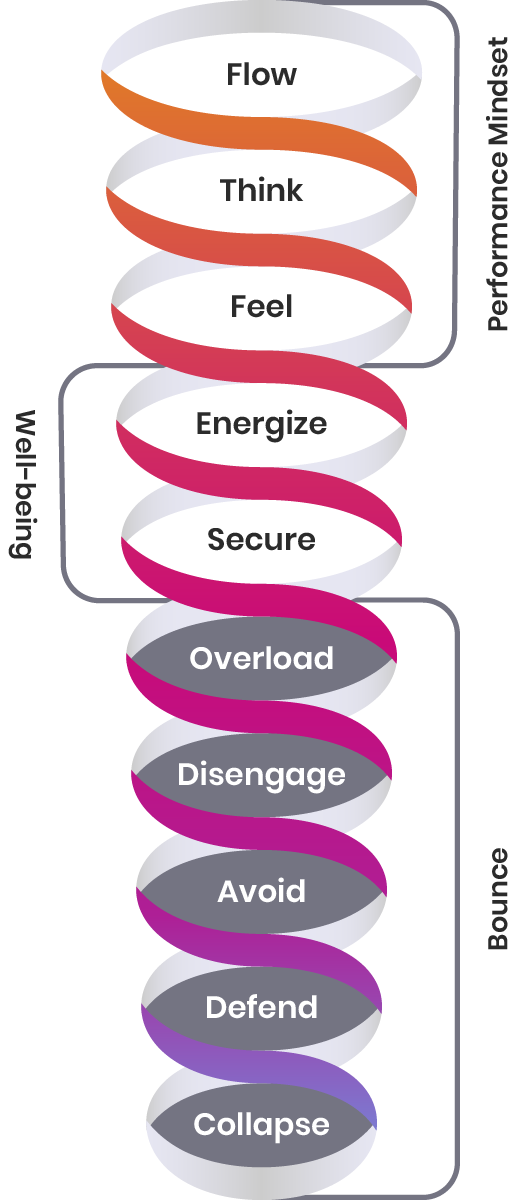
The Foundation of the Resilience Spiral
Resilience, as defined by Dr. Hansen, is the learned ability to:
1. Bounce forward fast in adversity
2. Grow physical, emotional, and mental strengths
3. Connect with oneself, others, and nature
4. Discover flow in the application of skill to meaningful challenges
These capabilities are essential for navigating the complexities of life, whether for individuals, businesses, or communities. Resilience is not just about surviving; it is about thriving and evolving through adversity.
Understanding the Resilience Spiral
The Resilience Spiral is a diagnostic and development model that describes our quality of experience and altitude in life. Our altitude can be high, where we feel clear, energized, and focused, or low, where we experience pain, suffering, and negativity. The journey through the spiral involves moving up and down these states, influenced by our physical, emotional, and mental conditions.
Integral Approach in the Context of Spiral Models
In the context of the Resilience Spiral, “integral” means incorporating a comprehensive, inclusive approach that accounts for various dimensions of human experience. This concept draws inspiration from other spiral models like Spiral Dynamics and Integral Theory.
Spiral Dynamics, developed by Clare Graves, Don Beck, and Chris Cowan, explores the evolution of human values and consciousness. It has been applied in global negotiations, politics, medicine, and business. Similarly, Integral Theory, proposed by Ken Wilber, is one of the most comprehensive and inclusive frameworks, integrating insights from various fields to create a unified understanding of reality.
Dr. Hansen’s Resilience Spiral integrates these approaches by combining insights from neurobiology, physiology, and evolutionary biology with practical applications for resilience. This integration ensures a holistic understanding of resilience, addressing the physical, emotional, mental, and social dimensions of human experience.
Four Key Perspectives
Dr. Hansen’s model emphasizes four perspectives to enhance resilience:
Insight – Know Yourself
Insight involves understanding your current state by checking your body, emotions, and mind. This self-awareness is crucial for improving your altitude and engaging effectively with others. Accurate terminology and self-assessment tools, like the Resilience Spiral, help in this understanding.
Mastery – Raise Your Altitude
Mastery is about knowing how to improve your state once you have identified it. This involves specific biological adjustments, such as regulating your nervous system to restore calm and readiness. Building physical, emotional, and mental skills through practices like good sleep, emotional control, and focused attention is essential.
Empathy – Understand Others
Empathy is the ability to accurately read and respond to the physical, emotional, and mental states of others. This skill requires deliberate practice and is vital for effective social interactions and leadership. High altitude enables better empathy and connection.
Altruism – Raise the Altitude of Others
Altruism involves actions that help others improve their state, reducing suffering and enhancing quality of life. Effective altruism is built on the foundations of insight, mastery, and empathy, leading to resilient individuals, communities, and ultimately, a resilient planet.
The Resilience Journey
The journey through the Resilience Spiral begins with the foundational state of being secure. This state is characterized by a calm, engaged physiology, typically achieved through practices like slow breathing, meditation, and yoga. Once secure, the focus shifts to physical vitality, emotional agility, and mental skills.
Secure
Achieving a secure state involves calming the body and mind, often through external cues of safety or self-regulation techniques. This state is essential for effective functioning under stress.
Energize
Physical vitality, achieved through fitness, nutrition, sleep, and daily rhythms, is crucial for maintaining energy and resilience. Investing in physical health significantly enhances overall resilience.
Feel
Emotional agility and social engagement are the next steps. Positive emotional states and social connections enhance our ability to think clearly and make effective decisions.
Think
Mental skills like focus, optimism, and agility are most effective when built on a foundation of physical and emotional stability. In this state, the mind becomes a powerful tool for creativity and problem-solving.
Flow
The ultimate state of resilience is flow, where we engage in challenging tasks with skill and productivity. Flow states are deeply fulfilling and require years of dedicated practice to achieve consistently.
Practical Application and Leadership
The Resilience Spiral is not just a personal tool; it is also valuable for leaders and organizations. By understanding and applying the principles of the spiral, leaders can enhance the resilience of their teams and create a positive, productive culture. Practical steps include regular self-assessment, practicing bounce tactics, and fostering an environment that supports physical, emotional, and mental well-being.
Leading with the Resilience Spiral
Leaders play a crucial role in shaping the resilience of their teams. By viewing resilience from an integral perspective, leaders can understand the layers of culture and influence positive change. This involves recognizing and addressing the physical, emotional, and mental states that define how people experience work.
For instance, during the COVID-19 pandemic, many organizations witnessed increased fear and anxiety among employees. Leaders who understood the Resilience Spiral could implement strategies to elevate the collective altitude, such as promoting secure states through clear communication, supporting physical vitality with wellness programs, and fostering emotional connections through team-building activities.
Conclusion
The Resilience Spiral, developed by Dr. Sven Hansen, provides a comprehensive framework for understanding and enhancing resilience. By focusing on insight, mastery, empathy, and altruism, individuals and organizations can navigate adversity, grow, and thrive. The journey through the spiral is ongoing, requiring continuous practice and commitment, but the rewards are a life filled with clarity, energy, and meaningful engagement.
Understanding resilience through an integral lens ensures a holistic approach that addresses all dimensions of human experience. By integrating insights from various fields and applying them in practical ways, the Resilience Spiral offers a powerful tool for personal and organizational growth. Embrace the Resilience Spiral and embark on your journey towards a more resilient, fulfilling life.
Original Source: https://resiliencei.com/blog/what-is-the-resilience-spiral/

What is Spirit in Action in Resilience Spiral
“You have covered physical, emotional and cognitive but surely spiritual is the key factor in many people’s resilience?” the question came from a black South African business woman last week. Even across our team she will get a range of answers. Spirit in Action can be the end goal, quietly ignored or actively rejected.
The topic is contentious and potentially explosive. People can react with anger or contempt. The increasing prevalence of substance abuse, anxiety, depression, and suicide suggest a crisis of meaning. Without constraining the liberty of religious choice, perhaps the spiritual path could do with some cautious and curious dialogue.
Our Resilience Diagnostic and Development model puts “spirit in action” right at the top of our spiral. In a dynamic world of multiple spiritual pathways and secular alternatives, we owe our participant a considered response. We welcome your participation in the dialogue.
I address her question in three parts:
- What we mean by Spirit in Action
- What a modern belief system might embrace?
- What practices underpin progress on a spiritual path?
Let us be respectful and inclusive of the many positive contributions that faith brings to our lives.
Spirit in Action: Part 1
Humans seek meaning. We’ve generated a diverse array of stories to make sense of existence. Some are more helpful than others. Hunter-gatherer communities came up with naturalistic magic. Agricultural – largely patriarchal – communities gave rise to the major spiritual traditions about 2,500 years ago. Some hold to traditional beliefs, while others embrace aspects of modern life such as electronic donations, apps and science.
Today, new spiritual promises compete with the older traditions. Science, sport, designer drugs, music, technology, biological diversity, and money compete successfully for our attention. In the past, you were a loyal convert or dead. Now, we are free to believe and do whatever we like. The thought: ‘god watches over me and might send me to hell’ is less scary.
Without the threat of hell or social sanction, a spiritual path is voluntary. It can be a lonely struggle of self-deprivation, deliberate practice, tenacity and patience. Few take it seriously. On the other hand, the decline in spiritual belief and practice correlates with increasing substance abuse, anxiety, depression and suicide.
As we pursue our own selfish and impulsive desires, we create tremendous suffering, threaten much of the life on earth and even our own existence.
Given the pickle humanity has created, perhaps we actually need a spiritual quest more than ever. But it must be fit for purpose in 2020 – not 500 BC. To work, it requires the principals of evidence-based (true), integral (respecting body, heart, mind and the huge diversity of life) and practical (actionable in effective ways right now).
What is “Spirit in Action”
One can be a force for good without being spiritual. Medicine strives to reduce suffering and disease, NGO’s tackle worthy tasks, and individuals change lives. Secular humanism – a non-religious, evidence-based and coordinated endeavour to improve the lives of humans does not prescribe a belief.
Curing disease, educating women, providing clean water, and delivering justice changes beliefs and delivers extraordinary outcomes. The dedication, self-sacrifice and noble aspirations are actually quite ‘spiritual’. ‘God’ becomes ‘Good’.
Beyond secular humanism, mapping a spiritual path to enlightenment is no easy task. The delicate and all-important question is: “Do I have to believe in God?”
Our hypothesis: spiritual is an experience of union with a greater reality than our small, temporary individual existence.
Your greater reality may be nature, truth, evolution, love, the universe, or simply GOD. This reality – let’s call it Spirit (capital ‘S’) – is vast, largely unknown but integral to the existence of your small self (little ‘s’). When your little self feels fully at peace with and connected to Spirit, we feel the emotions of joy, bliss, love and awe.
As we grow, learn and develop wisdom, our conception of Spirit matures. White, bearded, old man on cloud becomes awe in the presence of nature, and then settles into an abiding peace, love and joy. Eventually, we experience total unity with all in the unfolding moment.
It is humble and wise to honour a higher force beyond ourselves. To make sense of Spirit is a basic freedom that liberates the small self from suffering. The more integrated and connected to Spirit we are the more peace, love and joy we will experience and radiate. While this quest is challenging, without it we face an existential crisis. This quest for meaning and connection is Spirit in Action.
As a scientific mind, an alternative perspective is attractive. Let’s say I recognise the reality of my body, my emotions and my thought. I know they can be quantified. It is clear to me that certain practices and skills lead to a healthier body, positive emotions and clarity of thought. This is good for me and others.
It is possible that my spirit (small ‘s’) is in action, when I experience peace (calm physiology), vitality (healthy body), love (positive emotions), and focus (clarity of thought)? In other words, when my physical, emotional and cognitive resources are at their best, I experience myself at a higher altitude. I am integrated and have become more whole.
This experience of integral being is not just body, emotion and mind. It is something more. Could we call it spirit? I think so. When we are in the integrated state that many call flow, we serve ourselves and others much more skilfully.
In fact, both perspectives are necessary.
Having faith in Spirit, Nature or God, is clearly a source of resilience. Specifically, faith has been shown to help us bounce. It most certainly helps us connect with others. Spiritual community is essential to nurture practice. Our connection to a greater reality is the outer path of the spiritual quest.
When physically compromised, angry or depressed, or confused in mind, it is much harder to connect and integrate with a greater reality. When spirit emerges from a flourishing body, heart and mind, the outer path is clear. We feel resourced and motivated to embark on the spiritual quest. This is the inner path.
My conclusion is that a greater reality – what we call Spirit – is part of Spirit in action. To understand, connect with, and honour this greater reality is the goal of your resilience journey. Each one of us is free to explore this path.
Equally essential, this challenging quest demands that you cultivate and grow physical, emotional and mental strength. This is your source of power for the quest. It is, in our view, also a key part of spirit in action. Once again, each of us is free to embark on the practices that work for you.
In part two, I explore what a modern belief system might embrace.
Original Source: https://resiliencei.com/blog/spirit-in-action-part-1/