


The ROI of Resilience Training: What Current Data Shows
- Gallup’s 2026 State of the Global Workplace report puts disengagement’s global cost at roughly USD 10 trillion a year, up from the USD 8.8 trillion figure most resilience ROI content still cites.
- Gallup’s latest Q12 meta-analysis, covering 183,806 business units and 3.3 million employees across 90 countries, finds top-quartile engaged teams deliver 23% higher profitability and 78% lower absenteeism than bottom-quartile teams.
- The global corporate wellness market reached USD 55.1 billion in 2025, according to Grand View Research, confirming this is now a mainstream line item, not a fringe benefit.
- In Singapore, SkillsFuture Enterprise Credit can subsidise up to 90% of eligible resilience and leadership training costs, materially changing the net ROI calculation for local organisations.
Leaders invest in wellbeing and resilience because they are good employers. They care about their people. They hope resilience might improve performance. Steadily accumulating research shows these programmes deliver consistently positive returns on investment. Most organisations are still leaving money on the table by treating this as a values decision rather than a financial one.
ROI studies show the value of an investment in net present value terms. An ROI of 4 to 1, about average for resilience training, means a USD 100,000 investment is worth USD 400,000 to you on the day you invest.
The Business Case Just Got a Larger Price Tag
Gallup’s 2026 State of the Global Workplace report puts the annual global cost of disengagement at roughly USD 10 trillion, close to 9% of global GDP, and finds global engagement fell to 20% in 2025, its lowest point since 2020. This is a meaningful jump from the USD 8.8 trillion figure Gallup reported a few years ago and that much resilience ROI content still quotes. The cost of doing nothing keeps rising faster than the cost of a training programme.
There is a regional bright spot worth naming. Southeast Asia’s engagement rate now sits at 26%, above the global average and more than double the region’s 2011 level. That trend line makes continued investment in the region look less like catching up and more like protecting a genuine advantage.
What a Dollar Invested Actually Returns
Gallup’s Q12 meta-analysis, now in its eleventh edition and covering 183,806 business units, 3.3 million employees, 347 organisations, 90 countries, and 53 industries, remains the largest study of its kind. Comparing top-quartile to bottom-quartile engaged business units, the current edition finds:
- 10% higher customer loyalty and engagement
- 23% higher profitability
- 14 to 18% higher productivity
- 78% lower absenteeism
- 21% lower turnover in high-turnover organisations (above 40% annualised)
- 51% lower turnover in low-turnover organisations (40% or below)
These figures have held remarkably consistent across multiple editions of Gallup’s meta-analysis over more than two decades, which is itself part of the case. This is not a single study that might not replicate. It is one of the most repeatedly confirmed findings in organisational research.
What Is a Resilience Programme
Resilience is a learned set of attitudes, knowledge, and skills to bounce through adversity, grow, connect, and reach optimal performance, what we call flow. These capabilities help people recover from setbacks, improve wellbeing, connect effectively, and lift productivity. We call the approach Performance with Care.
People are holistic, with body, emotion, and mind connected whether in distress or at peak performance. A pill does not solve depression on its own. A single workshop will not solve performance on its own. Only an integral, evidence-based, practical approach meets the real diversity of needs across a workforce. A resilience programme includes careful design against clear objectives, fully briefed and visibly engaged leadership, well-considered measurement of the relevant factors, individual and group feedback that actually informs training design, targeted training delivered over time, and ongoing measurement, adjustment, and improvement.
What Current Research Shows by Category
Grouping current studies into major categories, each with the confirmed ROI range from controlled research:
- Resilience training broadly: 2 to 1 to 4 to 1, confirmed across five recent controlled studies.
- Mental health training: 3 to 1 to 6 to 1. Mental health has become one of the leading health concerns raised in workplace research, making this category increasingly central rather than peripheral.
- Stress management training: 2 to 1 to 4 to 1.
- Wellbeing and wellness training: 3 to 1 to 6 to 1, backed by four decades of consistently positive corporate health evidence.
- Emotional intelligence training: 4 to 1 to 7 to 1, the category with among the strongest confirmed returns.
- Focus and attention control training: 3 to 1 to 7 to 1, a newer research area given how cognitively demanding most modern work has become.
The Evidence Base Has Grown Substantially
Resilience Institute’s own research has expanded well beyond the sample we originally published this framework against. Our 2025 Global Resilience Report now draws on more than 8,400 professionals across 70 countries, a considerably larger and more current evidence base than the 877-person, single-year sample this framework was first built on.
We use 60 Resilience Factors, 30 strength factors and 30 risk factors, to track specific signals across the physical, emotional, and mental inputs to resilience. Across hundreds of programmes and thousands of participants, we have consistently seen growth in strength factors and reductions in risk factors. Clients running Fostering Team Resilience through a change or high-pressure period have seen resilience scores improve by up to 41% in a single programme cycle, a result built on this same measure-train-remeasure discipline, not a one-off intervention.
The Singapore Factor Most ROI Calculations Miss
For organisations based in Singapore, there is a further ROI lever the global research does not account for. SkillsFuture Enterprise Credit can subsidise a significant share, up to 90% for eligible programmes, of resilience and leadership training costs. That materially changes the net investment side of the ROI equation before a single outcome has even been measured, and it is worth checking against any current programme proposal rather than assuming it does not apply.
Before your next budget cycle, ask:
- Are we still quoting a disengagement cost figure that is several years out of date?
- Have we checked whether SkillsFuture or an equivalent local subsidy changes our net ROI calculation?
- Do we have a measured baseline and a re-test date, or are we relying on a one-off workshop and hoping the effect holds?
The value of resilience training is strongly supported by both scientific and economic evidence, and the economic case has only gotten stronger as disengagement’s global cost has grown. This is not a soft skills line item any board should still be treating as optional.

What Actually Makes a Team High-Performing (It’s Not Who’s On It)
- Google’s landmark Project Aristotle studied 180 teams across 250 attributes and found psychological safety, not talent, seniority, or team size, was the single strongest predictor of performance.
- Great Place to Work’s 2024 study of nearly 7 million employees across Asia found the best workplaces are 37 points more likely than typical ones to celebrate new approaches, and their employees are 69% more likely to adapt quickly to change.
- In hybrid and remote settings, psychological safety takes real, deliberate effort to build. It no longer happens by accident the way it might have in a shared office.
After two decades of playing on sports teams, culminating in an NCAA career, and another decade working for teams in a business setting, the parallels start to feel genuinely tangible rather than metaphorical.
A high-performing team is notoriously elusive to build. No amount of buzzwords, synergy, trust, leadership, guarantees a team actually functions and adapts well enough to win. If it were that simple, India’s cricket team wouldn’t have needed 28 years to end a World Cup drought stretching back to 1983, and every ambitious start-up would successfully “disrupt” its market on schedule.
The real ingredients of a high-performing team come from genuinely understanding how the parts, the players, interact with each other and the culture around them. Once those moving pieces are aligned and motivated toward a shared goal, performance becomes something you can actually build and refine. But real roadblocks can knock a team off course, so keeping a genuine, diagnostic read on team dynamics matters as much as anything else.
What Isn’t a Team?
The problem with many teams is that they aren’t actually a team. Whether leadership or the members themselves realise it, plenty of groups contain people who genuinely see each other as competition: if a colleague is doing well, that must mean I’m doing worse. That mindset doesn’t build a high-performing team. Instead of creating genuine synergy, an interaction more energetic than either individual alone could produce, these members push and pull against each other, quietly undermining collective performance rather than elevating it.
When teammates stop genuinely working together, trust erodes. It can start as simply as not trusting a colleague to do their part, which pushes others to overcompensate, which pulls them away from their own actual role, and the whole system starts to unwind toward an outcome nobody intended. No synergy, no trust, and someone always looks for who’s to blame. That’s where leadership comes in.
Teams typically have a few distinct kinds of leaders. Team leaders or captains carry a genuine feel for the team’s pulse and act as its ethical anchor, its culture. Great teams rally around a captain’s example; struggling teams fall behind whoever’s cutting corners. Sam Walker, founding sports editor at The Wall Street Journal, conducted an exhaustive study into the modern history of winning sports teams and found a team’s winning streak typically began and ended with the arrival and departure of a single player, and in every case, that player became the team’s captain or leader.
Then there are team managers or coaches: the people who assemble and run the team, set goals, pair members on tasks, adjust course, and, critically, select the captains. A genuinely great manager inspires the leads directly, and through them, the wider team, and can make the tactical adjustment that saves a plan gone sideways. As Sun Tzu wrote in The Art of War, “The general who wins a battle makes many calculations in his temple before the battle is fought. The general who loses a battle makes but few calculations.”
There are countless ways a group can end up genuinely nonfunctional. Before trying to force incompatible pieces into alignment, it’s worth confirming you actually have a team to begin with.
What Is a Team?
A team is, first and foremost, a group of people trying to reach a shared goal together, a new idea, a business relationship, a sale, or, in sport, a win. Teammates don’t see each other as competition; they see themselves as integral parts of something larger, built with the sole purpose of winning. Culture, alongside communication and development, is what actually decides whether that works.
A team is genuinely larger than the sum of its parts, an idea Northwestern’s Kellogg School of Management calls team intelligence, and every part of the system plays a real role. High-performing teams can adapt around a broken or missing link, but even a small defect can genuinely drag down performance. If a team truly believes every role matters to the whole, the culture becomes one of real positivity: each person buys into their part because they know doing their job well means the whole team wins.
In a fantasy world, everyone wants to be the star, the one who touches the glory. In reality, a team of finishers is incomplete. The closer needs a setup, the setup needs someone creating the opportunity, and everyone needs a genuine backbone behind them. Everyone works together while staying in their own lane. Few captains in world cricket have embodied this as visibly as MS Dhoni, whose calm, understated leadership of Chennai Super Kings in the Indian Premier League built one of the format’s genuine dynasties, earning him the widely used nickname “Captain Cool” for a culture built less on individual stardom and more on every player quietly doing their job under pressure.
The “Captain Cool” Culture, in Practice
Picture a team built to sell more of an existing product than it did last year, nothing new about the product itself, just more of it.
Team Manager (the Coach)
Runs the organisational and administrative backbone, selects personnel, and ensures the team’s system actually functions and hits its goals.
Team Lead (the Captain)
Works hands-on with the team, instilling culture directly rather than dictating it from a distance. Genuinely great leads open real lines of communication and break up the echo chambers that quietly choke a team’s energy. As Walker found in his research on history’s winningest teams, the best captains often pushed back and created real friction, and that friction, done well, embraces the genuine power of diversity: ideas get tested openly, kept when they work, and treated as a learning opportunity when they don’t. Mixed martial arts coach John Kavanagh calls this a “win or learn” mentality.
Customer Support (the Defence)
Handles every part of the customer’s actual journey, feedback included, and functions as the team’s genuine backbone. Good defence really does win championships, and tight communication between support and the team lead is essential.
Marketing, Advertising, and PR (the Playmakers)
Identify what the customer genuinely needs, build the campaigns, and track what’s actually working. PR specifically builds trust, opens doors, and steers the brand through a genuine crisis when one hits.
Sellers (the Finishers)
Chase and close real leads. In a digital business, a “seller” might just be a well-placed button on a site, and depending on the product, the team may need a dedicated account manager alongside the sales function itself.
If this team wants to perform at a genuinely high level, everyone does their job: finishing their own tasks well, and trusting every teammate is doing the same. That trust is what creates real synergy, results larger than the sum of the individual parts. Dhoni’s multiple IPL titles with Chennai Super Kings weren’t built around a single dominant superstar. They reflected an entire culture built around composure under pressure and everyone quietly doing their job.
The Research That’s Missing From Most “High-Performing Team” Advice
Roles and culture matter, but there’s a specific, well-documented mechanism underneath all of it worth naming directly. Between 2012 and 2014, Google ran an internal research initiative called Project Aristotle, studying 250 attributes across 180 of its own teams to find out what actually separated its best teams from the rest. The team running the study initially assumed the answer would involve raw talent, seniority, or an experienced manager. They were wrong.
The single strongest predictor of team performance turned out to be psychological safety: a shared belief that the team is genuinely safe for interpersonal risk-taking, speaking up, asking a question, admitting a mistake, without fear of embarrassment or blame. It outweighed who was actually on the team. Two supporting dynamics reinforced it directly: roughly equal turn-taking in conversation, rather than a few voices dominating, and high social sensitivity, team members genuinely attuned to each other’s emotional state.
This matters more, not less, in 2025’s hybrid and remote-heavy environment. Psychological safety used to build up partly by accident through the informal, low-stakes interactions of a shared physical office. Without that, leaders have to build it deliberately: openly admitting their own mistakes, genuinely modelling curiosity, and actively making sure quieter voices actually get heard rather than assuming the culture will sort itself out.
By the Numbers, Across Asia
Great Place to Work’s 2024 study of the best workplaces in Asia, drawing on 2.7 million individual responses representing nearly 7 million employees across the region, found several concrete, measurable patterns separating high-performing organisations from typical ones:
- At the best workplaces, 89% of employees say their company celebrates people who try new approaches, versus just 52% at typical workplaces in the region, a real 37-point gap.
- Employees who feel their company genuinely celebrates new approaches are 69% more likely to adapt quickly to change, exactly the capacity most organisations say they need most right now.
- The same employees are 18% more likely to give extra effort on the job, a direct, measurable link between psychological safety around trying new things and genuine discretionary effort.
- Regional engagement itself varies considerably: separate 2024-2025 research found 67% of employees in Singapore feel genuinely engaged, compared to 83% in the Philippines and just 38% in Japan, a reminder that culture-building advice needs real local calibration, not a single regional average.
Build for the Future
Fortune 500 coach Tugba Yanaz, writing in Entrepreneur, notes high-performing teams genuinely empower individual members to make their own decisions. Real autonomy builds real ownership, and ownership is what makes someone actually invest in their role rather than just occupy it.
Yanaz also found high-performing teams keep developing their people continuously. Younger generations entering the workforce consistently want more mentorship than they’re typically offered. Research by the late Harvard organisational psychologist J. Richard Hackman, shared through the American Psychological Association, found that competent coaching genuinely helps team members work through a rough patch and actually capitalise on an emerging opportunity. Real growth and mentorship aren’t a nice extra; they’re a genuine ingredient.
You Have a High-Performing Team. Now Measure It.
Building a high-performing team means genuinely addressing culture, finding a shared goal, building the right roster, instilling good habits, and creating real room for growth. Do all of that, add a little genuine luck, and you’re getting close.
Once you believe you’ve built one, the real question becomes how to know for sure. One genuinely reliable approach is measuring resilience directly, both individually and as a group, since resilience is fundamentally the capacity to adapt to change. Resilience Institute’s Resilience Assessment, now in its fifth version and a trusted industry tool since 2008, measures exactly this: individual and team capacity to perform, alongside mental fitness, cognitive skill, emotional intelligence, and wellbeing. It takes five minutes to complete individually, and the group report is genuinely interactive, benchmarked globally so you can see precisely where your team’s real needs sit.
Everyone Wants to Be on a Winning Team
Beyond diagnostics, there’s a simpler tell: a genuinely winning team attracts talent on its own. Gallup’s research confirms high-performing teams draw people toward them, since everyone wants to be part of a culture that’s actually working. Build it well, and people find their way there.
Google studied 180 teams looking for what made the difference. It wasn’t who was on the roster. It was whether people felt genuinely safe enough to speak up, and that’s a culture you build on purpose, not one you get lucky into.

Resilient Mindset: What the Research Actually Supports
- Large recent meta-analyses of growth mindset interventions find weak average effects (d = 0.09 to 0.14), a real check on the idea that believing you can improve is, by itself, enough to change outcomes.
- Twin studies suggest some traits linked to mindset, including pessimism and anxiety, carry a meaningful genetic component, which is a reason to build skills deliberately rather than rely on willpower alone.
- In Singapore, 40% of workers report facing constant stress and over a third sit at high mental health risk, according to a 2024 to 2025 workplace mental health barometer, making practical resilience skills a workplace necessity, not a self-help extra.
- A resilient mindset is best understood as a practised skill set, not a belief you adopt. Resilience Institute’s own Bounce, Grow, Connect, Flow model and the Zip Explosion, Breathe Out, Review, Act sequence give that skill set a concrete, repeatable structure.
A resilient mindset sounds like something you could simply decide to have. Read enough about it and the temptation is to treat it like a switch: flip it, and setbacks stop landing so hard. The research does not support that shortcut, and it is worth being honest about why, because the honest version is actually more useful than the inspirational one.
What a Resilient Mindset Actually Means
Start with mindset itself. Carol Dweck’s fixed mindset holds that ability is set in stone: “I am simply not built for this, so there is no point trying.” Her growth mindset, building on Martin Seligman’s earlier work on learned optimism, holds that ability develops with effort and the right support. The evidence on which belief leads to a more fulfilling life favours the growth position.
But beliefs are not fully a matter of choice. Twin studies suggest that traits such as pessimism, anxiety, and risk aversion carry a meaningful genetic component. That does not mean mindset is fixed for life. It means awareness and deliberate practice matter more than willpower, because you are working with real inherited tendencies, not a blank slate.
Resilience itself is a separate question from mindset, and it is worth defining on its own terms. Our research at Resilience Institute treats resilience as a learnable, integrated set of skills built around four movements: bounce, grow, connect, and flow. A person takes on a hard task, absorbs the inevitable setback, and learns to bounce forward quickly. Through repeated bounces, they grow physical, emotional, and mental capacity. Those skills connect within a team or a specific challenge, and when they align well enough, the person reaches flow. That is a resilient mind in practice, not a mindset someone announces.
The Research Has Gotten More Rigorous, and More Humbling
Growth mindset became one of the most cited ideas in organisational psychology, and it has also become one of the most scrutinised. A 2025 structured review covering more than 51,000 students found an average effect of d = 0.09 for growth mindset interventions on achievement, rising to d = 0.14 for the highest fidelity programmes. Earlier large meta-analyses reached similarly modest numbers. The honest reading of this evidence is not that growth mindset is wrong. It is that simply telling people their abilities can grow, without pairing that message with structured practice, produces a small effect at best.
This matters directly for how organisations should approach resilience training. A one-hour talk on believing in yourself is closer to the weak end of that evidence. A programme that pairs the belief with repeated, coached practice, the kind built into the bounce, grow, connect, flow model, is a different intervention entirely, and it is the one the research on skill-building, rather than belief-messaging, actually supports.
Check Your Own Beliefs
Before building a skill, it helps to notice the beliefs already running underneath your reactions at work. Read each pair and notice which one you lean toward by default.
- “There is no point trying to improve at this” versus “I can learn to do this with the right effort and support”
- “Setbacks mean I have failed” versus “Setbacks are information I can act on”
- “People are generally out for themselves” versus “People generally respond well to being trusted”
- “I should handle pressure alone” versus “Asking for support is a competence, not a weakness”
None of these is universally correct in every situation. A flexible, resilient mind is not the one that picks a fixed answer and defends it. It is the one that can hold both options and choose deliberately based on what the moment actually needs.
The Real Debate: Protect People, or Challenge Them?
This is where most organisational resilience conversations get stuck. One camp argues people need protection from adversity: psychological safety first, pressure minimised, support unconditional. The other argues adversity is the mechanism of growth itself, citing evidence that serious hardship can produce genuine post-traumatic growth and stronger community bonds, not just damage.
Pushed to an extreme, either position causes real harm. Over-protection can leave people frail, anxious, and unpractised at handling real pressure when it inevitably arrives. Over-challenge without support can leave people isolated, exploited, and burned out. The useful question is not which camp is right. It is when safety should be the priority and when challenge, with real accountability, is the better call for this specific person and this specific moment. That judgment is itself a resilience skill, and it improves with practice like any other.
How to Build a Flexible, Resilient Mind
The goal, in a single sentence, is to construct a conscious, deliberate alignment of your physical, emotional, mental, and social resources to engage effectively with whatever situation is actually in front of you.
When pressure hits, the body defaults to fight, flight, or freeze, and none of those states support clear thinking. Resilience Institute’s own sequence for this moment is Zip Explosion, Breathe Out, Review, Act. You catch the reactive impulse before it fires (zip the explosion), physically discharge the activation with a controlled exhale (breathe out), assess the situation with a clearer head (review), and then commit to a deliberate response (act). Elite performance settings use versions of the same principle under different names, but the mechanism is consistent: name the reactive state, create a pause, then choose rather than react.
Singapore’s Own Data Makes This a Workplace Priority
This is not an abstract self-development topic in Singapore. A 2024 to 2025 workplace mental health barometer found 40% of workers here face constant stress, more than a third sit at high mental health risk, and 39% say their mental health is already hurting their productivity, rising to almost half among Gen Z and Millennial employees. The Tripartite Advisory on Mental Well-being at Workplaces, jointly issued by MOM, SNEF, and NTUC, now sets practical expectations for employers on exactly this issue, and the national MINDLINE 1771 helpline launched in 2025 as a direct response to the scale of the problem. A resilient mind is not a nice-to-have skill for a Singapore workforce operating under these numbers. It is closer to basic infrastructure.
Before your next resilience or wellbeing session, ask:
- Are we teaching a belief, or building a repeatable skill people can practise under real pressure?
- Do our people have a concrete sequence to use in the moment, or just a slogan to remember afterward?
- Where in our culture are we over-protecting people, and where are we over-challenging them without support?
A resilient mindset is not something you decide to have. It is something you build, one deliberate pause and one practised response at a time, and the research is now clear enough to say so directly.

Why Resilience is the Missing Link in Change Management
- ADKAR and similar change frameworks work best when people are already cognitively clear, emotionally stable, and psychologically ready. Resilience is what builds that readiness, not a competing methodology.
- McKinsey’s own Organizational Health Index research found decisive leadership, making and following through on decisions at speed, makes an organisation 4.2 times more likely to be rated organisationally healthy overall.
- RI’s own data across resilience training participants shows measurable reductions in distress and increases in sleep, focus, and emotional regulation following intervention, exactly the capacities ADKAR and similar models quietly assume people already have.
Change is no longer an event. It’s the constant backdrop of modern working life. Leaders don’t just initiate transformation anymore, they live inside it continuously. And yet most change management strategies overlook one simple, human truth: people can’t process transformation well when they’re already overwhelmed.
Resilience isn’t a trend here. It’s a foundation. It’s not that established change frameworks fail as strategy. It’s often the actual state of the people asked to deliver that strategy that determines whether it succeeds.
What Most Models Miss, and How Resilience Complements Them
Take Prosci’s ADKAR model, a respected, well-researched methodology guiding individuals through Awareness, Desire, Knowledge, Ability, and Reinforcement. It has genuinely helped thousands of organisations succeed through complex transformation.
What resilience offers isn’t a replacement. It’s an enhancement. ADKAR works best when individuals are already cognitively clear, emotionally stable, and psychologically ready to engage, and resilience is precisely what builds that readiness in the first place. Organisations today face real, well-documented levels of burnout, disengagement, and mental fatigue. These aren’t just HR concerns sitting off to the side. They’re direct performance and adoption risks for whatever change effort is underway.
Resilience as a Strategic Enabler of Change
Resilience isn’t an alternative to established change management models. It’s a critical enabler underneath them, the invisible scaffolding that supports the visible strategy on top of it. It cultivates calm inside chaos, clarity inside complexity, and genuine conviction inside uncertainty. Before asking someone to change, it’s worth first helping them become genuinely change-capable.
What the Evidence Actually Shows
The American Psychological Association treats resilience as a genuine, well-established factor in how people navigate major life and work transitions, built on decades of psychological research rather than intuition. McKinsey’s ongoing Organizational Health Index research offers a directly relevant, if more specific, data point: organisations that emphasise decisive leadership, making and following through on decisions at speed, are 4.2 times more likely to be rated organisationally healthy overall, a broad, validated index covering direction, leadership, coordination, and more. Decisive leadership and emotional resilience are related but distinct capacities, and it’s worth being precise about that distinction rather than blurring the two, since the underlying point still holds either way: how leaders actually show up under pressure measurably shapes organisational outcomes.
Gallup’s research separately points to a reciprocal relationship between employee engagement and wellbeing, each reinforcing the other over time, with burnout tending to decrease and productivity improving when people are genuinely engaged and thriving at work. And RI’s own Resilience Assessment, used across more than 100,000 participants, shows measurable reductions of 30 to 40% in distress, alongside 20 to 35% increases in sleep, focus, and emotional regulation following structured intervention.
Put plainly: resilience works, and it makes every other element of change management easier to actually deliver.
From Global Brands to Grounded Results
Resilience Institute has embedded resilience training with clients including Google, Nestlé, AXA, and Electronic Arts, organisations navigating real scale, disruption, and reinvention. Across the board, a consistent pattern emerges: resilient people adapt faster, collaborate better, and sustain new behaviours for longer. Resilience doesn’t just support people through change. It prepares them to genuinely thrive inside it.
Mapping Resilience to the ADKAR Framework
Core resilience competencies enhance each stage of ADKAR directly, rather than sitting alongside it as a separate track.
Awareness requires cognitive clarity and genuine openness to receive new information. Mental agility and self-awareness help people understand the context of change without slipping into emotional reactivity.
Desire relies on intrinsic motivation and emotional alignment. Purpose, optimism, and emotional regulation fuel genuine desire and measurably reduce resistance.
Knowledge involves learning and absorbing new information under pressure. Focus, sleep quality, and practices that support neuroplasticity directly improve learning capacity.
Ability demands real behavioural change and skill application. Mastery through micro-habits, stress regulation, and practical rehearsal, rituals and coaching among them, builds this over time.
Reinforcement requires genuine consistency and cultural embedding. Social connection, influence, and long-term habit scaffolding help people sustain change and support others doing the same.
Resilience doesn’t replace ADKAR. It enhances it, and the two approaches are genuinely complementary rather than competing.
Four Pillars of Resilience
Insight
Cultivating self-awareness and mental agility, the foundation everything else builds on.
Mastery
Building the habits and skills needed to maintain high performance under real pressure.
Empathy
Enhancing emotional intelligence and fostering genuinely meaningful connection with others.
Influence
Empowering people to lead and inspire change from within, rather than waiting to be told what to do.
These pillars don’t just support change. They amplify it, turning what would otherwise be roadblocks into genuine stepping stones.
How to Apply Resilience to Change
Phase 1: Pre-Change Readiness
Run a Resilience Assessment to establish a genuine human baseline. Deliver one or two resilience workshops or digital journeys. Optionally, add leader coaching to model resilient leadership before the wider rollout begins.
Phase 2: Change Activation
Apply a structured change methodology like ADKAR as the backbone. Infuse communications and training with resilience micro-practices throughout. Monitor real-time readiness using pulse tools rather than waiting for a post-mortem.
Phase 3: Post-Change Sustainability
Repeat diagnostics to measure genuine growth, not just completion. Reinforce the positive rituals that formed along the way. Celebrate resilience gains directly, not just the final performance outcomes.
The Deeper Case for Resilience in Change
Why does this actually matter? Because change isn’t just operational. It’s existential for the people living through it. Asking people to change without tending to their genuine capacity risks failure, burnout, or quiet disengagement, none of which show up cleanly on a project timeline until they’ve already done real damage.
Resilience shifts that narrative. It builds the inner architecture to face challenge with genuine grace and move through difficulty with real momentum. In a real sense, resilience doesn’t just support change. It humanises it, and in doing so, helps organisations move from short-term compliance toward genuine, long-term transformation.
Resilience isn’t a soft skill layered on top of change strategy. It’s the readiness that determines whether the strategy ever actually lands.

Overstimulation Is Real: How to Recognise It and Actually Recover
- Americans now check their phones roughly 186 to 200 times a day, according to current 2025 survey data, once every five minutes of waking life.
- Research published in BMC Medicine found people using their phones five or more hours a day are 71% more likely to experience depression or anxiety, a real, measurable dose-response relationship, not just a vague sense of overwhelm.
- Overstimulation isn’t a character flaw or a lack of discipline. It’s what happens when the brain receives more sensory and informational input than it can actually process, and it’s genuinely manageable with the right resilience practices.
We live in a world that’s constantly buzzing, notifications, social media updates, the ordinary demands of daily life stacked on top of a nonstop information stream. For many people, this flood genuinely feels overwhelming, a phenomenon known as overstimulation. The good news: there’s a real way to protect yourself from this overload, and it starts with building genuine personal resilience.
What Overstimulation Actually Is
Overstimulation happens when the brain is hit with more information than it can genuinely process, whether from devices, noise, or a fast-paced environment. Current data on phone use gives a real sense of scale: Americans checked their phones an average of 186 to 200 times a day in 2025, roughly once every five minutes of waking life, according to recent industry survey data. Research published in BMC Medicine adds a sharper, more clinical finding: people using their phones five or more hours a day are 71% more likely to experience depression or anxiety, a genuine dose-response relationship between screen time and mental health outcomes, not just an impression.
Are You Overstimulated?
If you often catch yourself thinking “I feel like I can’t concentrate” or “I constantly feel on edge,” you may be genuinely overstimulated. Do you struggle with mental fatigue after a day of endless tasks? Feel anxious in noisy environments, or find it hard to unwind before bed? These are all real signs your brain is overloaded, and recognising the pattern is the actual first step toward managing it.
Signs Worth Watching For
Difficulty concentrating: tasks that used to be easy now feel genuinely overwhelming.
Physical symptoms: headaches, muscle tension, or a racing heartbeat can accompany overstimulation directly.
Anxiety and restlessness: your mind feels like it’s running at full speed even while you’re actively trying to relax.
Sleep issues: struggling to fall asleep, or waking up feeling just as tired as before, is another genuine indicator.
Younger Generations and Digital Overload
Millennials and Gen Z are especially exposed to this pattern. Having grown up with technology as a constant, always-on presence, it’s become a natural part of daily life for younger generations, and also one of the more significant contributors to their stress. Current screen-time data shows a real generational divide: Gen Z spends roughly two more hours a day on their phones than Baby Boomers, even though Baby Boomers actually pick up their phones more frequently across the day. For a lot of younger people, this constant digital presence is genuinely affecting mental health, contributing to higher rates of burnout and anxiety over time.
Practical Ways to Reduce Overstimulation
Take a Real Digital Detox
Even a short break from screens genuinely helps. Try setting your phone aside for an hour a day to give your mind real breathing room, no notifications, no quick checks.
Practise Genuine Mindfulness
Deep breathing, meditation, or a mindful walk all genuinely help you stay grounded and reduce stress, particularly when practised consistently rather than only reached for in a crisis moment.
Set Real Boundaries
Say no to unnecessary commitments or tasks that genuinely drain your energy. This frees real attention for what actually matters, rather than spreading yourself thin by default.
Build a Genuinely Calming Environment
Limit noise and distraction where you can, noise-cancelling headphones or a deliberately quiet space at home both genuinely help reduce the sensory load you’re managing at any given moment.
Prioritise Real Sleep
Consistent, high-quality sleep is genuinely essential for the brain to recover from daily sensory input, one of the highest-leverage things you can protect if overstimulation is a recurring pattern for you.
Worth Reading
Digital Minimalism by Cal Newport explores how genuinely reducing digital distraction supports a more intentional, less overstimulated life.
The Highly Sensitive Person by Elaine N. Aron is a genuinely useful resource if you frequently feel overwhelmed by sensory input specifically, offering real, practical insight into protecting yourself from overstimulation.
Kelly McGonigal’s TED Talk, “How to Make Stress Your Friend,” offers a genuinely fresh perspective on stress itself, and how to work with it constructively rather than purely trying to eliminate it.
Building Resilience to Combat Overstimulation
Resilience is your genuine capacity to recover and adapt to stress, and it’s central to dealing with overstimulation well. It isn’t about eliminating stress entirely, that’s not a realistic goal in a world this connected. It’s about learning to manage stress more effectively, building the specific mental strength needed to withstand life’s constant demands through small, consistent steps: mindfulness practice, real boundaries, protected sleep.
The best place to actually start is understanding where you currently stand. Knowing your genuine strengths and where you’re more vulnerable gives you a clearer, more targeted path forward than a generic set of tips applied uniformly.
Overstimulation isn’t weakness. It’s a predictable response to a genuinely unprecedented amount of daily input, and it’s manageable with the right, deliberately built resilience practices.
The most effective way to manage overstimulation is getting to know your current state directly. Resilience Institute’s Resilience Assessment helps uncover your genuine strengths and identify where you might be at risk for stress overload, giving you personalised insight to build habits that actually suit you, in a world that shows no sign of slowing down.

Resilience in the Age of Intelligence: Why Human Skills Will Define the Future of Work
- The World Economic Forum’s Future of Jobs Report 2025, surveying over 1,000 employers across 55 economies, ranks resilience, flexibility, and agility as the second most essential core skill today, right behind analytical thinking, with one of the largest projected increases in importance through 2030.
- The same report projects 92 million jobs displaced by AI and automation by 2030, against 170 million newly created, a real, substantial transition, not a hypothetical one.
- Being asked to train the AI system that may eventually replace you is already a documented, real phenomenon, not speculation, and how you respond to it says as much about resilience as anything else in this shift.
Let’s not sugarcoat it: the AI shift isn’t coming, it’s here. It promises real gains in productivity, creativity, and scale, and it also brings disruption on a genuinely human level. Roles people once built careers around are dissolving. Some will feel survivor’s guilt, wondering why they stayed while others were displaced by code.
The near-future workplace will increasingly run on intelligent systems. Many people will no longer be managed by humans at all, but by algorithms, some designed to be empathetic, others ruthlessly efficient. As large language models and autonomous agents absorb more of the cognitive load, the real question becomes: what actually stays uniquely human? The answer, backed now by real global data rather than just intuition, is resilience.
Resilience Is Now a Documented Top Skill, Not Just an Intuition
The World Economic Forum’s Future of Jobs Report 2025, drawing on responses from more than 1,000 employers representing 14 million workers across 55 economies, ranks resilience, flexibility, and agility as the second most essential core skill in today’s workforce, immediately behind analytical thinking, and named essential by seven in ten companies surveyed. It’s also one of the fastest-rising skills projected through 2030, alongside AI and big data literacy and leadership and social influence. This isn’t a soft aspiration. It’s what a majority of the world’s largest employers are actively telling researchers they need.
Resilience isn’t about grinding harder. It’s about bouncing better: the ability to navigate change, adversity, and uncertainty without losing clarity, composure, or compassion. In an AI-powered workplace, that becomes the difference between thriving and fracturing, not a nice-to-have layered on top of technical skill.
The Scale of the Actual Shift
The same WEF report projects 92 million jobs will be displaced by AI and broader labour-market shifts by 2030, against 170 million newly created, a net gain overall, but a genuinely large transition sitting underneath that headline number. Separately, a 2025 industry survey found 41% of employers plan AI-driven workforce reductions within five years, and nearly three in ten companies report having already replaced roles with AI, a figure some surveys expect to reach roughly 37% by the end of 2026. This isn’t speculative future-gazing. Amazon has stated directly, in an internal memo from its CEO, that AI efficiency gains will reduce its total corporate workforce. BT has announced plans to cut around 55,000 roles by the end of the decade, with roughly 10,000 of those specifically replaced by AI.
One of the most underappreciated risks in working alongside intelligent systems is simple overwhelm. As AI accelerates the pace of decisions and output, ancient nervous system responses activate in familiar ways: avoidance, defensiveness, collapse. Polyvagal theory, developed by neuroscientist Stephen Porges, frames this through the lens of fight, flight, or freeze. The answer isn’t pushing harder. It’s learning to deliberately down-regulate. Tactical calm, the trained ability to restore equilibrium under real stress, becomes a genuine edge. Breathwork, micro-pauses, grounding rituals, even intentional silence, measurably rewire how the body responds to uncertainty. Calm becomes a choice, not a luxury reserved for calmer times.
Structure Amid Chaos
AI may run continuously. Humans can’t. Sleep, rhythm, and routine remain genuine foundations, not indulgences. Inadequate rest compromises emotional regulation, cognitive clarity, and immune function directly. Daily planning gives real structure inside genuine flux. Companies serious about keeping people performing well need to invest in these basics directly, not just ergonomic chairs and a wellness app, but cultural norms that actually protect recovery, rhythm, and sustainable performance over time.
Micro-Habits: Bypassing Resistance to Change
As AI reshapes workflows, constant adaptation becomes unavoidable, and change is genuinely hard; the brain resists it by default. Micro-habits, small, repeatable behaviours that bypass overwhelm and build real momentum, are worth emphasising directly. One breath before speaking. One hour with the phone off. One walk before a big decision. These small rituals compound into real change over time, and in a period of large-scale disruption, small, consistent wins matter more, not less.
Emotional Intelligence: The Human Advantage
What happens when a colleague is an AI agent? It won’t need encouragement. It won’t take offence. It also won’t feel guilt, compassion, or genuine curiosity. These emotional faculties, once filed under “soft skills,” are becoming real strategic advantages precisely because they’re the things AI genuinely can’t replicate. Impulse control, emotional literacy, practised positivity, these form the emotional backbone of resilient people. Gratitude, especially during disruption, anchors attention in the present. Presence, not raw productivity, may end up being the real performance edge in a workplace increasingly shaped by AI.
Influence Without Authority: Redefining Leadership
AI doesn’t eliminate leadership, it redefines it. The leaders positioned to thrive are the ones who can influence without relying purely on formal authority, drawing on insight, mastery, empathy, and a genuinely clear sense of purpose. AI can execute strategy. Only humans set vision, galvanise a team, and carry a sense of direction through real ambiguity. In this environment, resilience isn’t just self-management, it’s social capital. Emotional tone sets the room. Mindset shapes the team, whether that’s intended or not.
The Quiet Grief of Displacement
Worth naming directly: grief. As roles are automated, at the scale the WEF’s own 92-million-job projection describes, a real sense of loss, of identity, relevance, dignity, follows for a great many people. Those who remain may feel guilt. Others may feel envy. A few will look for someone to blame.
Resilience doesn’t mean suppressing that grief. It means being with it, together, rather than alone. Organisations need real space for emotional honesty, not just performance dashboards. Leaders need to become genuine stewards of meaning, not just managers of output.
Training Your Replacement: A Real, Documented Challenge
There’s a quieter, deeply personal challenge already showing up, one that cuts straight to identity and purpose: being asked to train an AI system that may ultimately take over your own role. This isn’t hypothetical. From customer service scripts to advanced coding workflows, people are already feeding systems the exact knowledge that once made them genuinely indispensable, and many know precisely what they’re doing. Some comply out of duty. Others out of fear. A few out of genuine hope that aligning early with the shift keeps them relevant longer.
Underneath all of that, for a great many people, there’s grief. And, understandably in some cases, quiet resistance.
The Ethics of Exit and the Path of Stewardship
The real organisational risk here isn’t only job loss, it’s disengagement: quiet sabotage, withheld insight, people who’ve stopped giving their genuine best because they feel disposable. So how do organisations genuinely invite people to help train the systems reshaping their own roles, without asking them to sacrifice their sense of self in the process?
It starts with reframing, honestly. Seeing yourself as being replaced breeds real suffering. Seeing yourself as being repositioned opens room to grow. Training an AI system isn’t just offboarding, framed well, it’s genuine upskilling: prompt engineering, supervisory design, ethical feedback loops. These are real, emerging roles, and the people training today’s systems are often best positioned to lead tomorrow’s. There’s a genuine form of honour in contributing to a future you may not personally benefit from directly. That’s legacy. That’s leadership, not resignation.
The CEO’s Real Dilemma
Plenty of leaders find AI genuinely exciting not because they dislike people, but because people are hard: sick leave, interpersonal friction, burnout, misalignment. AI doesn’t complain. But people bring something AI structurally can’t: the spark, the story, the ability to hold real paradox. Strip out “the people problem” entirely, and an organisation risks erasing the very thing that makes it worth building in the first place. The organisations that keep people genuinely central, even as more tasks become automated, aren’t doing it out of sentiment. They’re doing it because that’s where the actual upside still lives.
Resilience isn’t a consolation prize for staying human in an AI-shaped world. It’s the operating system underneath everything else. The workplace may increasingly run on algorithms, but meaning, trust, and creativity still live in breath, choice, and presence. Presence, not panic, is the real advantage now.

Global Engagement Hit a New Low in 2026: What Gallup’s Data Means for Resilience
- Global engagement was 23% in Gallup’s 2024 report. It’s now 20%, the lowest level since 2020, and the second straight year of decline, with no region worldwide bucking the trend.
- The sharpest new finding: manager engagement specifically has collapsed from 31% in 2022 to 22% in 2025, wiping out what Gallup calls managers’ historical “engagement premium” over the people they lead.
- Disengagement now costs the global economy an estimated $10 trillion a year, roughly 9% of global GDP, and best-practice organisations still achieve 79% manager engagement, nearly four times the global average, proof this is genuinely fixable, not inevitable.
Gallup’s State of the Global Workplace report has become one of the most closely watched annual snapshots of how work is actually going for people, and the trend line across its last three editions tells a genuinely sobering story. In 2024, global engagement stood at 23%. The 2026 report, published in April 2026 and covering 2025 data, puts it at 20%, the lowest level Gallup has recorded since 2020, and the second consecutive year of decline. Every region measured saw engagement fall or stay flat. None improved.
Resilience Institute offers a holistic approach to exactly the pattern this data describes, sustainable human performance and wellbeing, not a quick fix. This piece looks at what’s actually changed between the 2024 and 2026 reports, and what the sharpest new finding means for how resilience training should actually be applied.
Then and Now: What Actually Changed
The headline numbers moved in a consistent, worsening direction across every recent edition of the report. Global engagement: 23% (2024 report) → 21% (2025 report) → 20% (2026 report), a genuine, sustained decline rather than a single bad year. Daily stress has stayed stubbornly high across the same period, 41% in the 2024 and 2025 reports, 40% in the 2026 report, essentially flat and still well above pre-pandemic levels. One figure did move in the right direction: global wellbeing (Gallup’s “thriving” measure) rose slightly to 34% in the 2026 report, its first improvement in three years, though still meaning fewer than one in three people worldwide report genuinely thriving in their lives overall.
The economic cost has grown alongside the decline. The 2026 report puts the cost of low engagement at roughly $10 trillion in lost productivity, around 9% of global GDP, a meaningfully larger figure than what earlier reports cited.
The Real Story: Managers Are the Ones Disengaging Now
Here’s what the 2024 report couldn’t yet show, and what makes the 2026 report genuinely different rather than just a worse version of the same story: manager engagement specifically has collapsed. It’s fallen from 31% in 2022 to 22% in 2025, a 9-point drop, with the steepest single-year fall, from 27% to 22%, landing between 2024 and 2025 alone. Individual contributor engagement, by contrast, has stayed relatively flat across the same period. Managers used to hold a real “engagement premium” over the people they led. Gallup’s own language is direct: that premium has essentially vanished, and managers are now barely more engaged than their own teams.
This matters enormously given a separate, consistent Gallup finding: managers account for up to 70% of the variance in team-level engagement. When the people responsible for driving engagement are themselves disengaging fastest, the effect ripples downward directly. Gallup’s own framing for 2026 is blunt: the manager crisis is now the workforce crisis, not a side issue sitting next to it.
There’s a genuinely hopeful data point buried in the same report worth holding onto: best-practice organisations still achieve 79% manager engagement, nearly four times the global average. This isn’t an inevitable, structural decline. It’s a solvable problem that most organisations simply haven’t solved yet.
Beyond Surface-Level Solutions
Plenty of organisations have addressed stress with surface-level fixes, wellness apps, generic stress management sessions, and these tend to fail at creating meaningful, lasting change. A more holistic approach, one incorporating emotional regulation, physical vitality, and mental clarity together, goes beyond basic wellness toward genuinely sustainable behavioural shift.
Real resilience requires a systems-level view: the interplay between work, life, and individual capacity, not any one lever in isolation. That’s what makes an intervention resonate with what employees actually need, rather than another well-intentioned programme that doesn’t move the underlying numbers.
Measuring What Engagement Surveys Miss
Gallup’s engagement data reveals the scale of the problem clearly. What it doesn’t reveal is the individual mechanics underneath it. Resilience Institute’s Resilience Assessment offers a deeper, more granular view, measuring specific factors like emotional stability, focus, and vitality that often stay hidden inside a traditional engagement survey. This data-driven layer lets organisations target interventions precisely: highlighting, for instance, that a specific team is struggling with sustained energy rather than motivation broadly, information a standard engagement score alone won’t surface.
Addressing Loneliness Directly
Loneliness remains a genuine, persistent thread across every recent edition of Gallup’s report, particularly among remote and younger workers, and it’s directly linked to declining mental health, disengagement, and lower productivity. Human connection is a genuine cornerstone of resilience, and programmes built to strengthen social bonds within teams, guided reflection, small group discussion, structured check-ins, even in virtual settings, measurably help counter the isolation the data keeps flagging year after year.
What This Means for Building Resilient Leadership
Invest in Managers Specifically, Not Just Employees Broadly
Given managers are now the fastest-disengaging group in the entire dataset, resilience investment aimed only at individual contributors misses the actual point of leverage. Managers need real support for their own resilience before they can genuinely model or sustain it for a team.
Build Regular Feedback and Clear Expectations
Practices like consistent feedback, clearly set expectations, and genuinely modelled emotional intelligence help managers create an environment that naturally reduces stress rather than compounding it.
Prioritise Organisation-Level Change, Not Just Individual Coping
Gallup’s own findings consistently favour organisation-level initiatives, changes in management practice, better resource allocation, over individual stress-management interventions alone. Resilient leaders create the conditions; individual coping skills matter more once those conditions are actually in place.
Moving From Surviving to Thriving
Gallup’s data consistently shows engaged employees are more likely to thrive across their whole life, not just at work, and building genuine resilience means helping people move past survival mode, where stress and overwhelm dominate, toward a state where they can find real meaning, purpose, and satisfaction in their role. A thriving workforce isn’t just more pleasant to manage. It’s measurably more productive, innovative, and adaptive, genuine advantages as organisations navigate a working environment that shows no sign of settling down.
The data didn’t just get worse between 2024 and 2026. It got more specific. The manager crisis is the workforce crisis, and that’s exactly where resilience investment needs to go first.

Positivity at Work: What Actually Builds a Resilient Culture
- Nearly 3 in 4 employees report feeling more engaged and performing better when they feel genuinely heard, and companies where employees feel heard financially outperform their industry peers by a meaningful margin.
- A popular claim that high-performing teams have exactly 6 positive interactions for every negative one doesn’t hold up. The underlying mathematical model was formally withdrawn by the journal that published it after a rigorous critique found the equations had no legitimate connection to emotional data.
- The more modest, still-defensible version survives: teams and cultures with a healthier balance of positive to negative interaction do tend to perform better, there’s just no precise magic number behind it.
Positivity at work is more than an individual’s mindset. It’s part of a larger system shaping how a workforce interacts, how people align with organisational goals, and how the culture as a whole either compounds or erodes over time. Leaders set values, expectations, and rules of engagement that flow down through an organisation; employees hold their own attitudes and perceptions that flow back up and shape culture in return. Building a genuinely positive workplace culture requires understanding both directions of that exchange, not just the one leadership controls.
Why Culture Shows Up in the Numbers, Not Just the Vibe
Do you feel listened to, supported, and included at work, or unheard and boxed in? That distinction matters for more than morale. A report on workplace mental health and wellbeing from the US Surgeon General found workplace culture has a substantial, measurable impact on employee wellbeing, productivity, and organisational performance. Toxic or negative cultures reliably show up in lost productivity and declining quality of work; positive cultures show up in stronger engagement and innovation. Culture has become a genuine input to the bottom line, not a soft adjacent concern.
Employer priorities have shifted meaningfully in recent years, driven by a genuine rebalancing of what employees expect from work. Ernst & Young research found 54% of US workers had left a job specifically due to their manager’s lack of empathy toward workplace issues, and 49% left because of inadequate sensitivity to stress from their home life. The organisations that adapted fastest to this shift are now measurably ahead on culture-related metrics; the ones that didn’t are the ones still asking why retention feels harder than it used to.
When Positivity Tips Into Something Toxic
Genuine positivity means holding a constructive outlook while still engaging honestly with the good, the bad, and everything in between. Taken to an extreme, it curdles into something else. Tabitha Kirkland, a psychologist at the University of Washington, describes toxic positivity as an approach devoid of empathy that refuses to acknowledge genuine difficulty. It leaves people feeling invalidated and unheard, which is directly corrosive to the same engagement and performance positivity is supposed to build in the first place.
A Workforce Institute survey found nearly three in four employees feel more engaged and perform better when they feel genuinely heard, and companies that financially outperform their industry peers show employees reporting feeling heard at a 26-percentage-point higher rate than their less successful counterparts. Taking positivity to a forced, unconditional extreme reliably backfires against the very outcomes it’s meant to produce.
What Positive Leadership Actually Looks Like
Positive leadership plays to people’s genuine strengths, gives real recognition, and maintains an authentically optimistic outlook, and it’s been consistently correlated with better engagement, optimism, and performance across the research.
Play to strengths, not roundedness. Management thinker Peter Drucker argued individuals create more impact by deliberately sharpening the skills they already excel at rather than chasing a well-rounded profile. Leaders can apply this at the team level too: pairing a strong analyst with a strong presenter on a single project often produces something neither could deliver alone.
Recognition compounds. Gallup’s research has found employees who don’t feel recognised at work are roughly twice as likely to leave. Recognition also does more than retain people individually; it signals clearly across a team what leadership actually values, which shapes behaviour well beyond the person being recognised. When feedback needs to address something that isn’t working, framing the conversation around what’s going well and how to build forward tends to land far better than leading with criticism.
The ratio claim worth retiring. A once-popular claim held that high-performing teams show exactly six positive interactions for every negative one, while low-performing teams show one positive for every twenty negative. This traces back to research on team dynamics closely tied to the Fredrickson-Losada “critical positivity ratio,” a specific mathematical model that the journal American Psychologist formally, partially withdrew in 2013 after a rigorous critique found the underlying equations, borrowed from fluid dynamics, had no legitimate mathematical connection to emotional or team data. The researcher who built the model chose not to defend it. What survives is a softer, still-defensible point: teams with a healthier balance of constructive to critical interaction do tend to perform better. There’s just no precise number behind it, and it’s worth being skeptical of anyone citing one with false confidence.
Optimism Spreads Through a Team, Literally
The American Psychological Association defines optimism as the attitude that good things will happen and that one’s aims will ultimately be fulfilled. Optimistic leaders contribute something genuinely functional to a team beyond mood: they help generate solutions, build a credible vision forward, and reinforce the behaviours that move a team toward it.
Wharton professor Sigal Barsade’s research on emotional contagion, the documented ripple effect through which emotions spread across individuals and groups, found positive emotional contagion specifically helps teams collaborate better, reduces conflict, and improves performance. When optimism becomes genuinely embedded in a team’s culture rather than performed, individuals within it tend to develop their own personal sense of optimism, which industry research from Leadership IQ, surveying over 11,000 employees, found may matter even more than manager-driven recognition alone: employees with a strong personal sense of optimism were more than twice as likely to report feeling inspired to do their best work.
Resilience: The Skill Underneath the Culture
The American Psychological Association defines resilience as the flexibility to adapt to change and challenge, and critically, it’s a trainable skill rather than a fixed trait. That same Leadership IQ research found resilience accounts for a meaningful share of an employee’s overall sense of inspiration at work, independent of recognition or optimism alone.
Resilience Institute has tracked resilience levels across organisations globally for years, using a Resilience Diagnostic assessment built on 60 psychometric questions that measure the specific factors supporting or undermining resilience, producing what’s known as a Resilience Ratio for individuals and organisations alike.
The Resilience Spiral
This visual framework organises the 60 questions into 11 categories arranged as a spiral, giving each user a map of strengths, risks, and practical next steps. The upper half of the spiral, Spirit in Action, Train Mind, Engage Emotion, Energise Body, and Master Stress, represents the direction of genuine growth, connection, and flow. Spirit in Action, at the top, represents peak performance. Master Stress sits at the base, the pivot point: left unmanaged, stress is what determines whether someone moves up the spiral or down it.
The lower half, Confused, Disengaged, Withdrawn, Vulnerable, Distressed, and Depressed, represents the progression when resilience isn’t sustained. Confusion produces a loss of focus; disengagement leads to boredom and falling productivity; withdrawal costs energy and presence; vulnerability shows up as fatigue and indifference; distress drives attrition and a deteriorating culture. Individuals and organisations operating from the upper half consistently function at a higher level than those sliding into the lower one.
Training It, Not Just Measuring It
Resilience Institute’s own training data, spanning the Resilience app, webinars, workshops, and communications support, has found structured resilience training measurably increases performance, reduces risk, and boosts growth in capability. The app itself provides ongoing access to resilience content, goal tracking, meditations, video training from Dr Sven Hansen, and a support chatbot, alongside the diagnostic that anchors the whole system. Thousands of organisations globally use this combination to measure and actively build both individual and organisational resilience, and the same balance-of-interaction principle discussed above, genuine, not forced, positivity, is exactly what the training is designed to build.
Positive culture isn’t a mood you generate once and coast on. It’s a ratio you keep genuinely honest, with no magic number required, just the discipline to keep it real.

Workplace Trends 2025: How Resilience Drives Hybrid Work, AI, and Employee Well-Being
- 88% of US employers now offer some form of hybrid work, and 80% of employees report actively using AI in their work, up from 72% the year before.
- Resilience, flexibility, and agility now rank as the second most essential workplace skill globally, immediately behind analytical thinking, according to the World Economic Forum.
- None of these trends, hybrid work, AI adoption, skills-based hiring, purpose-driven culture, work in isolation. Resilience is what lets an organisation actually absorb all of them at once.
The workplace keeps evolving, and the pace hasn’t slowed. Hybrid work has moved from temporary accommodation to permanent structure, AI is reshaping how tasks actually get done, and employee wellbeing has become a genuine strategic priority rather than an HR afterthought. These shifts bring real challenges, but they also create real opportunity for organisations that take resilience seriously.
Hybrid Work Is Now the Standard, Not the Exception
The trend: Hybrid work is no longer a temporary solution. Current Robert Half data shows 88% of US employers now offer some form of hybrid arrangement, and organisations are actively balancing genuine flexibility against the real challenge of maintaining collaboration, culture, and productivity across dispersed teams.
How resilience helps: Resilience practices bridge the gaps distance creates. Mindfulness, emotional agility, and genuinely clear communication keep team members connected and engaged regardless of location, and training on energy management and stress reduction supports productivity directly. Resilience training helps remote workers build real boundaries between work and personal life, reducing burnout risk, while leaders with strong emotional agility foster collaboration even across a dispersed team, modelling exactly the behaviour they want reflected back.
Employee Wellbeing as a Genuine Retention Strategy
The trend: Organisations are placing mental health and holistic wellbeing at the centre of workplace strategy, building genuine psychological safety, actively preventing burnout, and supporting real work-life integration rather than treating wellbeing as a peripheral benefit.
How resilience helps: Resilience Institute’s assessments and training programmes build physical, mental, and emotional wellbeing directly, fostering a culture where individuals genuinely thrive and teams perform at their best. Gallup’s research independently supports this direction: employees who frequently experience burnout are 63% more likely to take a sick day and 2.6 times more likely to be actively job-hunting, real, measurable costs that a serious wellbeing strategy directly addresses.
AI in the Workplace: Resilience as the Human Complement
The trend: AI adoption at work has grown fast and genuinely. A 2025 State of Hybrid Work report found 80% of employees now use AI in their work, up from 72% the year before, with more than a quarter using it daily. While AI handles repetitive tasks with real efficiency, human-centric skills, creativity, adaptability, emotional intelligence, remain more valuable than ever, and most current analysis suggests AI is augmenting roles more than replacing them outright, at least for now.
How resilience helps: Resilience training builds the adaptability and problem-solving capacity people need to thrive alongside AI rather than feel threatened by it. Resilient employees tend to view AI as a genuine tool for enhancing their own role rather than a competitor, which measurably reduces anxiety and supports real innovation instead of quiet resistance.
Skills Over Credentials: The Case for Learning Agility
The trend: Employers increasingly prioritise demonstrated skills and outcomes over traditional credentials. In a world of project-based work and dynamic teams, genuine adaptability and continuous learning matter more than a fixed qualification earned years earlier. The World Economic Forum’s Future of Jobs Report 2025, surveying over 1,000 employers across 55 economies, ranks resilience, flexibility, and agility as the second most essential core skill in today’s workforce, immediately behind analytical thinking.
How resilience helps: Resilience builds genuine learning agility, encouraging people to embrace change and proactively acquire new skills rather than waiting to be told what’s needed. A resilient mindset reframes an unfamiliar challenge as a real growth opportunity rather than a threat, exactly the disposition a skills-based economy rewards.
Purpose-Driven Workplaces: Values as a Retention Lever
The trend: Employees, particularly younger generations entering the workforce, are increasingly drawn to organisations that genuinely align with their own values and sense of purpose. Companies emphasising sustainability, integrity, and real social impact are better positioned to attract and retain strong talent as a result.
How resilience helps: Resilience training integrates purpose-driven leadership and genuine values alignment directly into how a workplace actually functions. Employees who feel authentically connected to their organisation’s mission stay more engaged and motivated, particularly during genuinely difficult stretches when that connection matters most.
Thriving Through All of It at Once
The future of work holds real possibility, but it demands genuine preparation and adaptability. None of the trends above, hybrid work, AI adoption, skills-based hiring, purpose-driven culture, resolve in isolation; most organisations are navigating all of them simultaneously. Resilience is what makes that simultaneous navigation genuinely possible, through mindfulness, emotional agility, and deliberate stress management applied consistently rather than reached for only in a crisis.
Every workplace trend eventually asks the same underlying question: can your people actually absorb this much change at once? Resilience is the honest answer to that question, not a specific tactic for any single trend.
Ready to build resilience strategies for your organisation? Discover how the Resilience Assessment can provide real insight into your team’s strengths and genuine growth areas.

A Guide to Positivity at Work
Table of Contents
What is positivity?
Positivity at work is more than a personal mindset or attitude. It is part of a bigger movement that influences the individual worker, how the workforce interacts with one another, and how workers align with the organisational goals and culture at large.
Positive workplace cultures ensure beneficial change that ripples from leaders all the way down to individual employees and vice versa. These types of cultures build empathy, optimism, and resilience — all keys to success. Building a positive workplace culture demands an understanding of the dynamics of the workplace from the top and bottom and the people within it.
From the top, leaders create values, experiences, and rules of engagement that trickle down the organisation to the employees. Employees also hold their own attitudes, beliefs, and perceptions that provide feedback to leadership and influence the overall workplace culture.
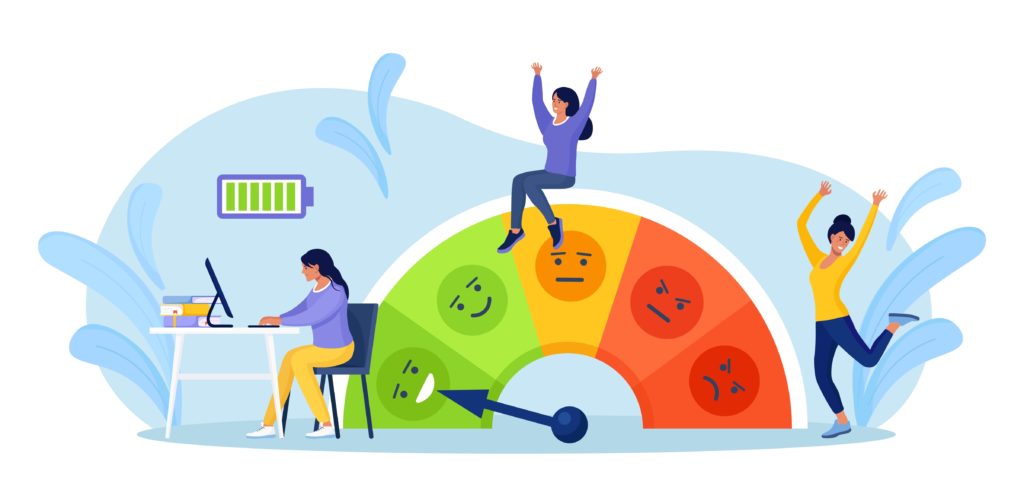
Positive vs negative workplace cultures
Do you feel listened to, supported, and included at work? Or do you feel unheard, neglected, and boxed in? The quality of the culture in the workplace plays a significant role not only in overall wellness but also in performance.
In broad terms, workplace cultures fall somewhere between positive and negative. A 2022 report on Workplace Mental Health and Well-Being by the United States Surgeon General reveals that workplace culture has a significant impact on employee well-being, productivity, and organisational performance.
Negative or toxic workplaces can result in a loss of worker productivity, performance, and overall quality of work. On the other side of the coin, a positive work culture can boost engagement and innovation.
Put simply, work is no longer just work. The cultures that form in the workplace have just as much to say about a company’s bottom line as the numbers.
Modern workplace culture
Today, the workplace is more than a space where people gather — either in person, online, or both — to perform their jobs. During the pandemic and the return to the office, I spent time reporting on the work-life. Amid the many interviews of academic experts, industry leaders, and workers, a pattern emerged.
The rapidly changing landscape, from hybrid work to the Great Resignation, caused employers to shift their views on workplace culture radically. While employers strived to meet goals, employees sought a more balanced work-home life.
For example, 2022 research by Ernst & Young found that 54% of workers in the United States left a job due to their boss’ lack of empathy when it came to issues at work. The research also found that 49% of workers left their job because of inadequate sensitivity to home life stress.
While some innovative leaders were onto this approach long before, the idea that the workplace should equally focus on employee expectations came to the forefront. The results have created a more dynamic workplace culture predicated on creating positive workplace cultures and mitigating negative influences.
Toxic positivity

Taken at face value, positivity is simply maintaining a positive perspective on life — the good, the bad, the ugly, and the beautiful. At its extreme, positivity can seem out of touch with reality. Simply putting on the don’t worry, be happy blinders can neglect the challenges and uncertainties that people face in everyday life.
Tabitha Kirkland, a psychologist and associate teaching professor at the University of Washington’s Department of Psychology, says that toxic positivity is devoid of empathy and neglects to recognize the negative things in life. This approach can make people feel invalidated and not listened to, which is critical to employee engagement, performance, and the financial success of the company.
A 2021 survey by the Workforce Institute found that nearly 3 out of 4 employees say that they feel more engaged and perform better at work when they feel heard. This also impacts the overall financial performance of the company, as the survey also found that employees in companies that financially outperform others in their industry feel heard more by a margin of 26%.
Taking an extreme approach to positivity can actually backfire.
Positive leadership and optimism
Positivity starts with a form of leadership approach that plays to people’s skills, gives recognition and encouragement to others, and maintains an optimistic outlook. Positive leadership has been correlated with better employee engagement, optimism, and performance.
Sticking to strengths
Renowned Austrian-American management consultant Peter Drucker believed that individuals could create more impact at work by focusing on developing the skills they excel at. Instead of spending time trying to make a well-rounded skill set, Drucker believed that sharpening the tip of the spear and strategically cultivating one’s strengths and learning styles would serve an individual the best.
Leaders and managers can take a page from Drucker’s book by identifying team members’ skills and enabling them to work within that range. This does not have to be an entirely individual pursuit.
For example, if a project requires data analysis, but must ultimately be presented at a higher level meeting, assemble a team of analysts and designers to work together to find the trends and then present them in a digestible form. The push and pull dynamics can create something more powerful than numbers or graphics would alone.
Recognition and encouragement
Encouragement and recognition are two key spices in the recipe of healthy conversations. Gallup notes that simply recognizing employees not only positively impact engagement and productivity, it also can help keep employees around for longer. The study found that employees who do not feel recognized at work are twice as likely to quit.
Beyond the individual, recognition also impacts teams by painting a transparent picture of what leadership thinks success should look like. But sometimes conversations have to steer towards more difficult subjects, like when things need improvement.
When it comes to difficult conversations, delivering feedback requires a delicate approach. Instead of using harsh criticism, reframing the conversation to focus on what went well and how to pursue future success can go a long way in making a positive impact on the team.
Research on team conversations indicates that high-performing teams have 6 positive interactions for every negative one, while low-performing teams only have 1 positive interaction for every 20 negative ones. While these numbers may seem extreme, there is a potential explanation for why positive interactions dominate better-performing teams.
Optimism and emotional contagion
If positivity is part of the larger cultural framework of an organisation, then optimism certainly plays a role. The American Psychological Association defines optimism as “hopefulness: the attitude that good things will happen and that people’s wishes or aims will ultimately be fulfilled.”
Optimistic leaders provide a necessary positive emotional contribution to the team. They find solutions to problems, help create a vision for the future, and inspire others to reach that goal by reinforcing the positives. Sound familiar? A leader who practices recognition and encouragement is already building an optimistic culture.

This optimism can positively impact teams through emotional contagion. Coined by Sigal Barsade, Professor of Management at Wharton School of the University of Pennsylvania, emotional contagion is the ripple effect that occurs as emotions spread among individuals and groups. Barsade’s innovative research found that positive emotional contagion helped people work together, limited conflict, and boosted performance.
So when optimism becomes the attitude and outlook in the workplace, positive emotions can flow. This is critical because if the team is optimistic, then individuals can begin to harbour a personal sense of optimism — which may be even more valuable.
A 2022 study by Leadership IQ of over 11,000 employees found that while managers that give recognition have a positive impact, employees with a personal sense of optimism are more engaged. In fact, employees higher in self-optimism are more than twice as likely to feel inspired to try their best at work.
The ripple effect of optimism starts at the top but has the potential to create the biggest impact on employees when it is felt at a personal level. The Leadership IQ study also identified another major component of an employee’s inspiration and engagement at work: resilience.
Resilience training, tools, and techniques
Resilience is the use of flexibility to adapt to change and challenges, says the American Psychological Association. Even more critical, resilience skills can be trained. This is important because resilience not only factors into worker engagement, but it can also account for 25% of an employee’s inspiration at work.
Measuring Resilience
The Resilience Institute conducted a global study on resilience levels that spanned from 2018-2021. When the pandemic hit, resilience levels dropped globally. However, people began to bounce back as they adapted to the rapidly changing world. This bounce factor enables people to adapt in the face of change and challenges.
During the pandemic, people have bounced back by learning to connect in new ways during lockdowns, learning to cope with their mental health, and learning how to get better sleep. In fact, the Resilience Insitute’s 2022 Global Report found that sleep is the most important factor for developing resilience.
We measure resilience through the Resilience Diagnostics assessment. Using key psychometrics, the Resilience Diagnostic assessment uses 60 questions that measure specific factors that support or undermine resilience. Individuals and the entire organisation can use the tool via the web or mobile app to view the factors that promote your resilience or hinder it. This is known as the Resilience Ratio.
The Resilience Spiral
This visual tool represents the 11 main categories that make up different parts of the 60 questions in the Resilience Diagnostics assessment. Completing the questionnaire provides the user with a map of strengths and risks and practical recommendations to move up the spiral.
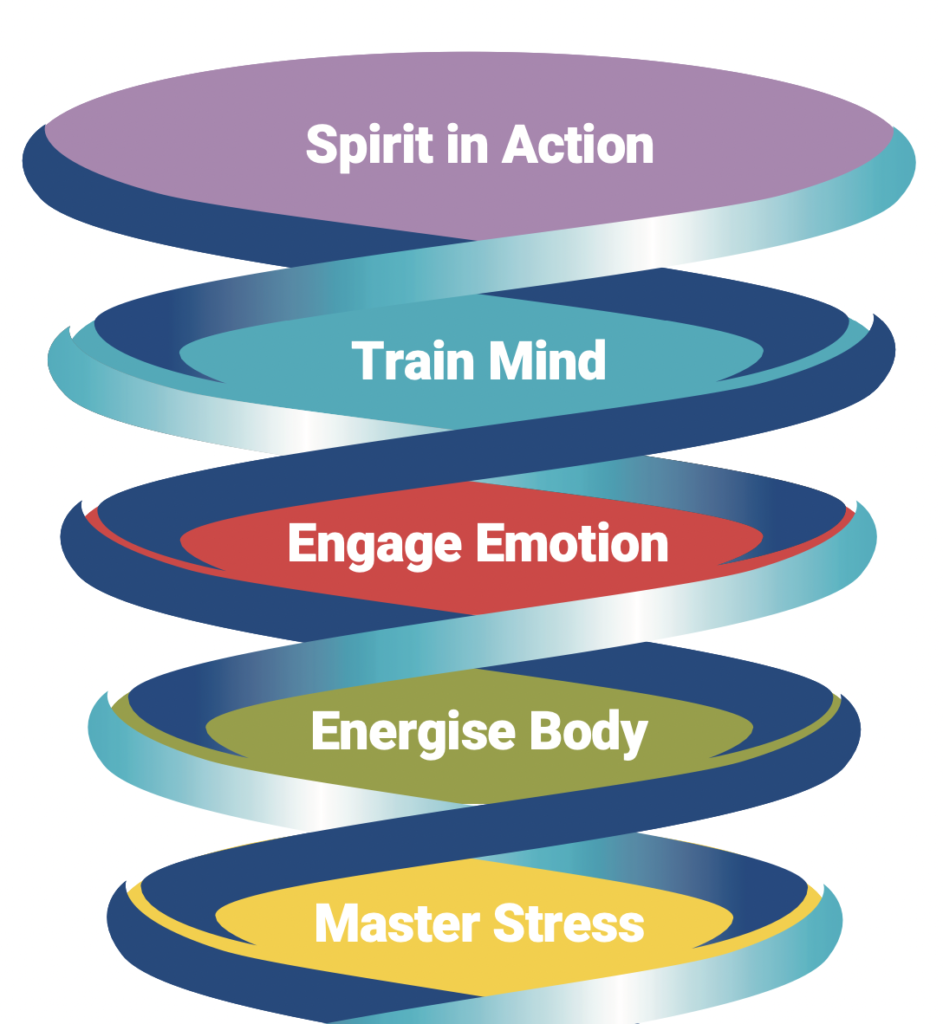
The top half of the Resilience Spiral includes the following categories:
- Spirit in Action
- Train Mind
- Engage Emotion
- Energise Body
- Master Stress
The upper half helps develop resilience and enables growth, connection, and flow. At the top of the spiral sits Spirit in Action, which represents peak performance. Next sits Train Mind, which relies on the fact that training the brain can combat the effects of ageing and performance.
Engage Emotion uses awareness to harshness the passion and creativity of emotions. The mind and body are intimately connected — energising the body sets the tone for the rest of the spiral. At the base sits Master Stress. Stress is the teetering point between the top and the bottom of the spiral because stress can rule your world when left unmanaged.
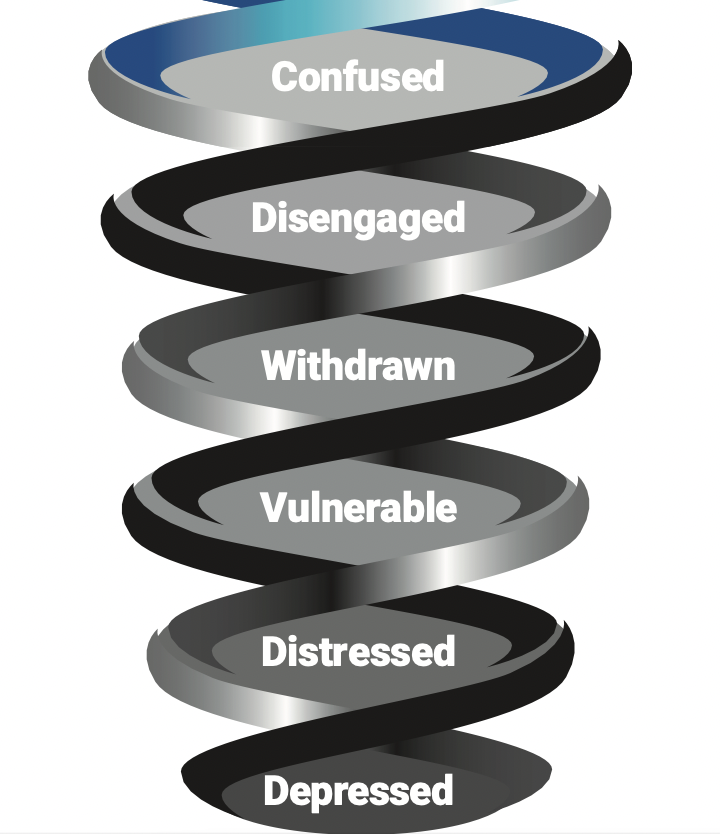
On the other side of the coin, the lower half of the Resilience Spiral includes the categories:
- Confused
- Disengaged
- Withdrawn
- Vulnerable
- Distressed
- Depressed
The lower half represents a lack of resilience. The first step down the spiral is Confused, which leads to a lack of focus. Next is Disengaged, which creates boredom and, eventually, loss of productivity. Progression down the spiral leads to Withdrawn — where the body loses energy and engagement.
Fatigue kicks in at the Vulnerable, as people feel indifferent. Distressed can lead to loss of staff and unhealthy organisational culture. Finally, Depressed signals the end of an organisation.
Resilient people and organisations work at higher levels. When resilience fails, people and organisations drop into the lower levels.
Training Resilience
The Resilience Institute offers resilience training — ranging from the Resilience app to webinars, workshops, and comms support — that can increase performance by 41%, decrease risk by 34%, and boost growth in capability by 38%.
Gain access to a library of information to help you learn more about the resilience factors and your own Resilience ratio, and learn skills for how to bounce back, access flow states, and increase emotional intelligence. The app also includes goal tracking, over 50 resilience training videos by Dr Sven Hansen, daily meditations, and a support chatbot.
The app is available in English, French, Spanish, Dutch, German and Mandarin. Thousands of organisations use The Resilience Institute to measure and improve individual and organisational resilience. Are you ready for resilience?
Original Source: https://resiliencei.com/blog/positivity-at-work/