


Mindful Leadership in Asia: What the Research Actually Shows
- A 2025 meta-analysis of 109 studies and nearly 20,000 participants found leader mindfulness consistently predicts more follower-centred leadership behaviour, and better follower wellbeing, performance, and leader relationships.
- Psychological safety research shows organisations built on a clan-style culture generate meaningfully higher psychological safety than those built on hierarchy, yet many organisations operating in Asia default to hierarchy without examining that trade-off.
- A 2026 scoping review of high power distance environments in Asia found the answer is not to eliminate hierarchy, since that rarely works, but to use it deliberately to build safer, more respectful relationships across rank.
- Global organisations that import Western mindful leadership frameworks unchanged into their Asia offices tend to see limited traction. The research now points to a specific, adapted approach instead.
Mindful leadership research has matured considerably since the idea first became popular in corporate learning circles. It is no longer a single brain-scan study and a persuasive TED talk. It is now a body of large-scale, peer-reviewed evidence, and a growing part of that evidence speaks directly to a problem that Western leadership frameworks have historically ignored: hierarchy. For any organisation operating in Asia, whether a regional business or a global multinational running a Singapore or Hong Kong hub, that is not a side note. It is the central design question.
What the Evidence Actually Shows
A 2025 meta-analysis published in the British Journal of Management pooled 109 studies, 396 effect sizes, and nearly 20,000 participants to test whether leader mindfulness genuinely predicts better outcomes for the people who work for them. It did, consistently. Leaders with higher mindfulness engaged in more follower-centred leadership behaviour, and their teams reported stronger wellbeing, better performance, and healthier leader relationships as a result. This is a materially stronger evidence base than the single neuroimaging study most mindful leadership content still leans on, and it confirms the underlying claim while adding an important nuance: the researchers specifically tested region as one of several moderators, which is itself a signal that context, not just the presence of mindfulness, shapes how the effect plays out.
A separate 2024 review in Frontiers in Psychology mapped the specific leadership qualities that regular mindfulness practice tends to build: sharper self-awareness, steadier emotional regulation, and a demonstrated ability to notice one’s own biases rather than act on them unexamined. None of this claims mindfulness turns a leader into someone new. It claims something more modest and more useful: consistent practice measurably shifts how a leader shows up under pressure, which is precisely the condition most leadership failures occur under.
Presence Versus Focus, and Why the Difference Matters More Under Hierarchy
Focus is the ability to concentrate on one task, shutting distractions out. Presence is broader: full awareness of the people and dynamics in the room, not just the task at hand. Most leadership training optimises for focus, because it is easier to teach and measure. Presence is harder, and it is precisely the skill that hierarchical cultures make harder to practise, since a leader’s rank alone can quietly discourage the kind of open, unfiltered feedback that presence depends on noticing.
Sports psychology offers a useful, if imperfect, parallel. Athletes who perform best under pressure are typically the ones who can hold total presence in the moment rather than narrowing entirely onto mechanics. The parallel to leadership is real but should not be overstated: a boardroom is not a competition arena, and the research connecting elite athletic presence to executive decision making is suggestive rather than a direct transfer. What does transfer cleanly is the underlying mechanism: presence, like any attentional skill, responds to deliberate practice, not innate talent alone.
Psychological Safety in High Power Distance Cultures
Psychological safety, the shared belief that a team is safe for interpersonal risk taking, has become one of the most cited concepts in organisational research since Amy Edmondson’s original work and Google’s well known internal study on team effectiveness. What gets discussed far less often is that most of the foundational research, including that internal study, was conducted primarily in Western, relatively low power distance organisational cultures.
Research specific to Asia tells a more complicated story. A large 2025 study spanning 18 societies and 2,451 employees found organisations with a clan-oriented culture, built on collaboration and belonging, generated significantly higher psychological safety than those built around hierarchy, and that trust in top management was the key mechanism connecting culture to safety. Separately, a 2026 scoping review focused specifically on high power distance environments across Asia concluded that trying to eliminate hierarchy outright is rarely realistic or effective. The more workable path is using the existing hierarchy deliberately, senior leaders actively inviting dissent, visibly rewarding people who raise concerns, and modelling fallibility themselves, to build respectful, safer relationships across rank rather than pretending rank does not exist.
This matters directly for any global organisation running a regional Asia office. A psychological safety programme copied unchanged from a headquarters in London or New York, built on an assumption of low power distance, will tend to underperform in Singapore, Jakarta, or Tokyo, not because the underlying science is wrong, but because it was validated in a different cultural operating system. The RI Asia perspective on this is straightforward: culture types like clan and hierarchy are not fixed traits an organisation is stuck with. They are measurable, and a resilience or culture assessment that accounts for regional context gives a leadership team a genuine baseline to work from, rather than an imported assumption.
Tools for Cultivating Mindfulness, Adapted for Hierarchical Teams
Meditation remains a foundational practice, and mindfulness apps have made guided sessions genuinely accessible for time-poor leaders. But the tools that matter most in a high power distance environment are not the individual ones. They are the visible, structural ones a senior leader controls.
On Emotional Regulation and the Polyvagal Theory
A physiological account often cited alongside mindful leadership is polyvagal theory, which links the vagus nerve to our capacity to self-regulate under stress. It offers a genuinely useful intuition, that leaders who understand their own physiological stress response can create more stability for the people around them, and it is worth treating as a helpful working model rather than a settled, uncontroversial account. Some of its specific physiological claims remain debated within the broader neuroscience field. The practical takeaway holds regardless of where that scientific debate lands: leaders who notice their own reactive state, and deliberately pause before responding, produce calmer teams than leaders who do not, and that pattern shows up consistently across the mindfulness and leadership research regardless of which underlying mechanism explains it.
Implementing This Without Importing a Framework That Does Not Fit
Mindful communication, better decision making, and stress management remain the three practical pillars of implementation. What changes for organisations in Asia is the delivery, not the destination. Decision making benefits from a clear, calm mind regardless of geography, but a leader in a high power distance culture also needs to actively create space for dissenting input that will not surface on its own. Stress management practices like breathing techniques and brief meditation work the same way everywhere physiologically, but the organisational permission to visibly step back and pause, without it reading as weakness, varies significantly by culture and needs to be modelled deliberately by the most senior person in the room.
Before your next leadership offsite, ask:
- Was our mindful leadership or psychological safety programme designed here, or imported unchanged from headquarters?
- When was the last time a junior team member disagreed with a senior leader in a meeting, and what happened next?
- Do we actually know which of our teams struggle most with psychological safety, or are we assuming it is evenly distributed?
Mindful leadership is not a Western concept waiting to be exported to Asia. The underlying skill, noticing your own reactive state and choosing a deliberate response instead, is universal. What has to be built locally is the structure around it, because hierarchy does not disappear just because a leader has learned to breathe more calmly.

How to Become a Resilience Coach: Training, Tools, and Insights
- A structured resilience assessment turns vague client feelings, “I feel stuck,” “I feel off”, into specific, measurable signals across 50 science-based factors.
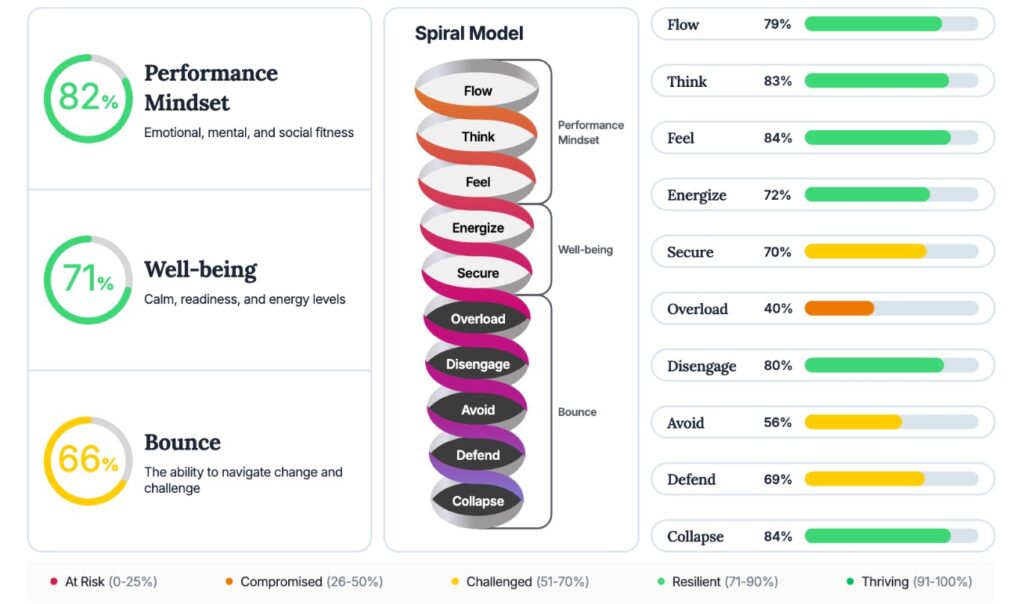
- The Resilience Spiral, now in its fifth iteration, maps the stages between distress and flow, giving coaches a shared, evidence-based language for human performance.
- Coaching outcomes become genuinely measurable: real client progress can be tracked and shown in concrete terms rather than left as an unverifiable impression.
Effective coaching needs more than listening skills. It needs data. It needs clarity. It needs tools that reveal what people often can’t see in themselves. That’s what makes Resilience Institute’s Coaching Certification distinct. It cuts through ambiguity and gets to the heart of what actually makes people thrive.
Why Is Self-Awareness So Hard to Pin Down?
Many clients struggle with self-awareness. They feel stuck, anxious, or disengaged, yet can’t quite explain why. They guess at solutions. Coaches guess too. The Resilience Assessment changes that.
It measures 50 science-based factors driving physical, emotional, mental, and social fitness. It shows real patterns, spots genuine blind spots, and turns vague feelings into clear, specific signals, giving coaches an actual roadmap to work from.
Have you ever coached someone and felt unsure whether they were telling you the whole story? Only in session four do they mention they’re taking sleeping tablets, or medicating for anxiety. Plenty of leaders don’t want to acknowledge they’re short on rest or multitasking all day. Using a holistic assessment to capture a genuine baseline depersonalises the struggle and shifts the conversation to an objective perspective:
“Ah, I see sleep has been a struggle for you recently…”
“So you find yourself juggling many tasks each day…”
“Your hypervigilance score signals that you’re struggling to fall asleep…”
Some leaders still wear sleepless nights or constant multitasking as a badge of honour. Some coaches still overlook the physical dimension entirely when supporting clients. But human performance is genuinely integrated, body, emotion, and mind together, and small, precise adjustments can transform how someone actually experiences their life. That’s where the Spiral comes in.
What Is the Resilience Spiral, and Why Does It Matter?
Since 2002, Resilience Institute has worked with thousands of organisations and more than 100,000 individuals. The Resilience Spiral sits at the core of that work. Now in its fifth iteration, it maps the natural stages of resilience, from distress through to flow.
The Spiral is genuinely practical. It weaves together fields that too often stay fragmented, mental health, stress mastery, emotional intelligence, high performance, and wellbeing, helping people climb toward what RI calls “altitude,” a state of real thriving where purpose, energy, and performance meet.
Isn’t Resilience Just a Buzzword?
No. Resilience is a learned set of skills, genuinely measurable and trainable. It includes sleep, nutrition, and recovery. It includes self-awareness, emotional regulation, and focus. It includes connection, purpose, and optimism.
RI’s model draws from neuroscience, positive psychology, epigenetics, preventative medicine, and behavioural science, refined over decades and tested in boardrooms, classrooms, clinics, and frontline teams alike. The feedback stays consistent: it gives people real language to describe what they’d previously only been able to feel.
What Makes This Certification Different?
Coaches completing the certification gain more than a framework. They gain a genuinely powerful assessment tool, letting them deliver individual reports that spark real insight, benchmark teams and track progress over time, target interventions with real precision, and show a genuine return on investment. That makes coaching not just more effective, but measurably more valuable to client organisations.
How Does It Help Coaches Succeed?
Coaching is a genuinely competitive space. To stand out, coaches need real results and a methodology grounded in science but flexible enough for actual practice. The Resilience Coach Certification offers a clear, structured model, actionable data from real clients, tools for both individuals and groups, and language that genuinely resonates with leaders. It isn’t a script. It’s a system, and it works.
Can Coaching Be Measured?
Most coaching programmes struggle to show clear outcomes. This one doesn’t. Group dashboards let coaches and organisations see genuine shifts in resilience over time, measuring growth, pinpointing pain points, and adjusting strategy accordingly.
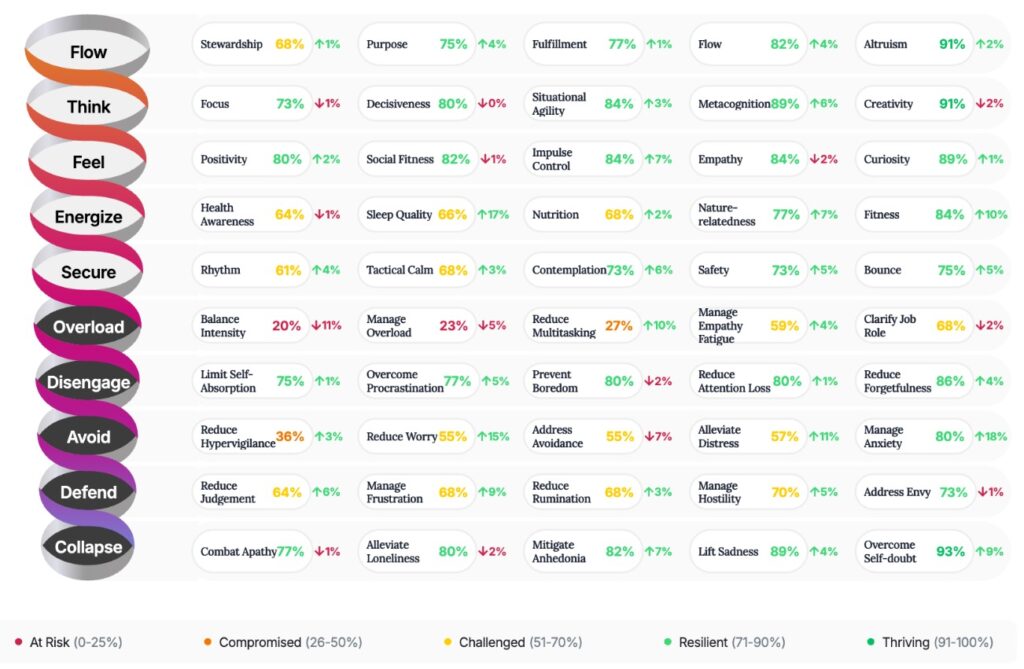
No more “thanks, I think that coaching helped.” Instead: “I improved my sleep quality by 17%, and I’m 18% better at managing anxiety.” That’s why HR teams and executives respond so well to this approach. It brings real credibility and real evidence, turning coaching into a genuine strategic investment. If you’re after referrals from existing or previous clients, give them data worth sharing. They become genuine ambassadors in the market.
What Kind of Coaches Should Apply?
This certification suits coaches working with leaders and executives, teams and departments, healthcare professionals, educators and students, and athletes and performers. It’s built for coaches who want a genuinely deeper impact, who value insight over opinion, and who are ready to work at the intersection of performance and wellbeing.
Why Now?
The world is demanding more from people than it used to. Change is constant. Stress runs high. Plenty of people feel genuinely overwhelmed. Coaches are more needed than ever, but meeting the moment requires the right tools. The Resilience Coach Certification is evidence-based and built to equip coaches to guide others through real complexity with genuine clarity.
What Happens After Certification?
Graduates join a global network of resilience professionals, with access to ongoing learning, group support and mentorship, upgrades as the model evolves, and new insight as the underlying resilience science develops. It’s a living system, not a static course, and it keeps improving. The certification is also approved by the ICF for Continuing Coach Education, offering 4 CCE hours on completion.
The future of coaching isn’t guesswork. It’s grounded, measurable, and genuinely human, and it starts with resilience.

The Best Coaching Tools for Executive and Leadership Coaching
- Coaches and HR professionals increasingly need tools that go beyond conversation, ones that offer measurable, evidence-based insight into resilience, strengths, and behaviour.
- Resilience-specific tools (like RI’s own Resilience Assessment and Hello Driven’s CReC platform) measure burnout risk and recovery capacity directly; strengths and personality tools (CliftonStrengths, DISC, MBTI) build shared language for communication and team dynamics.
- Pricing varies by tool and changes over time; always confirm current pricing directly with the provider rather than relying on a fixed figure from any single article.
Leaders are under pressure to perform, adapt, and inspire, often all at once. Coaches and HR professionals supporting them need tools that go beyond conversation: insights that are measurable, evidence-based, and genuinely relevant to the realities of leadership today.
Whether working with senior executives, cross-functional teams, or emerging leaders, the right coaching tool helps guide genuinely meaningful change. From strengthening resilience and reducing burnout to improving collaboration and communication, these tools bring real clarity to complexity. This guide reviews five of the most trusted and effective coaching assessments used by executive coaches, leadership consultants, and HR leaders worldwide.
Resilience Assessment (Resilience Institute)
A scientifically validated tool measuring 50 key factors across 10 levels of the Resilience Spiral, including focus, adaptability, empathy, recovery, and burnout risk. It provides clear, actionable insight into performance, mental health risk, leadership readiness, and team dynamics, now powered by RI’s own AI platform for individualised recommendations across areas like sleep, vitality, and emotional regulation. Reports are available for both individuals and groups, with benchmarking and trend tracking for repeat use over time.
Certified professionals gain access to a structured framework, preferred pricing, and best-practice guidance for using the tool in coaching engagements. Pricing is tiered per user, with a reduced rate for certified professionals; confirm current rates directly on RI’s assessment page.
Why it benefits executive coaches and HR leaders: it provides a measurable, holistic view of personal and team resilience, ideal for coaching aimed at genuine wellbeing, better decision-making, and sustainable performance.
Hello Driven (CReC Resilience Tools)
A digital platform for tracking and building resilience over time, built around the peer-reviewed Predictive 6 Factor Resilience Model (PR6), which measures six domains and expands to 24 skills through the extended PR6E. It uses AI-supported dashboards and micro-coaching to help users develop awareness and adaptability, with coaches and facilitators able to become certified through the Certified Resilience Coach (CReC) programme, which is ICF-accredited for continuing coach education.
Certification includes a 12-month platform subscription, group and trend-tracking features, and access to specialist follow-on pathways like Resilience First Aid and High Adversity Resilience Training. Confirm current certification pricing directly with Hello Driven, since programme inclusions and cost have been updated more than once since launch.
Why it benefits executive coaches and HR leaders: a solid option for organisations wanting continuous digital engagement with employees and a scalable resilience programme backed by a peer-reviewed model.
CliftonStrengths (Gallup StrengthsFinder)
Identifies an individual’s top 5 or full 34 strengths from a list of 34 themes, Achiever, Strategic, Relator, and others. Widely used in corporate coaching and leadership development, it’s a foundational tool for aligning roles with natural talent and genuinely fostering engagement, priced at a relatively accessible entry point for the Top 5 report and a higher tier for the full 34.
Why it benefits executive coaches and HR leaders: helps leaders build real confidence, deepen self-awareness, and align teams around complementary talents in a positive, genuinely scalable way.
DISC Personality Profile
A behaviour-based assessment categorising individuals into Dominance, Influence, Steadiness, and Conscientiousness. Often used to improve communication and resolve team conflict, particularly in leadership and cross-functional teams, and priced moderately, with cost varying by provider.
Why it benefits executive coaches and HR leaders: gives teams and leaders a shared language for discussing behaviour, genuinely useful for building trust, improving collaboration, and leading with real awareness.
MBTI (Myers-Briggs Type Indicator)
A globally recognised tool for understanding personality preferences, categorising individuals into 16 types. Often used in leadership coaching, communication training, and change management. It has genuine limitations in scientific robustness worth being upfront about, but remains one of the most familiar tools in corporate settings, particularly valuable for introducing personality frameworks and fostering team dialogue, typically administered by a certified practitioner at a moderate to premium price point.
Why it benefits executive coaches and HR leaders: familiar and accessible, ideal for clients who need a basic shared framework for understanding themselves and their teams, especially in cross-cultural or high-stakes environments.
Choosing the Right Tool for High-Impact Leadership
Whether coaching executives, supporting teams, or designing organisational development programmes, the right tool helps turn genuine insight into real action. Resilience-specific tools like RI’s own Resilience Assessment and Hello Driven bring measurable clarity to performance, mental health, and burnout prevention, arguably the most critical areas in modern leadership right now. Others, CliftonStrengths, DISC, and MBTI, offer frameworks for communication, collaboration, and personal growth that complement rather than replace that resilience-specific lens.
The best coaching tools don’t just inform. They empower. Choose the one that genuinely aligns with your coaching goals, your client’s actual needs, and the organisational context you’re working within, and always verify current pricing directly with the provider before committing.
The right assessment doesn’t replace good coaching. It gives good coaching something measurable to actually work with.

What It Takes to Be a Resilient Coach or Leader: Insights on Presence, Growth, and Impact
- Presence, not performance, is what makes coaching genuinely transformational. Without it, clients can’t feel safe enough to reflect, open up, or actually change.
- Feedback triggers a real stress response, not unlike seeing a police car pull up behind you. Curiosity-based questions open reflection where feedback tends to trigger defensiveness.
- Coaching mastery isn’t about technique or having the right answer. It’s about being willing to stay present in genuine discomfort, both the client’s and your own.
A conversation with Dr. Marcia Reynolds on presence, growth, and impact
There’s a quiet power in coaching that often goes unnoticed. It isn’t about asking the perfect question or applying the right model. It’s about how you show up, especially when someone else is struggling to think, lead, or move forward. That’s what makes coaching both genuinely challenging and deeply human.
To explore this, we sat down with Dr. Marcia Reynolds, former president of the International Coaching Federation, a globally recognised leadership coach, and author of Coach the Person, Not the Problem. On the Resilience Podcast, she shared what it genuinely means to be a resilient coach, and how presence, more than performance, is what actually unlocks real transformation.
Why Presence Is the Foundation of Resilience
Asked what matters most in building resilience through coaching, Dr. Reynolds brings it back to presence immediately. Without it, clients can’t feel safe enough to open up, reflect, or genuinely change. “If I break presence, I might break their feeling of safety.”
Presence isn’t passive. It’s the anchor that holds space when emotions run high, when thinking turns cloudy, or when someone is sitting in real discomfort. Too often, coaches rush that exact moment, reaching for a solution or trying to prove their worth instead of simply staying present. “When you slow down, you actually move faster,” Dr. Reynolds says. Real transformation begins in that stillness.
What Actually Makes Coaching Transformational?
Coaching isn’t about having the answers. It’s about helping someone else think more clearly. Where training and advice tend to activate the rational, task-driven part of the brain, coaching engages the creative, reflective parts where genuine insight actually lives. “When I reflect your story back to you and ask, ‘How is that working for what you want?’ you begin to see differently,” Dr. Reynolds explains.
That shift doesn’t come from strategy or skill alone. It comes from slowing down, listening fully, and being willing to walk alongside a client rather than ahead of them. “I’m not here to fix you. I’m here to think with you,” she says.
What Do Coaches Get Wrong About Feedback?
Much of coaching happens in the space between a question and someone’s own reflection, yet many coaches and leaders still default to feedback as their primary tool. Dr. Reynolds challenges that directly: “Feedback triggers the same stress response as a police car pulling up behind you.” Instead of correcting, she teaches leaders and coaches to stay genuinely curious. Ask, “What are you trying to achieve here?” or “How can I support you with this?”
That approach removes the threat and replaces it with real partnership. It invites reflection instead of defensiveness, and it turns even difficult conversations into genuine moments of growth.
How Can Leaders Shift Into a Coaching Mindset?
Shifting from expert to coach can feel genuinely awkward, especially for leaders used to being the one with the answers. The first step is simple: name the shift directly. “Let people know,” Dr. Reynolds suggests. “Tell your team: I’m learning a new way to lead. I want your support.”
Being transparent about your own growth builds real trust. It creates genuine permission for others to grow too, and it signals that leadership isn’t about control, it’s about co-creation. Leaders who coach well model exactly the mindset they hope to inspire in others. “It’s okay to feel awkward,” she adds. “But when you name it, you create trust.”
What Should Coaches Understand About Their Own Growth?
For many coaches, the hardest lesson is that coaching isn’t about performance. It’s about presence. Coaches often arrive from “telling” professions, teaching, therapy, consulting, and the first internal shift is learning to stop proving and start genuinely listening instead. “The first shift is into coaching presence. The second is into mastery, where you let go of technique and fully show up,” Dr. Reynolds explains.
Mastery isn’t about perfection. It’s about being real, genuinely grounded, and willing to stay in the discomfort of growth, both yours and your client’s. “You don’t have to be perfect. You just have to be present.”
Coaching mastery doesn’t come from having the right technique. It comes from presence, from being genuinely willing to slow down, stay curious, and show up real, in the discomfort, alongside the person you’re actually there for.