
Women Illustration
Overview of the personalised Resilience Assessment Report

See how we measure Resilience and the detailed insights into individual strengths and growth areas.

Download Report

The Challenge of Promoting Wellbeing

A study in Nature Human Behaviour published this week shows promise for mindfulness and positive psychology to improve mental states of wellbeing. (https://www.nature.com/articles/s41562-021-01093-w).

I was invited to discuss the findings on the Morning Show today with TV3 in New Zealand. We asked viewers if they practiced mindfulness. While 30% answered YES, 50% NO, another 20% answered “what the heck is mindfulness?”

Thus, 70% disengaged.

The host, Duncan Gardner, dismissed the interview with “See you next year.” Viewers really learned nothing about this important, yet flawed study. The interview is available at 46 minutes into episode on 20 April 2020.

In a nutshell, a systematic review and meta-analysis of 419 randomised and controlled studies involving 53,288 people showed low to moderate impact. Mindfulness-based and multi-component positive psychological interventions showed some efficacy in clinical and non-clinical populations.

Singular positive psychological interventions, cognitive and behavioural therapy-based, acceptance and commitment therapy-based and reminiscence interventions were impactful.

Read those last two paragraphs again. Do they make sense to you?

Table of Contents

The Promise

The suffering caused by physical, emotional and mental distress in our modern time is enormous and increasing. Thus far, the impact of psychology, psychiatry, medicine and pharmacology has been limited and confusing. The incidence of common conditions such as depression, anxiety, attention disorders and Autism continue to increase alarmingly.

As humans confront the changing environments we have created, we are failing to adapt. Despite massive investments, preventable physical, emotion and mental conditions continue to accelerate. We are not solving the challenge of wellbeing.

We desperately need effective interventions. All work done to define and test solutions must be celebrated. This is certainly the case in this meta-anaylsis but, in my opinion, we have a long way to go.

The Problems

Reading through the abstract of this paper is agonising. The vague terms used, and lack of clear definitions leave the average person confused or disengaged. Wellbeing – physical, emotional, mental, social and spiritual – are not defined.

How does the average person engage with ‘Mindfulness-based and multi-component positive psychological intervention’? No wonder, people prefer a pill or a glamorously promoted supplement such as the vitamin C promoted in the commercial preceding the interview.

Good science must define and simplify the terms so that they can be tested and, if proven successful, effectively promoted in practical ways.  For example: slow, diaphragmatic breathing through the nose at six breaths per minute reduces anxiety symptoms by xx%.

Psychologists have a long road to travel to bring clear, effective solutions to solve for wellbeing. Their claim: ‘researchers drill down to the core of wellbeing worldwide’, is false.

Solutions

Define the Goal

To live a good life inspired by love and guided by knowledge was Bertrand Russell’s recommendation. It is hard to beat. ‘To live’ is action based and physical. ‘Inspired by love’ is the domain of emotional and social intelligence. Guided by knowledge is mental awareness, agility and meaning.

If we are to use the term wellbeing, let’s agree that it includes physical vitality, mastery of emotion, agility of thought, social connection and meaning (spiritual).

When we use the term resilience, we mean the learned set of skills to:

  • Bounce forward in adversity
  • Grow physical, emotional and mental resources
  • Connect with self, others and nature
  • Discover flow in your life and work

We must define the terms clearly, embracing the integration of different components and expressing it in a way people can understand.

Define the Components

The most challenging component of an effective wellbeing and resilience strategy will be to define the human factors that we want to impact.

For example, a clinical diagnosis of depression is description of a prolonged state of sadness. It has physical aspects in fatigue and sleep disturbance. The emotion of sadness is persistent and overwhelming. The mind becomes confused, pessimistic and indecisive. A range of solutions exist. 

Physical activity, sunshine, sleep and good nutrition can reduce the symptoms. Emotion regulation including impulse control, gratitude, appreciation and kindness help. Mental skills such as CBT and ACT can work. All of these can work better than antidepressants if applied consistently.

The challenge of a therapist, coach, trainer or digital tool is to identify the right intervention for the person and secure consistent, disciplined application. Anyone can learn how to improve mental agility (CBT). Consistent application is a huge challenge.

Human factors describe the physical, emotional, social and mental attitudes and behaviours that can be learned and mastered. Annually, we search our assessments for the key factors that determine a good life. In 2020, these were the key factors that drive integral wellbeing and resilience:
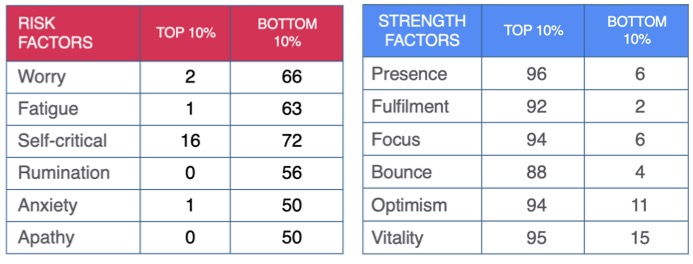
Key Factors that Drive Wellbeing through 2020 (n=7,000)

Note that the lead strength factor is Presence which we discussed on TV today. Presence, for some, is more tangible and less threatening than mindfulness. You are in the moment and fully focused. Focus requires attention control. You are non-judgemental meaning that you are not self-critical and drop your worry and rumination.

To be present also means being fully alert, physically well, refreshed, nourished, calm and positive. One can be fully present in any moment of choice – breathing, enjoying, connecting, problem-solving or simply resting.

Interactions and High Leverage, Practical Interventions

In our experience, this is a huge opportunity to turn the tide of suffering. Taking depression and anxiety, the two most common mental illnesses, we throw billions at therapy, medications and vague techniques. What if we were to simply secure a good night of sleep? Then, perhaps a slow diaphragmatic breathing practice?

If we sleep and breathe well, we have a profound preventive and curative solution for mental illness and physical illness. In addition, we would be stronger, better connected and much more functional in daily tasks.

By tracking the development of these human factors, we are able to identify the ones that respond to assessment, training and support. In a sample of 1,788 people during 2020 we were able to show the following changes:
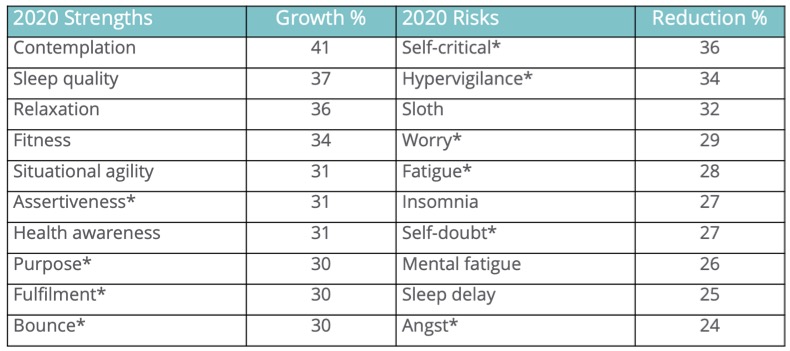
These gains are shown as a Growth Ratio (Sharpe Ratio: average improvement divided by the standard deviation). * indicates lead factors for high resilience (left) and low resilience (right)

By integrating these factors in categories of wellbeing and resilience, we can show how each category changes through a six-month training intervention:
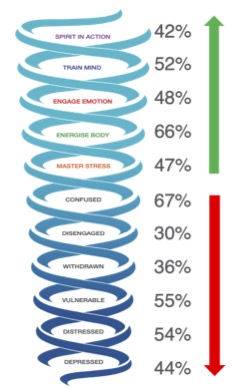
This group of entrepreneurs (n = 115) achieved significant positive change in every category measured. For example, the depression category includes the factor related to a diagnosis of depression (sadness, confusion, insomnia, self-critical, self-doubt). We see a 44% reduction in this category and a 54% reduction in distress symptoms. In addition, they are better able to master stress, be physical well, emotionally intelligent, mentally agile and connected with greater meaning (purpose, integrity, fulfilment, altruism, trust and flow)

Match the Actions to the Person

Finally, while some will respond positively to mindfulness, others may respond better to worry control, fitness, sleep or positivity. In a globally integrated world, we need to offer a range of clear, well defined skills that can be effectively interpreted by people in different circumstances.

Original Source: https://resiliencei.com/blog/mindfulness-dismissed/

A Guide to Positivity at Work

What is positivity?

Positivity at work is more than a personal mindset or attitude. It is part of a bigger movement that influences the individual worker, how the workforce interacts with one another, and how workers align with the organisational goals and culture at large.

Positive workplace cultures ensure beneficial change that ripples from leaders all the way down to individual employees and vice versa. These types of cultures build empathy, optimism, and resilience —  all keys to success. Building a positive workplace culture demands an understanding of the dynamics of the workplace from the top and bottom and the people within it.

From the top, leaders create values, experiences, and rules of engagement that trickle down the organisation to the employees. Employees also hold their own attitudes, beliefs, and perceptions that provide feedback to leadership and influence the overall workplace culture.

Positive vs negative workplace cultures

Do you feel listened to, supported, and included at work? Or do you feel unheard, neglected, and boxed in? The quality of the culture in the workplace plays a significant role not only in overall wellness but also in performance.

In broad terms, workplace cultures fall somewhere between positive and negative. A 2022 report on Workplace Mental Health and Well-Being by the United States Surgeon General reveals that workplace culture has a significant impact on employee well-being, productivity, and organisational performance.

Negative or toxic workplaces can result in a loss of worker productivity, performance, and overall quality of work. On the other side of the coin, a positive work culture can boost engagement and innovation.

Put simply, work is no longer just work. The cultures that form in the workplace have just as much to say about a company’s bottom line as the numbers.

Modern workplace culture

Today, the workplace is more than a space where people gather — either in person, online, or both — to perform their jobs. During the pandemic and the return to the office, I spent time reporting on the work-life. Amid the many interviews of academic experts, industry leaders, and workers, a pattern emerged.

The rapidly changing landscape, from hybrid work to the Great Resignation, caused employers to shift their views on workplace culture radically. While employers strived to meet goals, employees sought a more balanced work-home life.

For example, 2022 research by Ernst & Young found that 54% of workers in the United States left a job due to their boss’ lack of empathy when it came to issues at work. The research also found that 49% of workers left their job because of inadequate sensitivity to home life stress.

While some innovative leaders were onto this approach long before, the idea that the workplace should equally focus on employee expectations came to the forefront. The results have created a more dynamic workplace culture predicated on creating positive workplace cultures and mitigating negative influences.

Toxic positivity

Taken at face value, positivity is simply maintaining a positive perspective on life — the good, the bad, the ugly, and the beautiful. At its extreme, positivity can seem out of touch with reality. Simply putting on the don’t worry, be happy blinders can neglect the challenges and uncertainties that people face in everyday life.

Tabitha Kirkland, a psychologist and associate teaching professor at the University of Washington’s Department of Psychology, says that toxic positivity is devoid of empathy and neglects to recognize the negative things in life. This approach can make people feel invalidated and not listened to, which is critical to employee engagement, performance, and the financial success of the company.

A 2021 survey by the Workforce Institute found that nearly 3 out of 4 employees say that they feel more engaged and perform better at work when they feel heard. This also impacts the overall financial performance of the company, as the survey also found that employees in companies that financially outperform others in their industry feel heard more by a margin of 26%.

Taking an extreme approach to positivity can actually backfire.

Positive leadership and optimism

Positivity starts with a form of leadership approach that plays to people’s skills, gives recognition and encouragement to others, and maintains an optimistic outlook. Positive leadership has been correlated with better employee engagement, optimism, and performance.

Sticking to strengths

Renowned Austrian-American management consultant Peter Drucker believed that individuals could create more impact at work by focusing on developing the skills they excel at. Instead of spending time trying to make a well-rounded skill set, Drucker believed that sharpening the tip of the spear and strategically cultivating one’s strengths and learning styles would serve an individual the best.

Leaders and managers can take a page from Drucker’s book by identifying team members’ skills and enabling them to work within that range. This does not have to be an entirely individual pursuit.

For example, if a project requires data analysis, but must ultimately be presented at a higher level meeting, assemble a team of analysts and designers to work together to find the trends and then present them in a digestible form. The push and pull dynamics can create something more powerful than numbers or graphics would alone.

Recognition and encouragement

Encouragement and recognition are two key spices in the recipe of healthy conversations. Gallup notes that simply recognizing employees not only positively impact engagement and productivity, it also can help keep employees around for longer. The study found that employees who do not feel recognized at work are twice as likely to quit.

Beyond the individual, recognition also impacts teams by painting a transparent picture of what leadership thinks success should look like. But sometimes conversations have to steer towards more difficult subjects, like when things need improvement.

When it comes to difficult conversations, delivering feedback requires a delicate approach. Instead of using harsh criticism, reframing the conversation to focus on what went well and how to pursue future success can go a long way in making a positive impact on the team.

Research on team conversations indicates that high-performing teams have 6 positive interactions for every negative one, while low-performing teams only have 1 positive interaction for every 20 negative ones. While these numbers may seem extreme, there is a potential explanation for why positive interactions dominate better-performing teams.

Optimism and emotional contagion

If positivity is part of the larger cultural framework of an organisation, then optimism certainly plays a role. The American Psychological Association defines optimism as “hopefulness: the attitude that good things will happen and that people’s wishes or aims will ultimately be fulfilled.”

Optimistic leaders provide a necessary positive emotional contribution to the team. They find solutions to problems, help create a vision for the future, and inspire others to reach that goal by reinforcing the positives. Sound familiar? A leader who practices recognition and encouragement is already building an optimistic culture.

This optimism can positively impact teams through emotional contagion. Coined by Sigal Barsade, Professor of Management at Wharton School of the University of Pennsylvania, emotional contagion is the ripple effect that occurs as emotions spread among individuals and groups. Barsade’s innovative research found that positive emotional contagion helped people work together, limited conflict, and boosted performance.

So when optimism becomes the attitude and outlook in the workplace, positive emotions can flow. This is critical because if the team is optimistic, then individuals can begin to harbour a personal sense of optimism — which may be even more valuable.

A 2022 study by Leadership IQ of over 11,000 employees found that while managers that give recognition have a positive impact, employees with a personal sense of optimism are more engaged. In fact, employees higher in self-optimism are more than twice as likely to feel inspired to try their best at work.

The ripple effect of optimism starts at the top but has the potential to create the biggest impact on employees when it is felt at a personal level. The Leadership IQ study also identified another major component of an employee’s inspiration and engagement at work: resilience.

Resilience training, tools, and techniques

Resilience is the use of flexibility to adapt to change and challenges, says the American Psychological Association. Even more critical, resilience skills can be trained. This is important because resilience not only factors into worker engagement, but it can also account for 25% of an employee’s inspiration at work.

Measuring Resilience

The Resilience Institute conducted a global study on resilience levels that spanned from 2018-2021. When the pandemic hit, resilience levels dropped globally. However, people began to bounce back as they adapted to the rapidly changing world. This bounce factor enables people to adapt in the face of change and challenges.

During the pandemic, people have bounced back by learning to connect in new ways during lockdowns, learning to cope with their mental health, and learning how to get better sleep. In fact, the Resilience Insitute’s 2022 Global Report found that sleep is the most important factor for developing resilience.

We measure resilience through the Resilience Diagnostics assessment. Using key psychometrics, the Resilience Diagnostic assessment uses 60 questions that measure specific factors that support or undermine resilience. Individuals and the entire organisation can use the tool via the web or mobile app to view the factors that promote your resilience or hinder it. This is known as the Resilience Ratio.

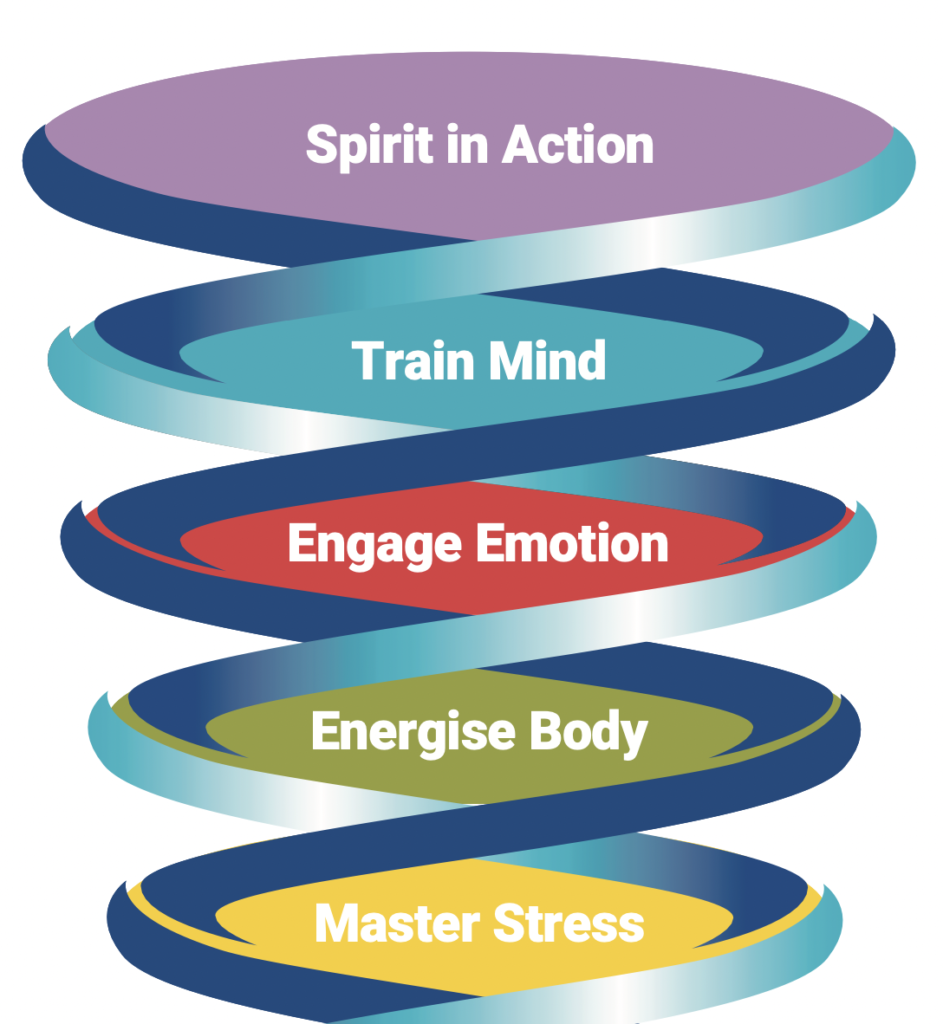
The Resilience Spiral

This visual tool represents the 11 main categories that make up different parts of the 60 questions in the Resilience Diagnostics assessment. Completing the questionnaire provides the user with a map of strengths and risks and practical recommendations to move up the spiral.

The top half of the Resilience Spiral includes the following categories:

  • Spirit in Action
  • Train Mind
  • Engage Emotion
  • Energise Body
  • Master Stress

The upper half helps develop resilience and enables growth, connection, and flow. At the top of the spiral sits Spirit in Action, which represents peak performance. Next sits Train Mind, which relies on the fact that training the brain can combat the effects of ageing and performance.

Engage Emotion uses awareness to harshness the passion and creativity of emotions. The mind and body are intimately connected — energising the body sets the tone for the rest of the spiral. At the base sits Master Stress. Stress is the teetering point between the top and the bottom of the spiral because stress can rule your world when left unmanaged.

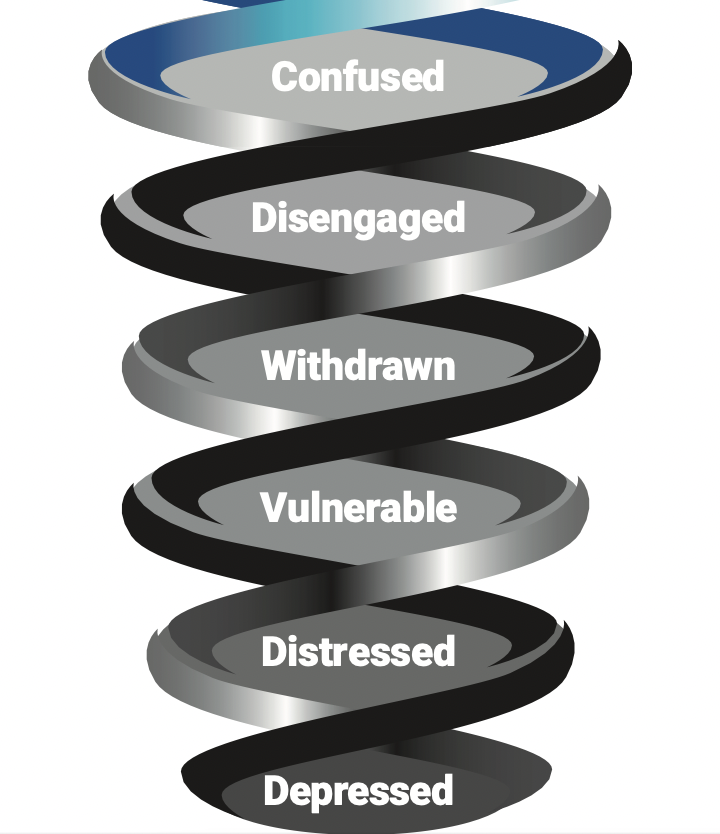
On the other side of the coin, the lower half of the Resilience Spiral includes the categories:

  • Confused
  • Disengaged
  • Withdrawn
  • Vulnerable
  • Distressed
  • Depressed

The lower half represents a lack of resilience. The first step down the spiral is Confused, which leads to a lack of focus. Next is Disengaged, which creates boredom and, eventually, loss of productivity. Progression down the spiral leads to Withdrawn — where the body loses energy and engagement.

Fatigue kicks in at the Vulnerable, as people feel indifferent. Distressed can lead to loss of staff and unhealthy organisational culture. Finally, Depressed signals the end of an organisation.

Resilient people and organisations work at higher levels. When resilience fails, people and organisations drop into the lower levels.

Training Resilience

The Resilience Institute offers resilience training — ranging from the Resilience app to webinars, workshops, and comms support — that can increase performance by 41%, decrease risk by 34%, and boost growth in capability by 38%.

Gain access to a library of information to help you learn more about the resilience factors and your own Resilience ratio, and learn skills for how to bounce back, access flow states,  and increase emotional intelligence. The app also includes goal tracking, over 50 resilience training videos by Dr Sven Hansen, daily meditations, and a support chatbot.

The app is available in English, French, Spanish, Dutch, German and Mandarin. Thousands of organisations use The Resilience Institute to measure and improve individual and organisational resilience. Are you ready for resilience?

Original Source: https://resiliencei.com/blog/positivity-at-work/

What Our 2020 Data Got Right (and Wrong) About Crisis Resilience

  • In March to June 2020, RI’s own diagnostic data found average resilience had risen roughly 7% compared to the same period in 2019, a genuinely counterintuitive early-pandemic finding.
  • That finding makes complete sense in light of the well-established Phases of Disaster framework: the sample was captured during the heroic and honeymoon phases of the crisis, the period of mobilisation and community bonding that reliably comes before a longer, harder decline.
  • The transferable lesson matters more than the specific 2020 numbers: early positive resilience signals during any crisis, a downturn, a restructure, a market shock, often reflect a temporary mobilisation phase, not a resolved trend. Reading them as the final word is a real risk.

In the middle of 2020, a few months into the pandemic, we looked at our own diagnostic data and found something that surprised us. Resilience hadn’t fallen. On average, across a sample of over 1,600 professionals and executives, it had gone up. Six years on, that finding is still worth revisiting, not as current data, but as a genuinely useful case study in how resilience actually behaves during the early phase of a major disruption, and why reading that phase correctly matters.

What the 2020 Data Actually Showed

We compared Resilience Diagnostic results from March to June 2019 (1,599 participants) against the same window in 2020 (1,659 participants), drawn from a similar pool of professionals and executives across comparable organisations. The average resilience ratio rose from 1.51 to 1.61, a roughly 7% increase during the acute early phase of a global crisis, not the decline anyone would have predicted going in.

The pattern wasn’t uniform. Male participants improved more clearly, from an average of 1.57 to 1.70, with the proportion at risk actually falling slightly. Female participants showed no change in the average ratio, but the proportion at risk rose by 15%, with increases specifically in anhedonia, self-doubt, and depressive symptoms. This tracks with separately well-documented research from the same period on the disproportionate caregiving and domestic burden many women carried during pandemic-era lockdowns and school closures, a genuine and important asymmetry inside an otherwise positive headline number.

At a category level, mental strength, physical energy, stress mastery, and related risk categories were slightly better during the crisis window. Emotional engagement, disengagement, and depressive symptoms were slightly worse. Specific strength factors that improved included purpose, integrity, fulfilment, compassion, situational agility, optimism, and sleep quality. Factors that declined included trust, flow, decisiveness, emotional agility, and empathy.

Why This Isn’t as Strange as It Sounds

Psychologists Leonard Zunin and Diane Myers developed a framework, widely used in disaster psychology, describing the emotional phases most communities move through during a prolonged crisis: warning, impact, heroic, honeymoon, disillusionment, and reconstruction. The heroic phase is marked by altruism and mobilisation, first responders, healthcare workers, and communities pulling together with real intensity. The honeymoon phase that often follows brings a genuine, if short-lived, sense of optimism and community bonding, along with a belief that things will return to normal reasonably quickly.

March to June 2020 sits squarely inside that window for most of the world. Our data wasn’t capturing a crisis that had resolved well. It was capturing a population still inside the heroic and honeymoon phases, genuinely mobilised, purposeful, and pulling together, before the far longer disillusionment phase that followed. That later phase, well documented separately across 2020 to 2022, brought the more severe and prolonged mental health decline most people actually associate with the pandemic: rising burnout, anxiety, and depression as the crisis stretched on far longer than the initial mobilisation could sustain.

Seen through that lens, the 2020 finding isn’t really a story about resilience being immune to crisis. It’s a story about which phase of a crisis a snapshot happens to catch, and how easy it is to mistake a heroic-phase mobilisation for a resolved, stable new normal.

The Transferable Lesson

This matters well beyond one pandemic. Any organisation moving through a major disruption, a restructuring, a market downturn, a leadership change, a merger, will likely see something similar in its early resilience or engagement data: a genuine, real mobilisation effect in the first weeks or months, purpose and cohesion measurably up, as people pull together around the immediate challenge. Reading that early signal as evidence the disruption has been successfully absorbed is a real risk. The honest interpretation is closer to: the team is currently in its heroic or honeymoon phase, and the real test comes later, when the mobilisation naturally fades and the underlying, unresolved strain has had time to surface.

Two practical implications follow. First, treat early positive signals during any crisis with appropriate caution rather than as confirmation the hard part is over. Second, plan deliberately for the later phase, the point where disillusionment risk peaks, rather than being caught off guard by a decline that the Phases of Disaster framework would have predicted from the outset.

A crisis rarely announces which phase it’s in. Knowing the shape of the curve in advance is what turns a surprising early number into a useful one.