
Women Illustration
Overview of the personalised Resilience Assessment Report

See how we measure Resilience and the detailed insights into individual strengths and growth areas.

Download Report

Vitality Is a Super Skill: What the Research Shows

  • In RI’s own sample of 21,000 professionals, the statement “I enjoy vibrant, good health and high energy” reliably separates the most resilient 10% from everyone else. Only 9% of the least resilient group scores it favourably.
  • Vitality has a real academic home: self-determination theory defines it as the felt sense of energy available to the self, and it’s been actively studied and re-validated as recently as 2025.
  • A key nuance the fitness-and-sleep framing misses: research finds people can feel genuinely vital even after real physical exertion, provided the activity was autonomously chosen rather than imposed.

Some people walk into a demanding week and seem to generate energy as they go. Others start depleted and stay that way regardless of how much sleep they logged the night before. The difference isn’t just biology. It’s a specific, well-studied psychological state researchers call vitality, and it turns out to be considerably more than the sum of good sleep and regular exercise.

What RI’s Own Data Shows

Across a sample of 21,000 professionals, one statement reliably separates the most resilient 10% from everyone else: “I enjoy vibrant, good health and high energy.” Among the least resilient group, only 9% rate that statement as true “very often” or “nearly always.” Vitality functions as both an output and an input here. People who wait passively for it to arrive via doctors, public services, or luck tend to suffer. People who actively invest in the foundations, or simply decide to be vital, tend not to.

Vitality Has a Real Research Home

Vitality isn’t just a motivational phrase. Psychologists Richard Ryan and Christina Frederick formally defined subjective vitality within self-determination theory as the felt sense of energy available to the self, feeling alive, alert, and enthusiastic rather than simply not-tired. It’s been an active area of study ever since, and 2025 alone saw new validation research applying a refined Subjective Vitality/Depletion Scale across both older adults and adolescents, confirming the construct holds up as a distinct, measurable state across very different life stages.

Self-determination theory frames vitality as arising largely from the satisfaction of three basic psychological needs: autonomy, the sense of acting from genuine choice; competence, the sense of being effective; and relatedness, genuine connection to others. When those needs are met, vitality tends to follow. When they’re chronically frustrated, depletion does, regardless of how many hours were spent asleep the night before.

The Nuance Most Advice Misses

Here’s the part worth sitting with. A 2025 review of self-determination theory research on physical activity found that people can experience genuine vitality even after significant physical effort, provided the activity was willingly embraced rather than imposed. The same workout, the same hours, the same physical output can leave one person energised and another person drained, depending largely on whether it felt chosen.

This reframes the usual advice. “Be fit, sleep well, eat well” is necessary but incomplete. A rigid, externally imposed fitness regime someone resents can cost vitality even while technically improving fitness markers. The research points to something more specific: build the foundations, but build them in a way that feels genuinely yours, not merely compliant.

Building Vitality: What to Do Right Now

1

Decide, Don’t Just Endure

Resist fatigue and apathy actively rather than passively absorbing them. Commit to the pursuit of vitality as a deliberate choice, not a hope that it shows up on its own.

2

Open Your Posture and Exhale Fully

Lengthen through the spine, head back, chin level. A closed, collapsed posture reinforces low energy; an open one gives the body somewhere to put it.

3

Breathe With Intent

As you inhale, imagine energy moving up through the body in a spiral. It sounds simple because it is; the physical act of a full, deliberate breath genuinely shifts physiological state.

4

Let It Show on Your Face

Let your eyes carry the crinkle of a genuine smile. Facial expression and felt state run in both directions; this isn’t performance, it’s part of the actual mechanism.

The Foundations Running in the Background

Alongside the moment-to-moment practices above, vitality rests on habits that need to run continuously rather than being invoked once: protecting real sleep, building genuine all-round fitness, making time to relax, breathe, or meditate, and staying playful enough to keep extending your own creativity. None of these work as a one-time fix. They’re the ongoing infrastructure vitality is built on, and per the autonomy research above, they hold up best when they feel like your own choices rather than an externally imposed regime.

Vitality isn’t just what’s left over after enough sleep and exercise. It’s what happens when effort feels genuinely yours, not merely correct.

What is Spirit in Action in Resilience Spiral Part 3

Life is a storm. You will bask in the sunlight one moment, be shattered on the rocks the next. What makes you human is what you do when that storm comes. – Alexandre Dumas, The Count of Monte Cristo.

Part 1 explored what Spirit in Action is and Part 2 scoped out why this is important at individual, community and planetary levels of function. In Part 3 the question to address is: “What exactly should, could or will I do?”

This is the most difficult challenge to engage with. Our personal responsibility is contentious. Some strive for decades in abject poverty, accumulating tens of thousands of hours in prayer or meditation. Others simply relax into the moment. You might choose to punish the body, discipline the emotions or train the mind. Or, you may choose bacchanalian revelry.

For many today, drifting about in mindless fidgeting, distraction and impulse gratification becomes the default. As we see in burgeoning reports the impact is clearly evident:

  • We spend 10 hours in front of a screen versus 17 minutes active (National Geographic, 2017)
  • The average person will touch, swipe or tap a phone 2,617 times a day (Lewis P, 2017)
  • Our fitness, strength and posture are in decline (Journal of Physical Therapy, 2016)
  • Over 70% take medication and 2% take over 5 medications (Mayo Clinic, 2015)
  • Adults sleep an hour less than needed – teens 2 hours less (Walker M, 2018)
  • We are self-centred and lonely – teen togetherness dropped 40% 2010-15 (Twenge J, 2017)
  • Anxiety (and worry) is a constant companion
  • Depression and suicide continue to increase
  • We have pushed our planet into the 6th great extinction (McKibben B, 2019)

Gyms, diet books, mindfulness, mental health professionals, medicine as a whole and medication have little impact beyond a lucky few. We desperately need a fresh approach.

The question “what should, could or will I do?” becomes interesting. With unlimited freedom to choose combined with the irresistible compulsion to react to short term gratification, most of us have surrendered the quest for higher levels of consciousness.

Many religions have been used on a “should” basis. Authorities decree that people should follow the rules of the church. If we look at the state of many lives, perhaps the approach has merit in our modern world.

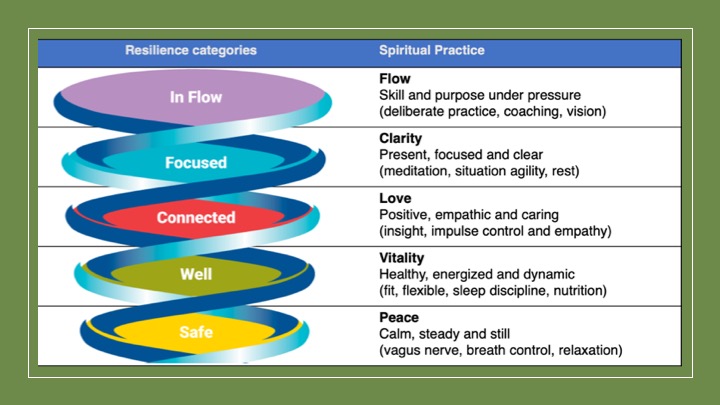
What we “could” do is extraordinary. Imagine if we applied modern wisdom, technology and medicine with respect and resolve to human life. This is incredibly exciting. We are clearly capable of immense greatness – peace, vitality, love, clarity and flow. We watch this achievement amongst our athletes, musicians, artists, entrepreneurs and philanthropists.

This vision of actualised human beings has guided the great work of William James, Abraham Maslow, Mihalyi Csikszentmihalyi, Ken Wilber and those at the Mind & Life Institute. It is a vision of optimism and hope. In the face of the many challenges facing humanity, it is essential to remember and drill this possibility.

Spirit in Action is a method to frame and guide this journey. If willing and able, here are five deliberate practices that will take you to a much better place.

First, strive to be calm, steady and still in the storms of life. Caught up in the adrenaline surge of fight or flight, we sink to a reptilian level of consciousness. When calm you are healing, moving, feeling and thinking better.

Drill: learn and master contemplative/breathing/relaxing practice 5 min per day

Second, strive to be healthy, energised and dynamic. Illness, fatigue or lethargy makes the experience of enlightenment impossible to sustain. Being able to enjoy vitality is a key part of the experience of connection and joy.

Drill: be non-negotiable in your sleep, activity and nutritional disciplines

Third, strive to be positive, empathic and caring. It is essential to consciously feel and flex your emotions with an orientation towards generosity. The experience of peace, love and joy is diagnostic of enlightenment for many theologians.

Drill: restrain your impulses, generate joy and respect the joy of others

Fourth, strive to be present, focused and clear. Ruminating on the past or fretting about the future causes suffering. When present, we experience each moment in its fullness. Suffering drops away.

Drill: catch your thinking and focus 100% on the present moment

Fifth, live with skill and purpose – particularly in the testing moments. Flow is the state of full engagement with a meaningful challenge. Whether this is in loving prayer, skilled acts of compassion or creative pursuit, your spirit (little self) is in action and you will feel one with Spirit (greater reality).

Drill: define how, where and why you get flow and get a little every day

Accepting wise mentorship on this path of deliberate practice will accelerate your quest. It is very easy to get stuck in eddies when one area consumes too much attention. Many who exercise fanatically clean forget to relax or develop their emotions. Many meditate at the expense of their physical capabilities. Sometimes too much love, can distort our altruism into destructive sympathy.

Our development framework for Spirit in Action

Each of these base categories of discipline can reach levels of enlightenment. Consider the advanced yogi (super-calm), your favourite athlete (grace), Buddhist compassion (love), mathematical brilliance (clarity). They all trend towards flow.

There are many paths available for enlightenment. We live in a wonderfully diverse and creative world because humans courageously pioneer untrodden paths. Use the basic concepts and the lessons of our great spiritual traditions to stabilise and direct your journey. Seek truth, respect and practicality.

At the end of the day you have to choose and walk your own path.

As Gandhi reminds us:

To remake the world, you have to remake yourself.

Original Source: https://resiliencei.com/blog/spirit-in-action-part-3/

What is Spirit in Action in Resilience Spiral Part 2

What might a contemporary wisdom embrace? Can we seek to better express a shared narrative that seeks truth and goodness? How do we make this wisdom fit for purpose in 2020?

Part 1 explored spirit from two perspectives. First, the outer journey of connecting to a greater reality (Spirit). Second, the inner journey of integrating our physical, emotional and mental resources to nurture our essence (spirit). Both are basic freedoms for which we are each responsible.

We recognise and acknowledge different spiritual narratives – or religions. Many (see Aldous Huxley’s Perennial Philosophy) believe that they share a core wisdom. The core wisdom seeks truth and goodness. Humans, as story-tellers, are free to express the stories that help us make sense of, and apply, wisdom.

Purpose and Direction

More people die from suicide (800,000 per year) than are killed by human violence (21 Lessons for the 21st Century, Noah Y. Harari, 2018). While fulfilment of basic needs has improved, human wellbeing is in decline. Suffering – particularly in terms of anxiety and depression – is overwhelming. Despair is widespread.

The core purpose of spiritual wisdom is to reduce suffering. As we reduce suffering, we experience more joy. This is the direction of spirit in action. It is simple and clear.

  1. Understand and reduce suffering.
  2. Seek to build wellbeing and joy.

The fuel for this journey is hope. Modern wisdom must deliver a message of hope to people. That hope must be built on a good narrative and practical steps one can take to reduce suffering and increase joy. Each person must learn from an early age how to take responsibility for their physical, emotional and mental wellbeing. The must believe in growth for it is here that hope lies.

Subjectivity and Inclusiveness

Usage of “I” has trumped “we” in recent decades. Does spiritual wisdom serve the individual or all life? We express a wide range of subjectivity. Some risk health and life to boost muscle mass for a fleeting sense of pride. Others seek a drug or alcohol fix to serve an impulse of joy. Many fiercely serve and defend their tribe, race or nation as we see in modern populism. We may even seek to serve all sentient beings and the resilience of the planet.

This is a wicked challenge. It may be the most crucial responsibility of wisdom. While humans are easily seduced into selfish impulse, we are equipped with empathy and altruism. We spontaneously seek to reduce suffering. We can care so much for a child, money or a cause that we can neglect ourselves and others who need us. Unrestrained sympathy can cause more suffering.

Religious conquests with noble objectives to serve ‘god’ and secure a place in heaven, destroyed communities and their cultural achievements. Today we serve money with a devotion that has squandered the beauty of our planet and put all forms of life at extreme risk. Many put their own life and wellbeing at risk on a daily basis to earn an extra dollar.

At the end of the day, the dilemma is what to love? Myself now, my place in heaven, my children, my tribe, money, humanity, the rhinos or pangolins, all life, natural beauty, truth…? One can understand the frustration of rural leaders when billionaire naturalists want to protect animals by taking land, food and hunting rights from their people. Conservation is a war zone driven by love. What irony.

Personal Enlightenment

When resilience fails our behaviour becomes increasingly deluded, short sighted and destructive. We suffer, those around us suffer and hope for a better world is extinguished. The foundation of spiritual wisdom is to support and nurture this inner journey.

The higher we rise the more important it becomes to reinforce this inner discipline. When leaders lie, steal, self-aggrandise and abuse, the community and natural environs suffer. We see this in corrupt nations, churches, NGOs and businesses.

Maybe spiritual wisdom is to serve personal enlightenment only. Ultimately, working on both the inner journey of integrating self and connecting to a higher reality is the only show in town. This is the choice of the contemplative in a cave or monastery. Everything else is secular – cultural, political or scientific.

The commandments might be:

  1. Respect, discipline and love yourself
  2. Respect, acknowledge and be kind to others
  3. Take care of your body
  4. Regulate your emotions
  5. Use your mind to see the truth
  6. Act with wisdom and compassion

The Social Contract

We are social creatures. Our individual wellbeing is intimately connected to our community resilience. When we jointly debate and resolve how best to move away from suffering and towards joy, we become an enlightened and just society. The community is a powerful catalyst and support of the personal, inner journey.

A spiritual wisdom can be the mission and values that bond individual and community into a just, compassionate and creative force. When leaders and community hold each other to account, good will prevail. The different perspectives of a community increase the probability of truth and goodness.

When spiritual wisdom is absent, we have corrupt communities (or failed states). Self-interest, greed, corruption and mass suffering follows. Evil prevails. It is extremely difficult for personal enlightenment to proceed.

The extensive suffering and destruction to people, economies, environment and all fellow species is a catastrophic tragedy that takes generations to repair. Our ‘western’ attempts to intervene have failed miserably. This becomes a challenge to the next level.

Planetary Wisdom

We live in the age of the Anthropocene when human activity is the major shaping force on the planet. What we do over the next decades will shape the future of life. For 30 years we have known clearly the threat to human life and ecosystems. Yet, we continue to play a game of blind Russian roulette with nuclear arms, carbon emissions, population growth, and waste.

Neither the individual nor the community – not even a group of nation states – can solve this particular problem. Governance has evolved from tribe, to region, to nation and now wrestles with integrated regions such as the European Community. The pressing challenge is wise and just governance for all humans and the ecosystems we rely upon.

Our actions or non-actions have profound implications. How much plastic waste is enough? Do we leave failed states to the pillage of their leaders or do we intervene? Do we close coal plants and face economic decline when a coastal population is threatened? Do we leave Africa to double its population knowing full well that many species, habitats and entire ecosystems collapse?  At what point do we obliterate a rogue state threatening nuclear attacks?

It is possible to construct a spiritual wisdom that might guide the decisions of global bodies such as the UN or WHO? We are facing questions of what is sacred and what is not. Religions have long restrained our impulses and excesses. It feels like a time when a new wisdom might be needed to restrain our consumptive hedonism so that there is something beyond suffering and despair left for our children’s children.

The call for a spiritual wisdom for humanity is loud. It may go by many names. The principles or commandments might be:

  1. Seek and communicate the truth
  2. Live with restraint and compassion
  3. Respect and steward our planetary ecosystems
  4. Act with courage and creativity
  5. Keep a sense of humour and radiate joy

We will need enlightened individuals and resilient communities to help us debate, construct, guide and maintain it. The alternative is dark.

Part 3 addresses the personal practice of spirit in action.

Original Source: https://resiliencei.com/blog/spirit-in-action-part-2/

Workplace Trends 2025: How Resilience Drives Hybrid Work, AI, and Employee Well-Being

  • 88% of US employers now offer some form of hybrid work, and 80% of employees report actively using AI in their work, up from 72% the year before.
  • Resilience, flexibility, and agility now rank as the second most essential workplace skill globally, immediately behind analytical thinking, according to the World Economic Forum.
  • None of these trends, hybrid work, AI adoption, skills-based hiring, purpose-driven culture, work in isolation. Resilience is what lets an organisation actually absorb all of them at once.

The workplace keeps evolving, and the pace hasn’t slowed. Hybrid work has moved from temporary accommodation to permanent structure, AI is reshaping how tasks actually get done, and employee wellbeing has become a genuine strategic priority rather than an HR afterthought. These shifts bring real challenges, but they also create real opportunity for organisations that take resilience seriously.

Hybrid Work Is Now the Standard, Not the Exception

The trend: Hybrid work is no longer a temporary solution. Current Robert Half data shows 88% of US employers now offer some form of hybrid arrangement, and organisations are actively balancing genuine flexibility against the real challenge of maintaining collaboration, culture, and productivity across dispersed teams.

How resilience helps: Resilience practices bridge the gaps distance creates. Mindfulness, emotional agility, and genuinely clear communication keep team members connected and engaged regardless of location, and training on energy management and stress reduction supports productivity directly. Resilience training helps remote workers build real boundaries between work and personal life, reducing burnout risk, while leaders with strong emotional agility foster collaboration even across a dispersed team, modelling exactly the behaviour they want reflected back.

Employee Wellbeing as a Genuine Retention Strategy

The trend: Organisations are placing mental health and holistic wellbeing at the centre of workplace strategy, building genuine psychological safety, actively preventing burnout, and supporting real work-life integration rather than treating wellbeing as a peripheral benefit.

How resilience helps: Resilience Institute’s assessments and training programmes build physical, mental, and emotional wellbeing directly, fostering a culture where individuals genuinely thrive and teams perform at their best. Gallup’s research independently supports this direction: employees who frequently experience burnout are 63% more likely to take a sick day and 2.6 times more likely to be actively job-hunting, real, measurable costs that a serious wellbeing strategy directly addresses.

AI in the Workplace: Resilience as the Human Complement

The trend: AI adoption at work has grown fast and genuinely. A 2025 State of Hybrid Work report found 80% of employees now use AI in their work, up from 72% the year before, with more than a quarter using it daily. While AI handles repetitive tasks with real efficiency, human-centric skills, creativity, adaptability, emotional intelligence, remain more valuable than ever, and most current analysis suggests AI is augmenting roles more than replacing them outright, at least for now.

How resilience helps: Resilience training builds the adaptability and problem-solving capacity people need to thrive alongside AI rather than feel threatened by it. Resilient employees tend to view AI as a genuine tool for enhancing their own role rather than a competitor, which measurably reduces anxiety and supports real innovation instead of quiet resistance.

Skills Over Credentials: The Case for Learning Agility

The trend: Employers increasingly prioritise demonstrated skills and outcomes over traditional credentials. In a world of project-based work and dynamic teams, genuine adaptability and continuous learning matter more than a fixed qualification earned years earlier. The World Economic Forum’s Future of Jobs Report 2025, surveying over 1,000 employers across 55 economies, ranks resilience, flexibility, and agility as the second most essential core skill in today’s workforce, immediately behind analytical thinking.

How resilience helps: Resilience builds genuine learning agility, encouraging people to embrace change and proactively acquire new skills rather than waiting to be told what’s needed. A resilient mindset reframes an unfamiliar challenge as a real growth opportunity rather than a threat, exactly the disposition a skills-based economy rewards.

Purpose-Driven Workplaces: Values as a Retention Lever

The trend: Employees, particularly younger generations entering the workforce, are increasingly drawn to organisations that genuinely align with their own values and sense of purpose. Companies emphasising sustainability, integrity, and real social impact are better positioned to attract and retain strong talent as a result.

How resilience helps: Resilience training integrates purpose-driven leadership and genuine values alignment directly into how a workplace actually functions. Employees who feel authentically connected to their organisation’s mission stay more engaged and motivated, particularly during genuinely difficult stretches when that connection matters most.

Thriving Through All of It at Once

The future of work holds real possibility, but it demands genuine preparation and adaptability. None of the trends above, hybrid work, AI adoption, skills-based hiring, purpose-driven culture, resolve in isolation; most organisations are navigating all of them simultaneously. Resilience is what makes that simultaneous navigation genuinely possible, through mindfulness, emotional agility, and deliberate stress management applied consistently rather than reached for only in a crisis.

Every workplace trend eventually asks the same underlying question: can your people actually absorb this much change at once? Resilience is the honest answer to that question, not a specific tactic for any single trend.

Ready to build resilience strategies for your organisation? Discover how the Resilience Assessment can provide real insight into your team’s strengths and genuine growth areas.

What is Spirit in Action in Resilience Spiral

“You have covered physical, emotional and cognitive but surely spiritual is the key factor in many people’s resilience?” the question came from a black South African business woman last week.  Even across our team she will get a range of answers. Spirit in Action can be the end goal, quietly ignored or actively rejected.

The topic is contentious and potentially explosive. People can react with anger or contempt. The increasing prevalence of substance abuse, anxiety, depression, and suicide suggest a crisis of meaning. Without constraining the liberty of religious choice, perhaps the spiritual path could do with some cautious and curious dialogue.

Our Resilience Diagnostic and Development model puts “spirit in action” right at the top of our spiral. In a dynamic world of multiple spiritual pathways and secular alternatives, we owe our participant a considered response. We welcome your participation in the dialogue.

I address her question in three parts:

  1. What we mean by Spirit in Action
  2. What a modern belief system might embrace?
  3. What practices underpin progress on a spiritual path?

Let us be respectful and inclusive of the many positive contributions that faith brings to our lives.

Spirit in Action: Part 1

Humans seek meaning. We’ve generated a diverse array of stories to make sense of existence. Some are more helpful than others. Hunter-gatherer communities came up with naturalistic magic. Agricultural – largely patriarchal – communities gave rise to the major spiritual traditions about 2,500 years ago. Some hold to traditional beliefs, while others embrace aspects of modern life such as electronic donations, apps and science.

Today, new spiritual promises compete with the older traditions. Science, sport, designer drugs, music, technology, biological diversity, and money compete successfully for our attention. In the past, you were a loyal convert or dead. Now, we are free to believe and do whatever we like. The thought: ‘god watches over me and might send me to hell’ is less scary.

Without the threat of hell or social sanction, a spiritual path is voluntary. It can be a lonely struggle of self-deprivation, deliberate practice, tenacity and patience. Few take it seriously. On the other hand, the decline in spiritual belief and practice correlates with increasing substance abuse, anxiety, depression and suicide.

As we pursue our own selfish and impulsive desires, we create tremendous suffering, threaten much of the life on earth and even our own existence.

Given the pickle humanity has created, perhaps we actually need a spiritual quest more than ever. But it must be fit for purpose in 2020 – not 500 BC. To work, it requires the principals of evidence-based (true), integral (respecting body, heart, mind and the huge diversity of life) and practical (actionable in effective ways right now).

What is “Spirit in Action”

One can be a force for good without being spiritual. Medicine strives to reduce suffering and disease, NGO’s tackle worthy tasks, and individuals change lives. Secular humanism – a non-religious, evidence-based and coordinated endeavour to improve the lives of humans does not prescribe a belief.

Curing disease, educating women, providing clean water, and delivering justice changes beliefs and delivers extraordinary outcomes. The dedication, self-sacrifice and noble aspirations are actually quite ‘spiritual’. ‘God’ becomes ‘Good’.

Beyond secular humanism, mapping a spiritual path to enlightenment is no easy task. The delicate and all-important question is: “Do I have to believe in God?”

Our hypothesis: spiritual is an experience of union with a greater reality than our small, temporary individual existence.

Your greater reality may be nature, truth, evolution, love, the universe, or simply GOD. This reality – let’s call it Spirit (capital ‘S’) – is vast, largely unknown but integral to the existence of your small self (little ‘s’). When your little self feels fully at peace with and connected to Spirit, we feel the emotions of joy, bliss, love and awe.

As we grow, learn and develop wisdom, our conception of Spirit matures. White, bearded, old man on cloud becomes awe in the presence of nature, and then settles into an abiding peace, love and joy. Eventually, we experience total unity with all in the unfolding moment.

It is humble and wise to honour a higher force beyond ourselves. To make sense of Spirit is a basic freedom that liberates the small self from suffering. The more integrated and connected to Spirit we are the more peace, love and joy we will experience and radiate. While this quest is challenging, without it we face an existential crisis. This quest for meaning and connection is Spirit in Action.

As a scientific mind, an alternative perspective is attractive. Let’s say I recognise the reality of my body, my emotions and my thought. I know they can be quantified. It is clear to me that certain practices and skills lead to a healthier body, positive emotions and clarity of thought. This is good for me and others.

It is possible that my spirit (small ‘s’) is in action, when I experience peace (calm physiology), vitality (healthy body), love (positive emotions), and focus (clarity of thought)? In other words, when my physical, emotional and cognitive resources are at their best, I experience myself at a higher altitude. I am integrated and have become more whole.

This experience of integral being is not just body, emotion and mind. It is something more. Could we call it spirit? I think so. When we are in the integrated state that many call flow, we serve ourselves and others much more skilfully.

In fact, both perspectives are necessary.

Having faith in Spirit, Nature or God, is clearly a source of resilience. Specifically, faith has been shown to help us bounce. It most certainly helps us connect with others. Spiritual community is essential to nurture practice. Our connection to a greater reality is the outer path of the spiritual quest.

When physically compromised, angry or depressed, or confused in mind, it is much harder to connect and integrate with a greater reality. When spirit emerges from a flourishing body, heart and mind, the outer path is clear. We feel resourced and motivated to embark on the spiritual quest. This is the inner path.

My conclusion is that a greater reality – what we call Spirit – is part of Spirit in action. To understand, connect with, and honour this greater reality is the goal of your resilience journey. Each one of us is free to explore this path.

Equally essential, this challenging quest demands that you cultivate and grow physical, emotional and mental strength. This is your source of power for the quest. It is, in our view, also a key part of spirit in action. Once again, each of us is free to embark on the practices that work for you.

In part two, I explore what a modern belief system might embrace.

Original Source: https://resiliencei.com/blog/spirit-in-action-part-1/

How Micro Habits Build Big Change

  • “It takes 21 days to form a habit” traces to a 1960s plastic surgeon’s offhand observation about patients adjusting to a new face after surgery, not a study of habits at all.
  • The real research puts the median at 66 days, with a genuinely enormous range, 18 to 254 days, depending on the habit’s complexity and the individual attempting it.
  • Missing a single day doesn’t meaningfully derail the process. The habits that actually stick are the ones built small enough to survive a bad day, not the ones chased against an artificial deadline.

Big, ambitious change usually fails for a predictable reason: it demands too much, too fast, from a system, a person’s daily life, that has limited capacity to absorb sudden shifts. The more reliable path runs through small, deliberately designed habits that compound quietly over time. Understanding how that compounding actually works, and how long it genuinely takes, changes how realistically you can plan for it.

The 21-Day Myth, and Where It Actually Came From

Almost everyone has heard some version of “it takes 21 days to form a habit.” It’s a genuinely useful story to trace, because the real origin has nothing to do with habits at all. In 1960, plastic surgeon Maxwell Maltz published Psycho-Cybernetics, in which he observed that his patients typically took about 21 days to psychologically adjust to a new face after surgery, or to phantom sensations following an amputation. That’s the entire basis for the claim: a clinical observation about adjusting to physical change, generalised, decades later, into a rule about behaviour change it was never designed to describe.

The actual research on habit formation tells a different, more useful story. A landmark 2010 study by Phillippa Lally and colleagues at University College London tracked participants building a new daily habit over 12 weeks and found a median of 66 days to reach near-automatic behaviour, with individual results ranging from as little as 18 days to as long as 254, depending on the habit’s complexity and the person attempting it. A 2024 meta-analysis covering more than 2,600 participants confirmed a similar median, somewhere between 59 and 66 days, with some more complex habits taking considerably longer still. One further finding matters as much as the headline number: missing a single day along the way did not meaningfully disrupt the overall trajectory toward automaticity.

This reframes the whole project. Chasing a fixed 21-day deadline sets most people up to feel like they’ve failed right around the point real change was actually starting to take hold. Planning realistically for something closer to two months, with room for the occasional missed day, sets expectations that match how change actually works.

Why Small Beats Big

James Clear’s Atomic Habits popularised a version of this idea worth taking seriously: habits compound the same way interest does, small, consistent actions producing outsized results over a long enough timeframe, precisely because each repetition is small enough to actually survive contact with a busy, imperfect life. Stanford behaviour scientist BJ Fogg makes a closely related point in his own research: the size of a habit matters more than most people assume. A habit so small it feels almost trivial, two push-ups, one sentence in a journal, a single deep breath before a meeting, is far more likely to survive a bad day than an ambitious routine that collapses the first time real life gets in the way.

Both frameworks point toward the same underlying mechanism the Lally research confirms directly: consistency across a realistic, forgiving timeframe beats intensity chased against an artificial deadline, every time.

Building a Micro Habit That Actually Sticks

1

Shrink It Until It Feels Almost Too Easy

If the habit still feels like it requires willpower to start, it’s still too big. A genuinely tiny version, one that feels almost silly to skip, is far more likely to survive the weeks it actually takes to become automatic.

2

Attach It to Something Already Automatic

Anchor the new habit to an existing one, immediately after your morning coffee, right before you close your laptop for the day. Borrowing the automaticity of an established routine gives the new habit a stable, repeatable trigger rather than relying on remembering it independently.

3

Plan for Weeks, Not Days

Set your own expectations around a genuine two-month runway rather than a three-week sprint. Simple habits may click sooner; more complex ones will likely take longer. Knowing that going in prevents the discouragement that comes from measuring real progress against a made-up deadline.

4

Let a Missed Day Be Just a Missed Day

The research is specific and genuinely reassuring here: missing a single day did not meaningfully disrupt the overall path toward automaticity in the studies tracking this. Treating one missed day as proof the whole effort has failed is precisely the thinking pattern most likely to actually end it. Pick the habit back up the next day and keep going.

Big change rarely arrives as a single decisive leap. It arrives as a small, repeated action, given enough time, closer to two months than three weeks, to actually take hold.

“Take a Deep Breath” Is Bad Advice!

Taking a deep breath will create arousal, anxiety, distress, and reduce CO2 even more. “Experts”, from physicians to coaches, default to this faulty recommendation.The science of breathing demonstrates how this advice is scientifically and practically wrong. Rather, apply the correct practice to counter distress, calm, focus and connect to reality. This is how you prevent and beat “burnout”.

The Science Behind Breathing and Heart Rate

1. Heart rate changes with breathing. Inhalation accelerates your heart. Exhalation – particularly when sustained longer than inhalation – slows your heart.

2. This is called sinus arrhythmia or heart rate variability. When it follows a sine curve it is a very reliable marker of good health and reduced risk (1).

3. Exaggerating inhalation engages chest muscles shortening and accelerating the breath. This causes CO2 to drop and is part of hyperventilation syndrome (2).

4. Hyperventilation happens when anxious and, if sustained, leads to low CO2 (carbon dioxide) and a range of symptoms including anxiety, pounding heart rate, chest pain, light-headedness. It is estimated to affect 10-30% of otherwise healthy people and can lead to hospitalisation.

5. Arousal, with increased heart rate is associated with the sympathetic nervous system (SNS) and calm, with lower heart rate is associated with the parasympathetic nervous system (PNS, mediated by the vagus nerve) and called vagal tone or vagal brake (3).

6. Neck and upper chest (secondary) muscles ventilate the upper lung. These are only required in extreme situations of physical effort

7. Diaphragm and intercostal (primary) muscles ventilate lower lung. These muscles facilitate heart rate variability, calm and good health.

What Really Happens When You Take a Deep Breath

You will activate your chest and neck muscles, trigger the sympathetic system, strain your neck muscles, accelerate your heart, and activate a state of increased arousal. The vagal brake is switched off and you can compromise both muscle and brain function as CO2 falls.Advice to “breathe in through the nose” further strains secondary breathing muscles. Adding “out through the mouth” causes the loss of CO2 and a shorter exhalation. If you continue to take this advice you can drive your physiology into an acute or chronic case of hyperventilation.There is no point in voluntarily taking a deep breath. Your neurophysiology takes care of it in the background. Remember the last time you dived under a big wave!

The Key to Calm Is in the Exhale

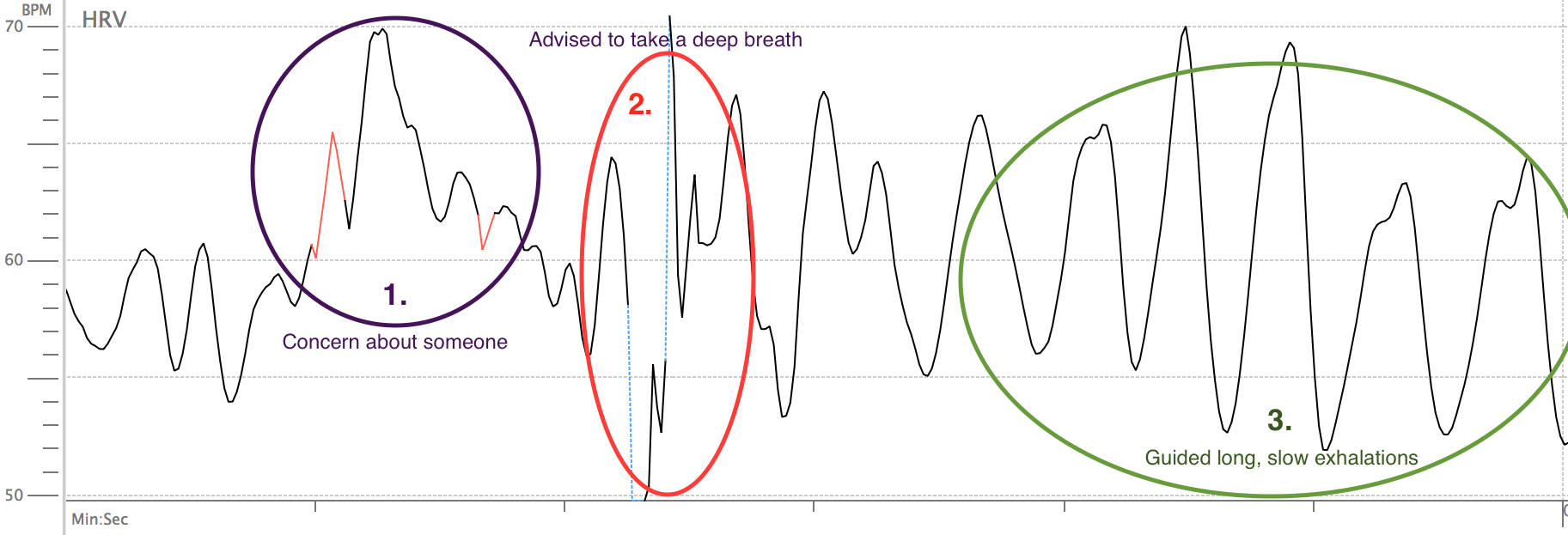
The first step to calm and focus is to exhale voluntarily through the nose. As you lengthen the outbreath, the diaphragm relaxes, domes upward and the vagus (PNS) nerve activates. Heart rate slows, muscles relax, and blood returns to the prefrontal cortex and empathy circuits.Whether on stage, in battle, on the court, needing to connect or be creative, experts in all fields have to master this simple technique. Below is a short demonstration of heart rate variability showing these effects.

untitled

Figure 1. Heart rate changes through three conditions:

  1. Concern about conflict in a family (heart rate accelerates from 55-60 up to 70 bpm)
  2. Advised to take three deep breaths (irregular pulse, wild acceleration 50 to 70). It counters the natural calming that was taking place prior to advice.
  3. Slow exhalations creates high amplitude heart rate variability and calm

For more on the physical, emotional and mental effects of breath and vagus nerve read The Power in Your Vagus Nerve.

How to Use Breath to Calm the Body and Focus the Mind

Whenever you notice agitation, worry, fatigue and any distress symptom, simply exhale for 5 or 6 seconds with a pause at the end. Then breathe slowly into the lower ribs and abdomen through the nose for 3 or 4 seconds. Repeat as needed.

Tactical Breathing: The 4×4 Method for Calm Under Pressure

All special forces are now taught a variation of this which involves: 4 seconds exhale, 4 seconds hold, 4 seconds inhale and 4 seconds hold. This is used to get combat ready (condition yellow) and effective by being calm, focused an connected. The yogis have recommended this explicitly for over 2000 years. We recommend reading Breath by James Nestor (Penguin, 2021) and for those wanting to stretch adaptation, The Wim Hoff Method by the iceman (Penguin, 2021)

Sources:

(1) Matthew Mackinnon, Psychology Today.

(2) Dinah Bradley, Family Doctor.

(3) Sven Hansen, Breath, Revive, Connect: Insights.

Original Source: https://resiliencei.com/blog/take-deep-breath-bad-advice/

What Elite Athletes Teach Us About Physical Presence

  • Judgments about competence and confidence form from facial and postural cues in a fraction of a second, well before conscious thought or spoken words have a chance to shape the impression.
  • The body is far more malleable and trainable than emotion or thought in the moment, which is exactly why physical presence is where deliberate practice should start.
  • Eight specific, trainable disciplines, recovery, posture, restraint, and deliberate practice among them, separate competitors who look composed under real pressure from those who visibly don’t.

Elite tennis is a genuinely instructive place to study presence under pressure. Out on court, in front of a screaming crowd or broadcast to millions, a player faces intense scrutiny sustained over hours, with nowhere to hide and no teammates to lean on. Watching how the best competitors master their presence in that environment, whether you follow the sport or not, offers a real lesson in something every leader, parent, and professional eventually has to do under pressure of their own.

The Body Signals First

Research on rapid impression formation, including work by Princeton psychologists Janine Willis and Alexander Todorov, has found that people form judgments about competence and trustworthiness from facial exposure as brief as 100 milliseconds, faster than a conscious thought can form. Emotional and cognitive processing both take measurably longer to catch up. In practice, this means the body speaks first, and what it says is shaped by how well you’ve already trained your emotional and mental state before the moment arrives. Since the body is the most tangible and trainable of the three, it’s the right place to start.

Eight Disciplines Worth Practising

There’s no single correct way to build presence. This is a creative, individual process, test what follows against your own needs, adapt it, and refine it over time.

1

Recover Deliberately

Presence starts with genuine recovery: sleep, breath, movement, and real nourishment. The vehicle needs proper servicing before it can perform. Elite competitors build a structured recovery routine the moment a match or performance ends, rather than leaving it to chance. Ask yourself honestly whether you’re physically prepared for what the day actually demands.

2

Dress With Intention

Unlike most other species, humans deliberately adorn themselves, clothing, grooming, jewellery, and creative presentation is a genuine tool, not a distraction. The relevant question isn’t whether the presentation is flashy or understated. It’s whether it’s actually sending the signal you intend to the people you’re engaging with.

3

Walk and Stand With Purpose

In the animal world, a limp signals an opportunity to a predator. Walk tall and directly, with a genuine spring in your step. Keep the shoulders open and let the arms swing naturally rather than staying pinned to the sides. Stand with feet apart, weight balanced on the balls of the feet, ready to move rather than rooted and rigid. It’s worth actually recording your own gait on video at some point; most people are surprised by what they see.

4

Lengthen the Back of the Neck

Keep the spine light and long, which meaningfully reduces strain on the neck. Balanced shoulders and an upright neck read as alert, ready, and confident. A hunched, forward-bowed posture reads as beaten, and the signal runs in both directions: it shapes how others perceive you, and it’s associated with measurable hormonal shifts in the person holding that posture, including lower testosterone and higher cortisol.

5

Protect Your Core Posture Under Frustration

Across many species, exposing the belly or midsection is among the strongest submission signals a body can display. It’s a pattern worth watching for in yourself: does frustration make your posture collapse inward and expose vulnerability, or stay upright and composed? The habit is common under real pressure, and it’s genuinely worth correcting, since it reads as distraction at best and derails your actual purpose at worst.

6

Keep the Mouth Closed

Open the mouth to speak, or during intense physical exertion, and otherwise keep it closed. Nasal breathing genuinely supports better health and performance than mouth breathing does. A slack, hanging jaw offers no benefit at all. Deliberately sealed lips, a soft tongue, and slower breathing also, usefully, tend to make you a better listener.

7

Restrain Emotional Outbursts

Visible rage, whether that’s a smashed piece of equipment, a shouted insult, or an explosive outburst, might have read as acceptable competitive fire in an earlier sporting era. That era has largely passed. Destructive emotion still needs to be felt and acknowledged, but expressed with genuine restraint and skill rather than let loose. While a flash of visible anger can excite a portion of any audience in the moment, real, sustained progress comes from expressing the steadier qualities instead, respect, tolerance, and composure under real provocation.

8

Practise Deliberately

Nobody develops a masterful forehand without years of dedicated practice, and physical presence is no different. Watch postural styles you genuinely admire, in whatever context you encounter them. Record video or photos of yourself in action and review them honestly. See an experienced physiotherapist for a real muscle balance assessment. Build a daily stretch and core strength routine. Actively manage sleep deprivation, overload, and hyperventilation, since all three undo posture work fast. Walk tall, sit upright, and rest properly, consistently, not just before something important.

The body speaks before thought has a chance to. Training it deliberately is what makes sure it’s saying what you actually mean.

Purpose Is a Super Skill: How To Make It Work For You (Research-based)

  • In RI’s own sample of 21,000 professionals, 96% of the most resilient scored their purpose as clear and meaningful, against just 6% of the least resilient.
  • Independent longitudinal research backs this up at scale: a 2022 study found people with the highest sense of purpose had a 46% lower mortality risk, roughly 1.8 times the protective effect of not smoking.
  • A 2025 study tracking nearly 14,000 adults for up to 15 years found those with the strongest sense of purpose were 28% less likely to develop mild cognitive impairment or dementia.

Ask most people what they’re working toward and the answer tends to arrive fast and specific for some, and slow and vague for others. That gap isn’t trivial. It shows up in health data, resilience data, and, according to a growing body of longitudinal research, in how long and how well people actually live.

The Gap Between High and Low Resilience

Resilience Institute’s own data, drawn from a sample of 21,000 professionals, found a striking split. Among the top 10% most resilient, 96% rated their purpose as clear and meaningful “very often” or “nearly always.” Among the least resilient group, that figure was just 6%. Without a clearly defined purpose, people become exposed to distraction, drift, and procrastination, effectively living according to someone else’s agenda rather than their own.

What Independent Research Adds

RI’s internal numbers aren’t an isolated finding. A 2022 study led by researcher Eric Kim found that older adults with the highest sense of purpose had a 46% lower risk of death over a four-year follow-up compared to those with the lowest scores, an effect size researchers noted was roughly 1.8 times as protective as avoiding smoking. The association held across race, ethnicity, and gender, with a slightly stronger effect among women.

More recent research extends this into cognitive health specifically. A study published in the October 2025 issue of The American Journal of Geriatric Psychiatry followed 13,765 adults aged 45 and older for up to 15 years and found those with the highest baseline sense-of-purpose scores were about 28% less likely to develop mild cognitive impairment or dementia than those with the lowest scores. A separate coordinated analysis spanning four major longitudinal studies, including Rush University’s Memory and Aging Project, found the relationship runs in both directions: a stronger sense of purpose predicts better cognitive functioning over time, and better cognitive functioning helps sustain a stronger sense of purpose, each reinforcing the other.

Purpose Doesn’t Stay Fixed on Its Own

One finding worth taking seriously: researchers have found sense of purpose tends to decline for many people as they move through later adulthood, often tracking alongside health declines rather than staying constant by default. Purpose isn’t a box ticked once. It’s closer to a practice that needs periodic re-anchoring, particularly through life transitions, career changes, retirement, and shifts in health or relationships.

This lines up with a concept that’s long shaped longevity research across parts of Asia: ikigai, the Japanese idea of a reason for being, credited as one contributing factor in the well-documented longevity of Okinawa’s population. The common thread across both the Japanese cultural framework and the Western longitudinal data is the same: purpose isn’t an abstract nicety. It’s functionally protective, and it needs active tending rather than passive assumption.

Finding and Maintaining Yours

1

Look Back for the Signal, Not a Blueprint

There’s no single correct purpose to discover. Think back to times your life or work felt genuinely on track. Joy and real engagement are the signals worth following. What purpose would explain why those moments felt that way?

2

Step Back and Write It Down

Deliberately remove daily busyness long enough to take a wide view. What work genuinely needs doing? Where are your particular skills best used? How do you want to feel, and who do you want to contribute to? Write down what this purpose would actually look like in action, not just as an abstract phrase.

3

Reduce What’s Off-Purpose, Honestly

Look for the parts of your day genuinely disconnected from what you’ve written down, and work to shrink them. Share your stated purpose with people you trust and ask for honest feedback. Doing the off-purpose work in service of eventually doing less of it is still progress.

4

Hold It Lightly

Being relentlessly on-purpose can tip into rigid or exhausting, for you and for the people around you. Welcome failure as information. Laugh when you drift off track, forgive yourself quickly, and protect real time for nature, play, and creative expression alongside the discipline.

Building a clear purpose takes real time, experimentation, and setbacks along the way. The more precisely you can describe it, the more consistently it seems to translate into motivation and faster, more intuitive decision-making, exactly the pattern both RI’s own data and the independent longevity research keep pointing to.

Purpose isn’t a nice-to-have layered on top of a good life. The data increasingly treats it as one of the load-bearing walls.

A Guide to Longevity: What Actually Works

  • The global dietary supplement industry is worth over $150 billion, yet good evidence for real longevity benefit from most supplements is practically non-existent.
  • Genetics accounts for perhaps 10% of longevity outcomes. Environment and lifestyle, sleep, movement, diet, relationships, purpose, do almost all the rest of the work.
  • Across RI’s own data on more than 71,000 people, the same short list keeps separating the top 10% most resilient from everyone else: sleep quality, fulfilment, bounce, focus, daily relaxation, and clearly articulated purpose.

The desire to extend life runs deep. Fear of death is old and universal, and the willingness to pay handsomely for an “elixir of life” is just as old. This piece looks at longevity through the lens of resilience, and the honest recommendation up front is this: the exciting frontier research is genuinely worth following, but double down on the basics while living with equanimity, joy, and wisdom. That combination outperforms almost everything sold in a bottle.

Balancing Hope With Evidence

Humans have concocted herbs, potions, prayers, and countless strange remedies across every society, and both well-meaning and outright criminal entrepreneurs have profited handsomely from selling “elixirs.” The global dietary supplement industry is worth over $150 billion today, growing at a rapid clip, while good evidence for real benefit remains practically non-existent for most products on the shelf, and the environmental cost of the plastic packaging alone likely outweighs whatever marginal benefit exists.

Until relatively recently in human history, life expectancy topped out around 30 years. That began changing around 1900, driven by unglamorous but transformative basics: clean water, safe housing, reliable food, reduced child mortality, and improved healthcare. Today, global life expectancy still varies enormously, from the high 50s in some of the hardest-hit regions to 83 in Japan, though the gap has narrowed meaningfully where sustained public health investment has taken hold. Eswatini offers a genuinely striking example: life expectancy there rose from 45 in 2009 to roughly 57 by 2021, driven by a massive scale-up in HIV treatment access that surpassed international targets, a real demonstration of how much basic healthcare access alone can move this number. The current documented maximum human lifespan remains 122 years, held by Jeanne Calment.

What Good Science Actually Says

Genetics contributes perhaps 10% to longevity outcomes, and remains an active area of ongoing research. Environment and lifestyle do nearly all the rest of the work: not smoking, maintaining a healthy weight, moving for at least 30 minutes most days, eating well with a Mediterranean-leaning pattern, managing mental health and distress, protecting sleep quality and consistency, reducing alcohol, and building genuinely strong relationships. Regular screening, blood sugar, blood pressure, and sometimes lipids, catches problems early enough to matter. Wealth measurably outperforms poverty, adding up to two decades in some analyses. Women currently outlive men by several years on average. Untreated mental illness can reduce life expectancy by 10 to 25 years, and chronic illness reduces it significantly as well. Education, independently, is associated with greater longevity.

Genuine innovation continues at the frontier, genetics, biotechnology, and artificial intelligence are all being applied to the search for new “elixirs of life,” and attention-seeking claims abound alongside the real research. Staying cautiously optimistic that genuine progress will emerge is reasonable. As of now, though, there’s no convincing evidence for anything that meaningfully outperforms the fundamentals above, whatever a given colleague’s hormone regimen or supplement stack might suggest.

What the Most Resilient People Actually Do

Resilience Institute’s own data tracks the behaviours of programme participants directly, drawing on assessments from more than 71,000 people between 2016 and 2022. Comparing the top 10% by Resilience Ratio against the bottom 10% reveals a consistent, repeated pattern across the strength factors that separate them: securing sleep quality, seeking and securing genuine fulfilment, understanding and mastering the ability to bounce back, strengthening and lengthening focus, practising daily relaxation, and clearly defining and articulating purpose.

On the risk side, the same top group consistently protects against three things above all: eliminating chronic worry, protecting against fatigue, and mastering anxiety before it compounds. RI’s most recent programme impact data, drawn from a 2022 cohort of over 4,000 participants, shows measurable gains across these same factors following structured resilience training.

Dr. Sven Hansen’s Personal Reflections on Longevity

Resilience Institute’s founder, Dr. Sven Hansen, shares his own approach directly: “I am almost 64. Blessed with great parents, environments, education, marriage, family, friends and a purposeful career. Structured and demanding sport is part of every day. Sleep is not negotiable. I relax or meditate daily. My wife will likely outlive me. Life is fun. Ocean swimming and surf-ski are competitive. Kite surfing and nature-walking is joyous. I am no puritan. I love the sun, never use sunscreen, eat and drink mostly Mediterranean, and feed my curiosity with at least one book a week.”

Worth noting: the sunscreen choice above reflects Dr. Hansen’s personal practice, not general medical guidance. Mainstream dermatological consensus continues to recommend sunscreen as an effective, evidence-backed tool for reducing skin cancer risk, alongside protective clothing and shade during peak sun hours.

“My father was a professor of paediatrics who published hundreds of studies on child well-being and lived well to 91. As children, we met many experts who pioneered preventive medicine. I have consumed literature on prevention, well-being, longevity, mental health and resilience throughout my medical career, and it is my life work. These are my recommendations for longevity.”

Sit Lightly With Your Life

You are important, but not that important. We coalesce into a living, conscious being for a brief blink of time. Play the game of life well and enjoy the moment. Accept death. Be grateful and content. Live with dignity. Be good to others. Smile.

Sleep Well

Maintain consistent sleep timing, quantity, and quality. Sleep’s restorative effects are well established: it restores hormones, immunity, brain function, emotional regulation, and creativity, and it’s the one thing you can do daily that touches nearly every other system. Without it, everything else gets harder.

Move With Precision

We’re designed to move, and when we don’t, we age faster and get sick more often. Train the body daily across flexibility, balance, strength, cardiovascular fitness, and speed. Real progress comes from study, expert guidance, consistent practice, and relentless follow-through, not intensity alone.

Master Relaxation

Life and work pressure generate real physical, emotional, and mental distress. Restoring homeostasis requires reliable, genuinely effective relaxation. When pressure and distress persist unchecked, wellbeing and longevity both decline. Whatever works, breathwork, massage, time in nature, meditation, deep relaxation, practise it daily for at least eight minutes.

Find Your Purpose and Flow

Emerging research suggests clarity of purpose may support wellbeing and longevity even more than fulfilment alone. Define what genuinely matters to you, articulate it clearly, then build the skills to meet the challenge ahead. Absorb setbacks, learn from them, and bounce forward.

Be Connected

Feeling safe with others and finding real ways to collaborate is a fundamental human drive worth actively working at, through family, sport, work, or shared pursuits. Even those who live in deliberate isolation tend to seek some form of connection to something larger.

Eat Consciously

Eat plenty of vegetables, lean toward a Mediterranean pattern, and genuinely enjoy good food. Know when to stop. Periodically running the body lean has real support behind it: caloric restriction is one of the more well-validated ways to extend lifespan across multiple species. Fasting for a day or two a week is worth considering.

Soak in Nature

Research on nature-relatedness consistently shows real physical and emotional benefit from around 20 minutes a day, or roughly two hours a week, in natural settings, both green (forest, garden) and blue (ocean, lake) environments. Exercising outdoors in the morning or evening adds safe sun exposure and supports healthy vitamin D levels.

Don’t Be Gullible

Stay wary of self-proclaimed experts selling pills, creams, or interventions promising to enhance, prolong, or enrich your life. Enormous sums go toward enthusiastically marketed products whose bright packaging claims outrun the actual evidence. There’s a genuinely lively scientific debate underway in this space; stay curious, but stay sceptical. A handful of possibilities currently have real, if measured, support: nicotinamide (vitamin B3) has published evidence for reducing non-melanoma skin cancer risk in higher-risk individuals; vitamin D remains well supported, ideally from sensible sun exposure; melatonin in small doses may support sleep cycles for some people past 50; and cold exposure before sleep may help via built tolerance for discomfort, though the evidence here is thinner.

The pursuit of longevity comes from a fear of death. Don’t chase living forever. Live with equanimity, joy, and wisdom instead, and double down on what’s genuinely well-proven: sleep, movement, relaxation, purpose, connection, nutrition, and nature, practised with real consistency.

Recommended reading from those pushing the frontiers of longevity:
The Song of the Cell, Siddhartha Mukherjee, 2022
Exercised, Daniel Lieberman, 2021
Life Force, Tony Robbins, 2022
Lifespan, David Sinclair, 2019